Show Stopper Shadow Box DIY

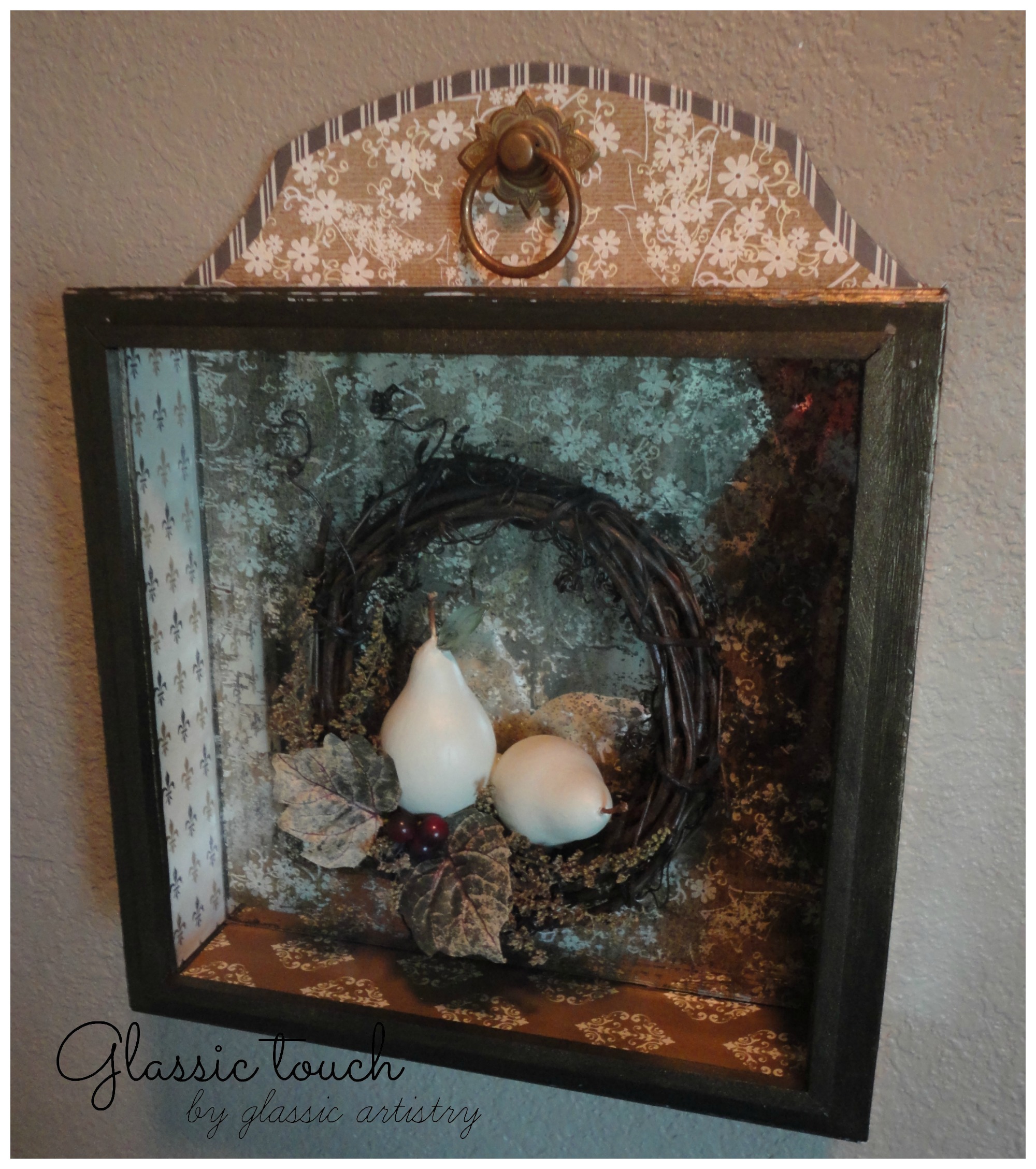
This project actually began last November when I was looking for a storage box for the pear gourd wreath shown in my October 2015 blog post. The dried flowers were pretty fragile and I was a little leary about packing it away. That’s when I thought of a shadow box. Why not frame it as wall art?  I could make a box .. something eclectic… maybe a combination of scrapbook paper and aged mirror.

The biggest dilemma was finding a suitable box. Who knew finding a 10 x 10 x 2.5 inch box, with a lid, would be so hard?  I was even willing to buy a fancy box of chocolates, had the box been right. Sometimes, I get a bit antsy when I’m itching to do a project and can’t find just that certain thing I think I need. But, I’ve learned that a little patience goes a long way, and if I just wait, something always seems to show up.

My daughter and I were checking out the clearance aisles at Burlington Coat Factory last month. I wasn’t really shopping for anything, just entertaining my toddler granddaughter in the cart, when I saw a pile of magnetic clasped boxes on the shelf.  So unexpected, and more than PERFECT!  A clasp option would make the box easily accessible to switch out whenever you wanted.   I was reenergized, this was going to be fun!

DSC09455

With the clasp at the bottom, I measured in 5/8″ from the top and bottom of the lid, and 3/4″ on each side, to cut out a frame opening. Cut nice straight lines by running a sharp utility knife along a ruler’s edge. Seal the box with gesso. Let dry.

DSC00251  DSC00263

A 1/4″ sq. craft stick was mitered for the frame opening.

DSC00271

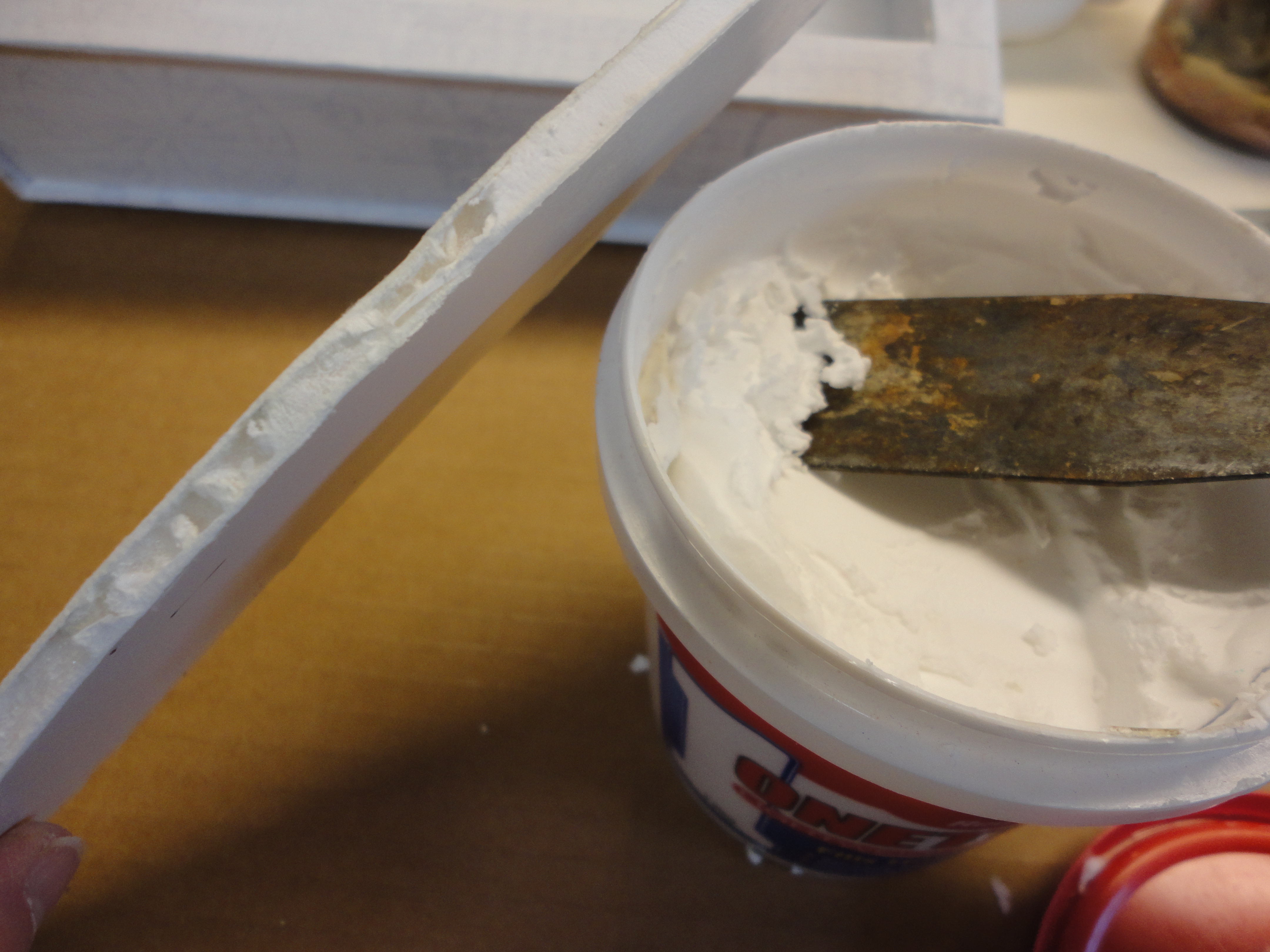
Trace the box on a piece of foam core board, and draw an arch at the top. Lie flat, on padding or cardboard, and cut out with a utility knife. Fill in rough edges of foam board with lightweight spackling. When dry, sand lightly to smooth. Seal board with gesso. Let dry well.
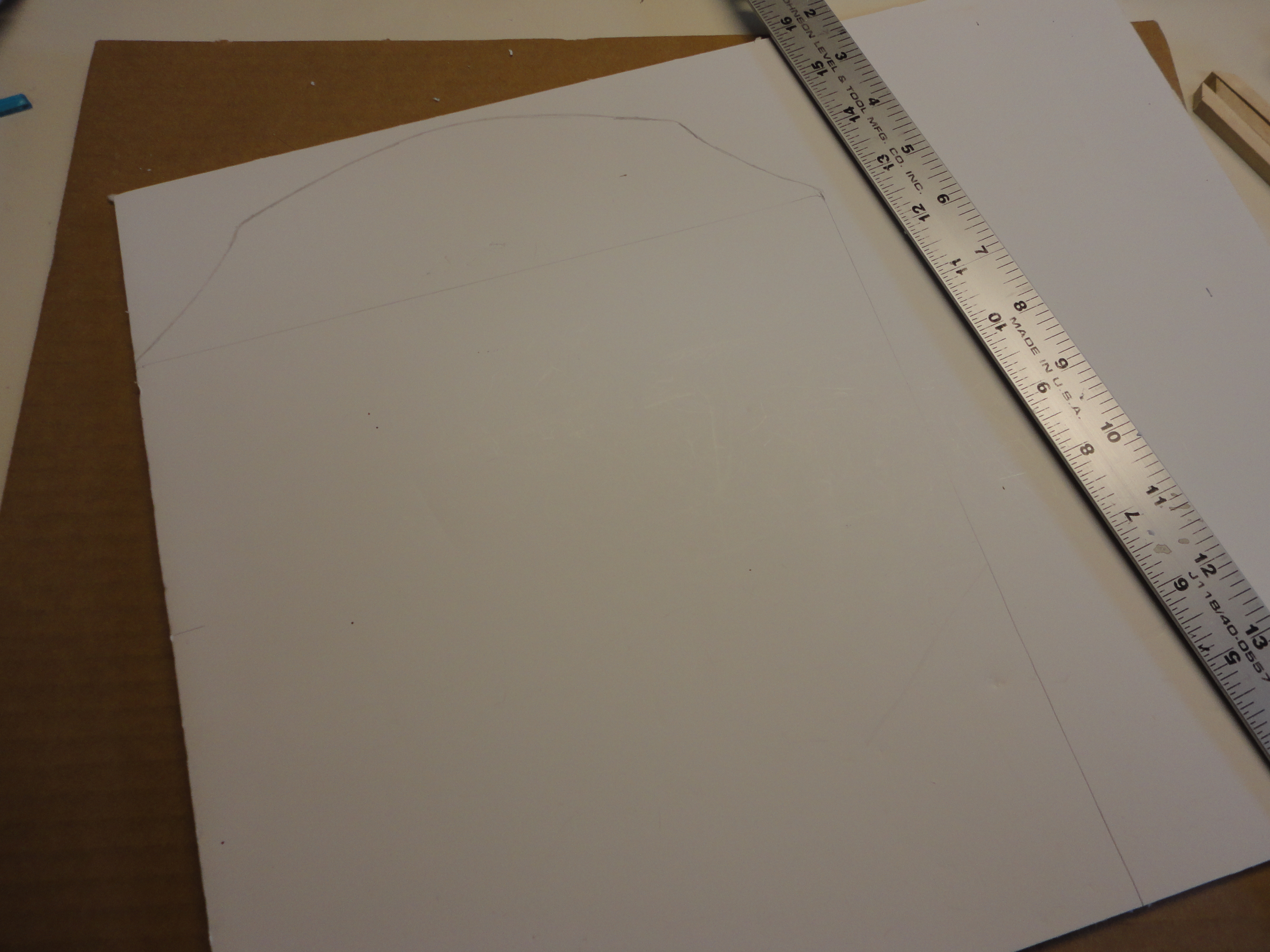
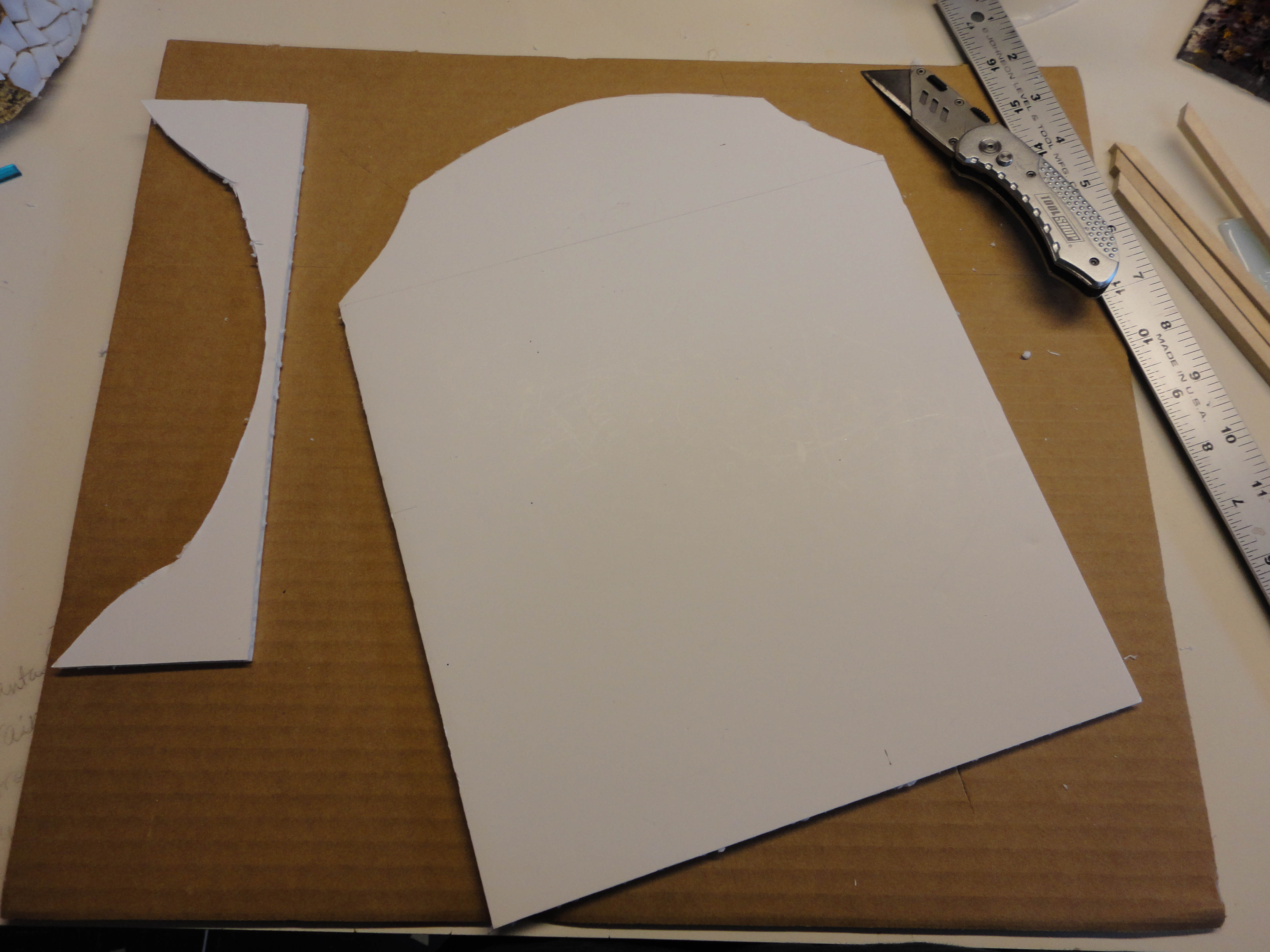
DSC00295  DSC00300  DSC00289

Paint the box, frame pieces, and foam board with black primer or craft paint. No need to paint where the box and foam board will be glued together. The second picture, below, may look a little strange, but the foam board will curl when painted.  I laid mine over a container, weighing each end down, past center, to dry. Once dry, I turned it over, laid it flat on my worktable, and weighed it down to flatten again. Trust me, please, it works.

DSC00316  DSC00368

I knew I had been saving a cool, striped C.J. Banks clothing sack for a reason. After smoothing it out with a warm iron, it covered the long foam board with no seams.

Place the foam board on top of the striped paper to center the stripes, and trace it with a pencil. Hold the paper up to a bright window, face down, and retrace your line on the back of the paper. This pattern line will help keep your stripes centered when gluing. Cut your pattern out larger, away from the line about 1 1/2″. Do not cut on the traced line.
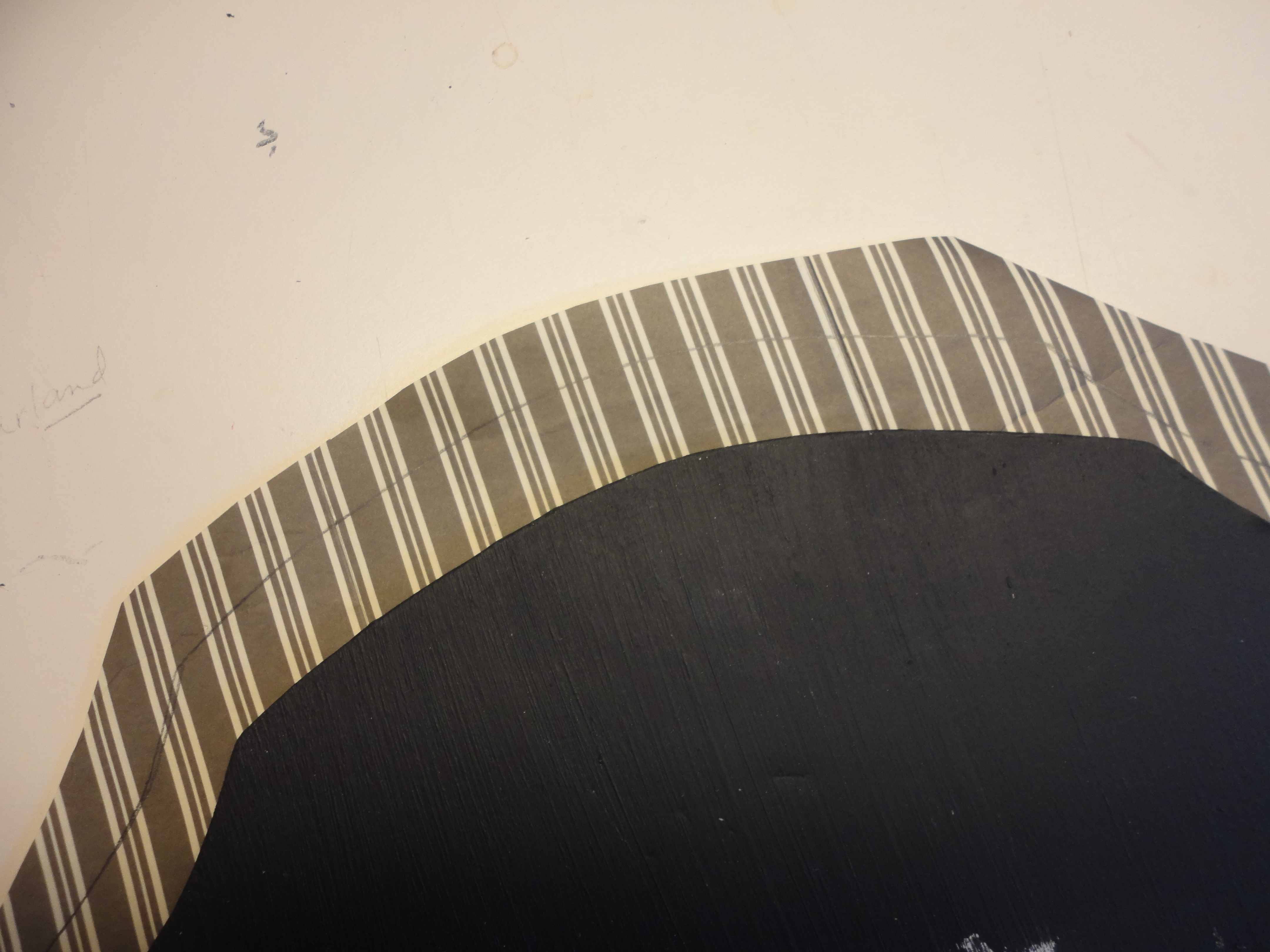
DSC00389  DSC00394

Paper may stretch when wet. Wanting to achieve the smoothest surface possible, I glued and dried small sections at a time, using a plastic gift card and brayer to work out air bubbles.

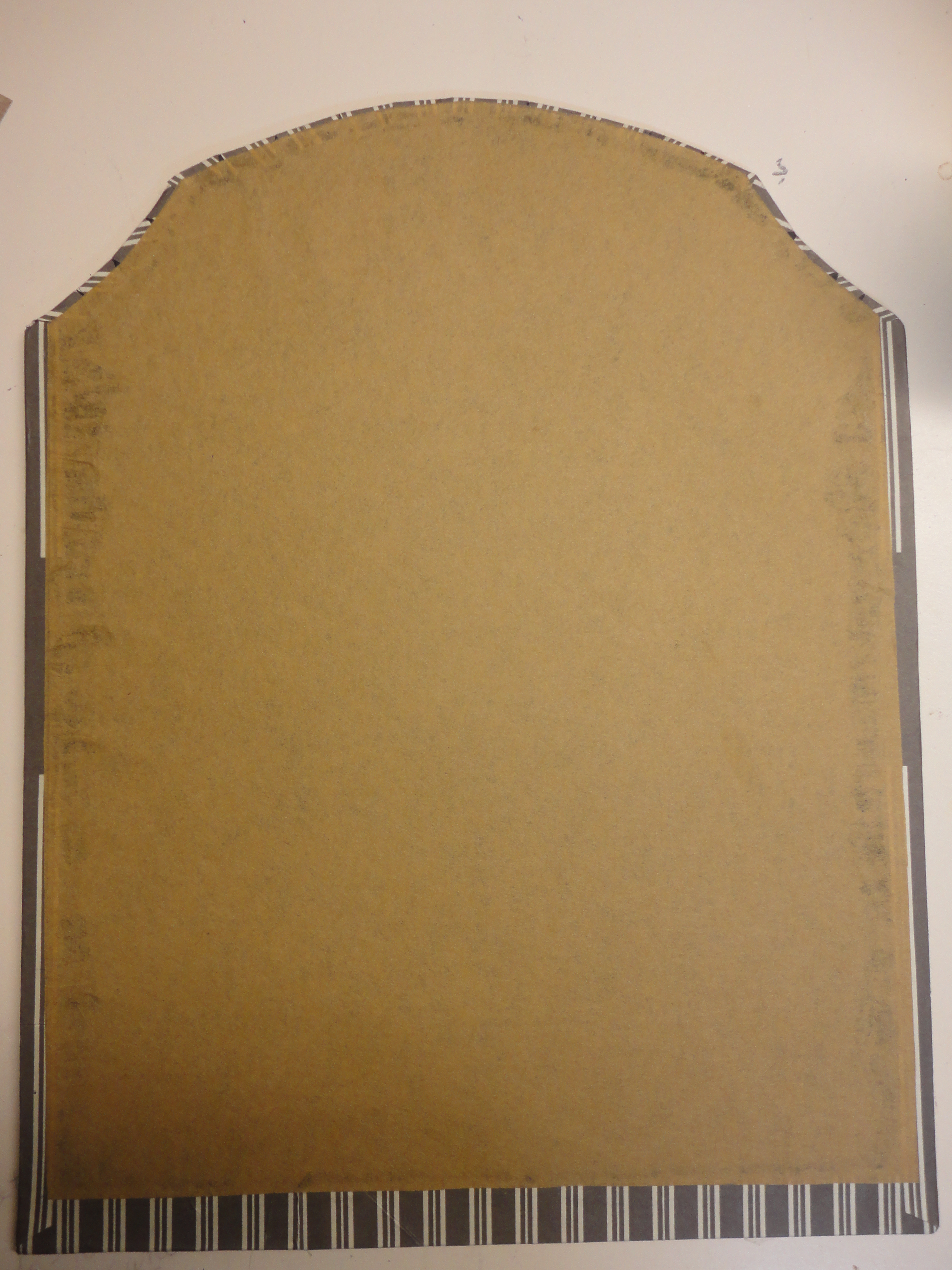
Lay foam board face up. Beginning at the bottom, brush on a light, even coat of thinned white glue, going up about 3 or 4 inches. Turn the glued foam board over, and position it face down on the backside of the striped paper, within the retraced pattern line. Press it firmly in place, turn it back over, face up, and smooth out air bubbles. Weigh down to dry. Continue to glue until covered.

DSC00395  DSC00397  DSC00402

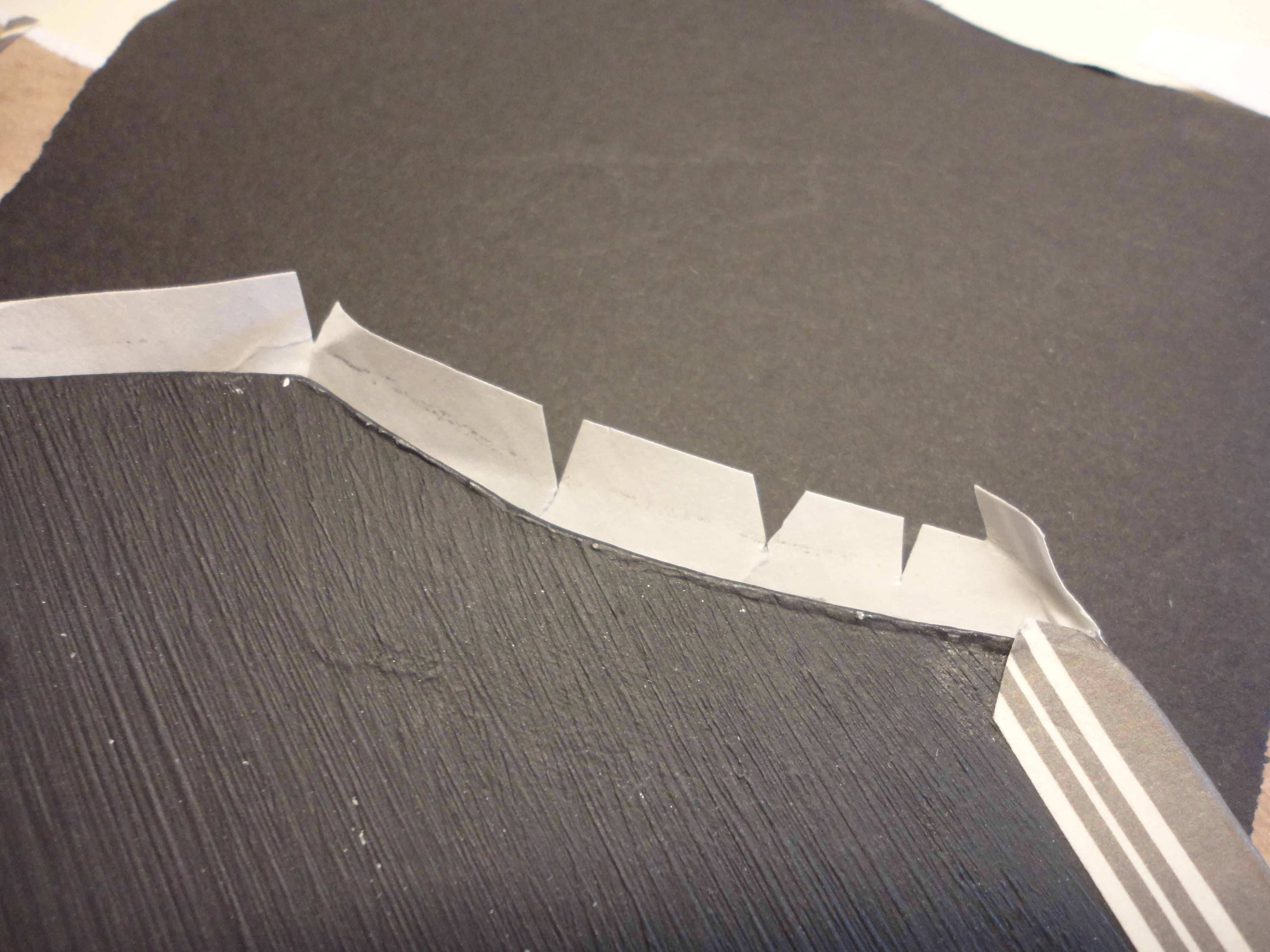
Use a fid, or paper folding tool, to wrap paper tightly around edges before gluing. Trim away excess paper for neat corners, and cut some darts around the arch. Glue and weigh down to dry. Glue may seep at edges, as a precaution lay a sheet of wax paper over the glued area before weighing down. A piece of light weight brown paper was added for a finished look.

DSC00415    DSC00424 DSC00437  DSC00452

Fortunately for me, my youngest daughter downsized recently, and stored a treasure trove of scrapbooking paper in my basement. I chose three patterns I felt would compliment each other and my wreath. Pieces were cut to the appropriate sizes to cover the surfaces of the box.

A little black and metallic gold craft paint was mixed together to match the papers. The mixture over the black base paint almost created an olive green tinge, an added plus!  I painted the front and back of the lid, the folds of the lid, all corners, edges, and frame pieces.
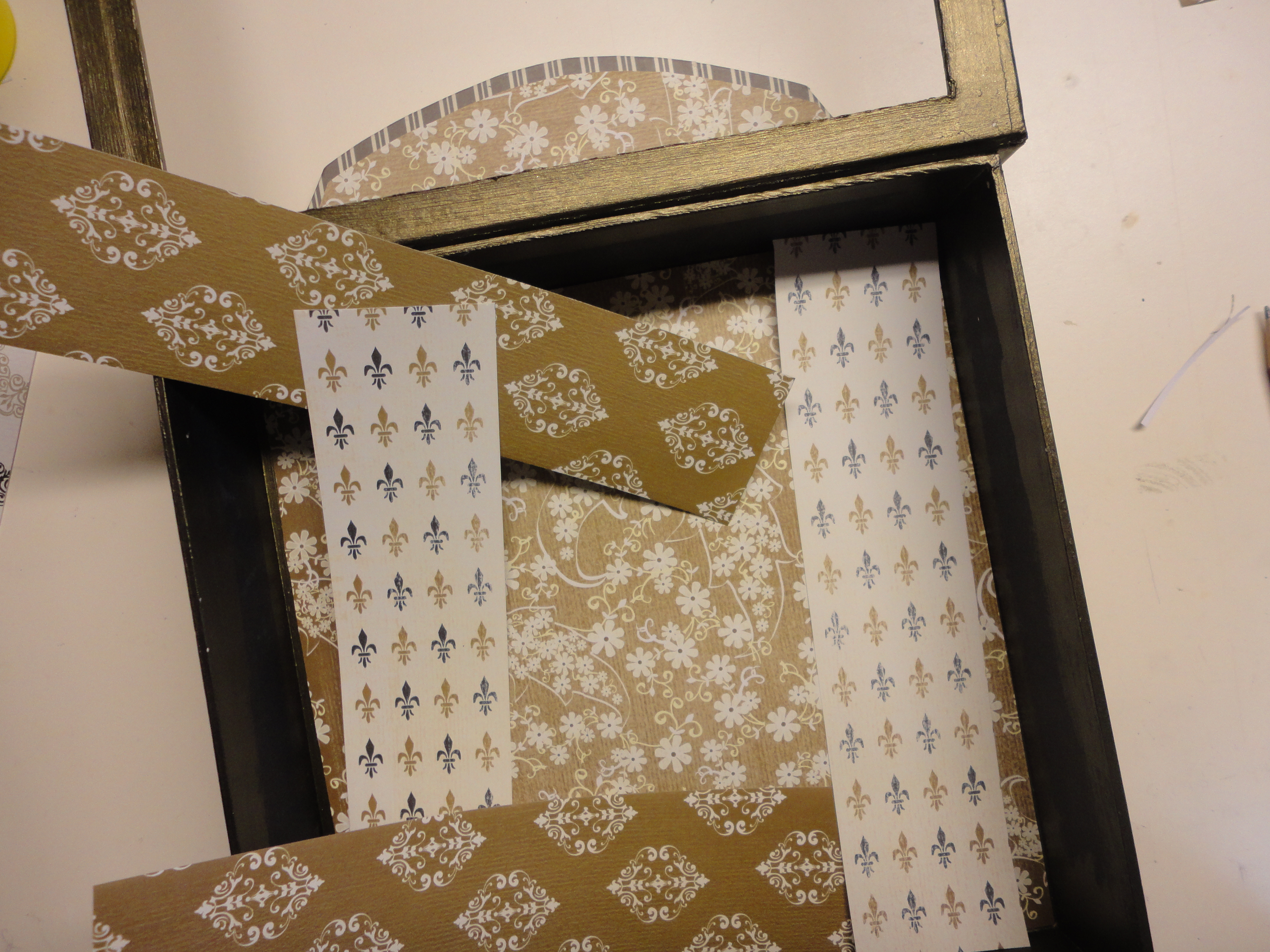
DSC00512  DSC00476  DSC00487

I love the look of aged mirror. I had a few pieces I had aged, with some of the backing completely gone, and thought bits of the decorative paper would look awesome peeking through them. I cut two pieces for the outer sides and a square for the inside.

The paper pieces were glued on with a thin layer of white glue. After they were smoothed and air bubble free, I clamped the mirror pieces and spare foam board pieces over them to ensure they would dry flat and stay smooth. Glue the paper accent on the arch and weigh down to dry.

DSC00523  DSC00538  DSC00537

Cut a thin piece of clear glass for the frame opening. Stand the box on it’s top and fold lid down flat. Position the glass on the inside of the lid, covering the opening. Slowly, lower the box down over the glass to make sure it fits inside the box and doesn’t hinder closing. Use small dabs of E6000 to glue the glass in place. Be careful not to use too much glue or it will seep to the front and you’ll have some cleaning to do. For cushion, and to help even out weight, lay a couple pieces of foam board across the glass before weighing with books to dry.  I squeezed small dabs of E6000 on the backside corners and edges of my mirror pieces, and clamped them on the papered sides while the glass was drying.

DSC00549  DSC00552  DSC00564

Gorilla Glue was used to adhere the foam board to the back of the box. Gorilla Glue swells as it dries, be careful not to apply it too close to the edge, it will seep out and get ugly.  Apply it to the backside of the box, in a thin line, at least 1/2″ away from the edge, and a few swirls in the center. Remembering to keep the clasp at the bottom, position the box very near the bottom of the striped foam board piece, leaving about 1/16″ of the stripes showing.

Squeeze small dabs of E6000, on the backside corners and edges of the square mirror piece and glue it to the inside of the box. Weigh it all down to dry. I found a smaller box that fit in, on top of the mirror, then weighed the box down. Let dry overnight.

DSC00589

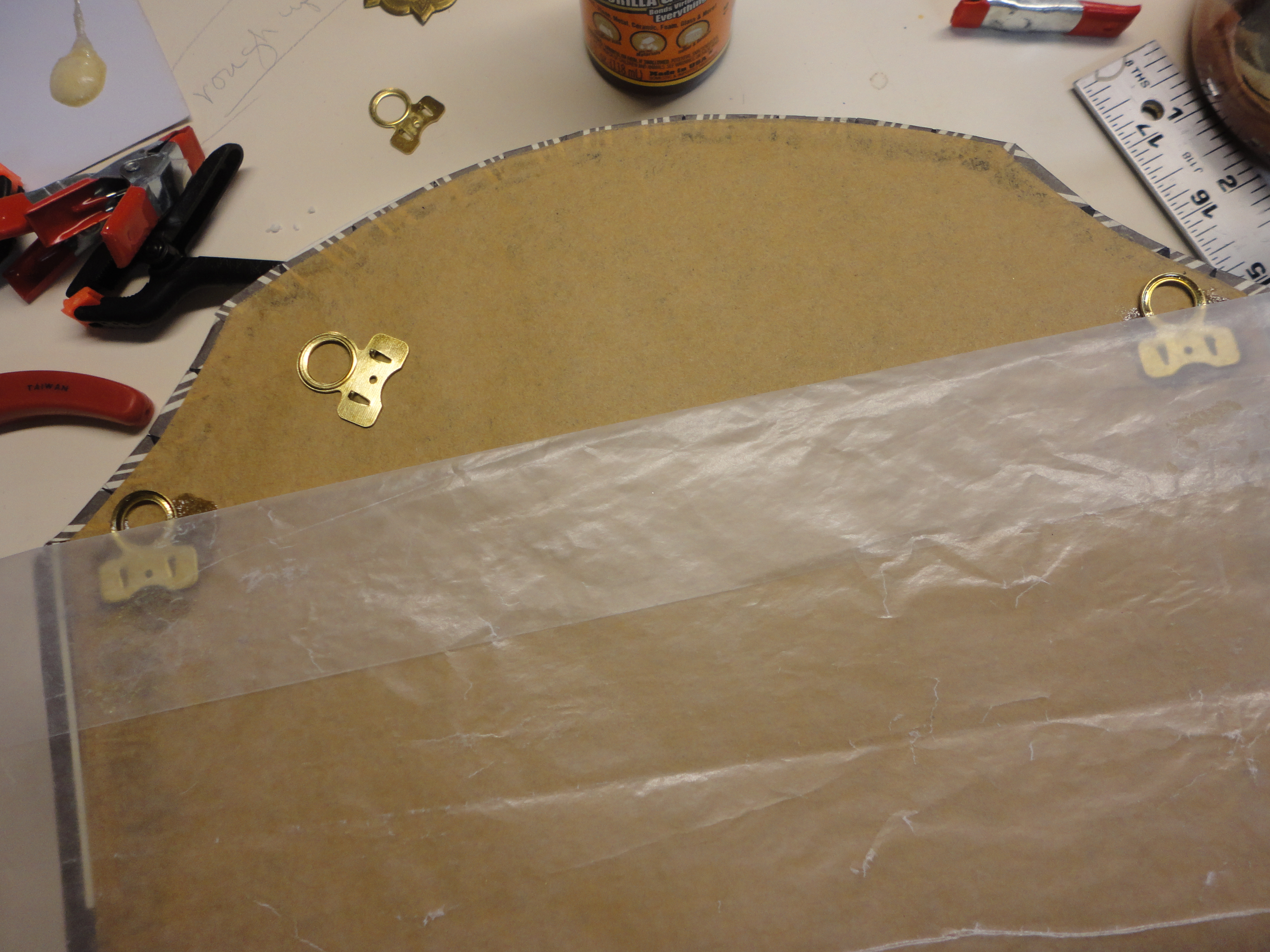
I’m going to rely heavily on Gorilla Glue to hold prong hooks for hanging.  I bent the tops of the hangers out a little, before gluing, to accommodate a nail head. A sheet of wax paper was laid over the glued areas, before weighing it down to dry, so nothing got stuck and damaged the brown paper.

The frame pieces were held in place with painter’s tape. I removed them, one at a time, brushed on thinned glue, and clamped them down to dry. They shifted easily, so I waited until one was secure before moving to the next. You may have to touch up a little paint where you used painter’s tape.
DSC00596  DSC00606

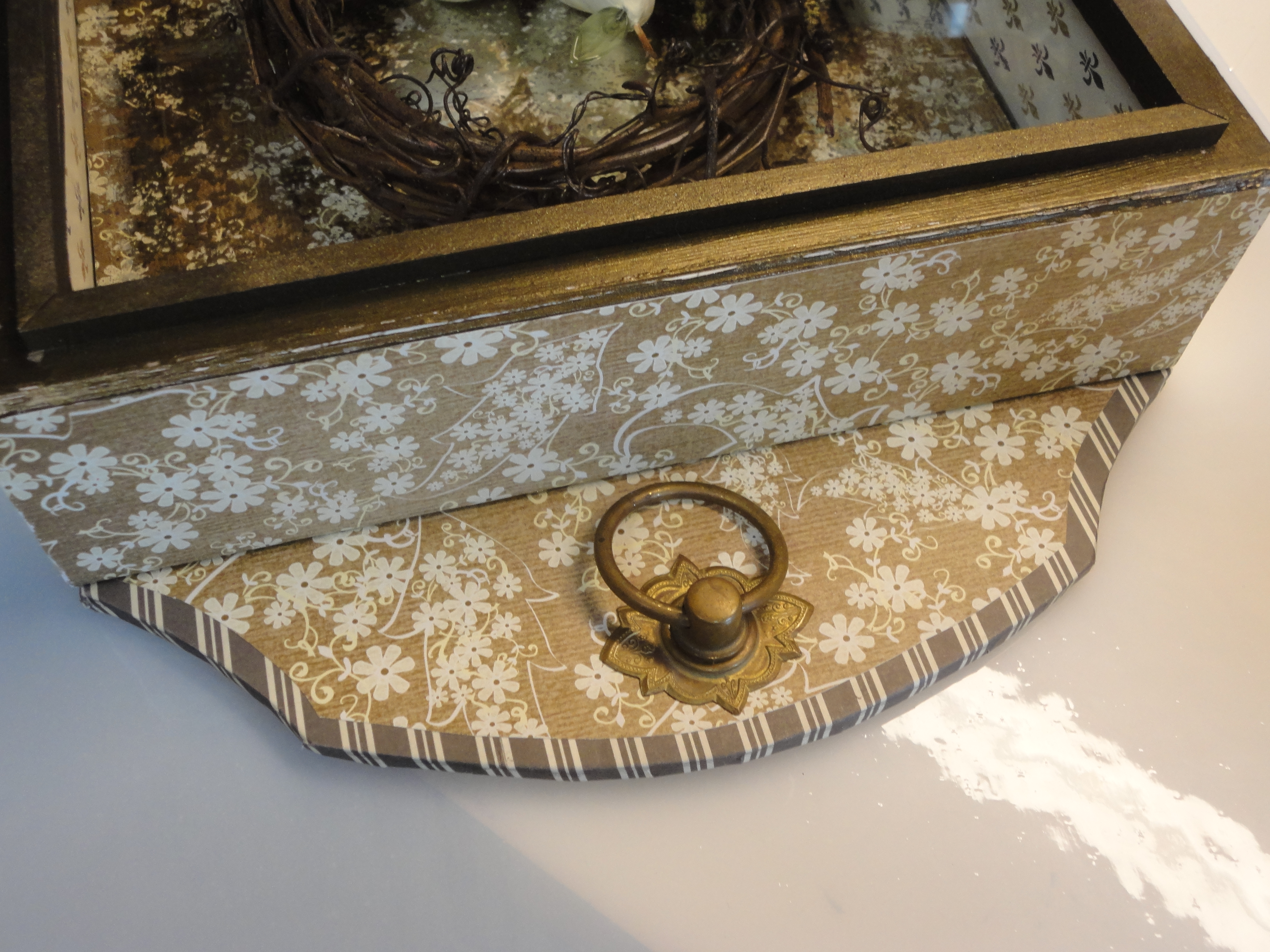
To complete the look, an old drawer pull was added to snazzy up the arch.

The wreath was laid in the box, with small dabs of E6000 in a few places on it’s backside, where it touched the mirror, and left to dry overnight.

860 watermark   771 watermark   DSC00682 DSC00687

I’m pretty sure that shadow box making has just nudged it’s way onto my favorites list. I think the hanging element can be improved with a little more forethought, but, I am so pleased with the way this project turned out.  Although it was time consuming with all the gluing and drying, I believe it was worth it. Any time you can learn a little, have fun, and have something to show for it, is time well spent!  Don’t you agree?

← Back

Thank you for your response. ✨

Warning
Warning
Warning
Warning

Warning.


My Vintage Style Christmas Tree – Part Two

I thought it would be fun to make some colorful ornaments to brighten up my tree.  They are all pretty simple … System 96 glass with some noodles and stringers. I fired everything in my small tabletop kiln, on kiln paper. All of these were taken to about 1700 degrees. I like to watch the action through the little window so I don’t over fuse and get that muddled look.

There had to be a stocking, of course! I used two pieces of thin white for the stocking top.

DSC09644

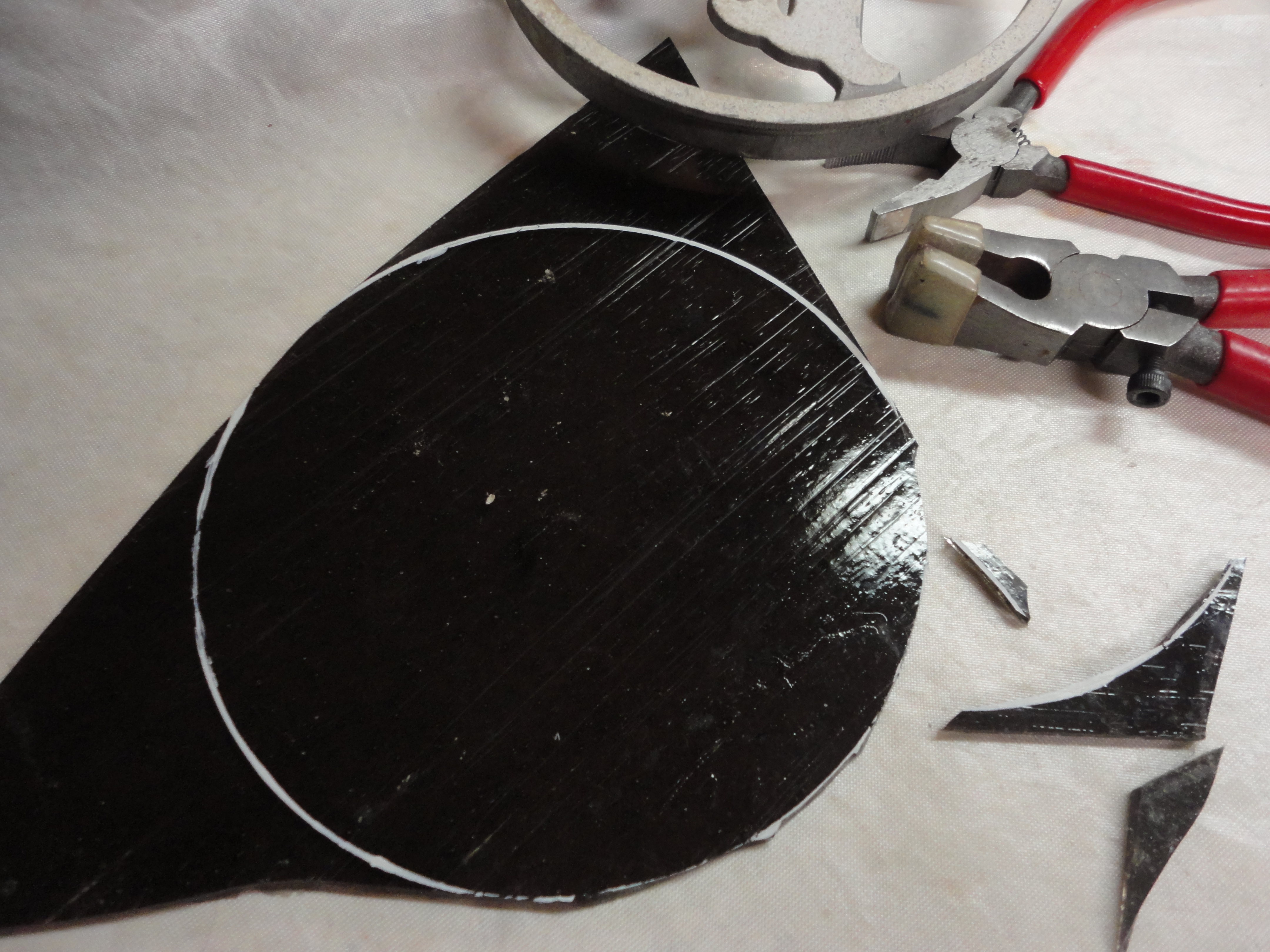
Something circular would be nice, but not just solid and plain. I’ve found the easist way for me to save some grinding time, on something like this, is to drill the hole first. Then center the hole under your clear plastic pattern, trace and cut out.

How to combine glass and metal had me stumped for a little bit, until I noticed a pile of little bells I had laid aside to rust .. hmm? Wouldn’t it be neat if they could dangle in an ornament somehow? I started with 1/4″ wide strips of glass, and laid them out as shown below … it worked! I may have to make some of these on a larger scale for my big tree!

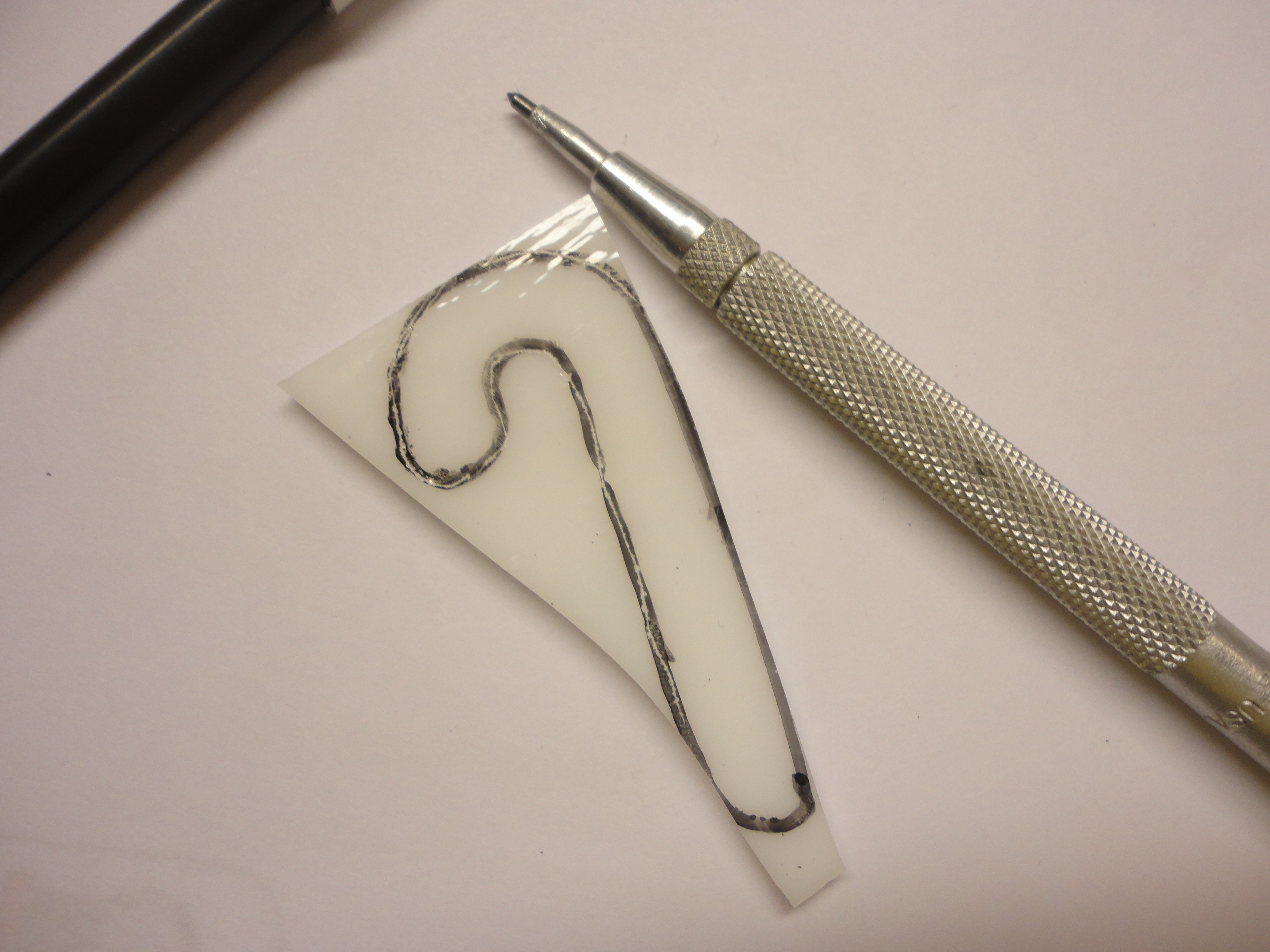
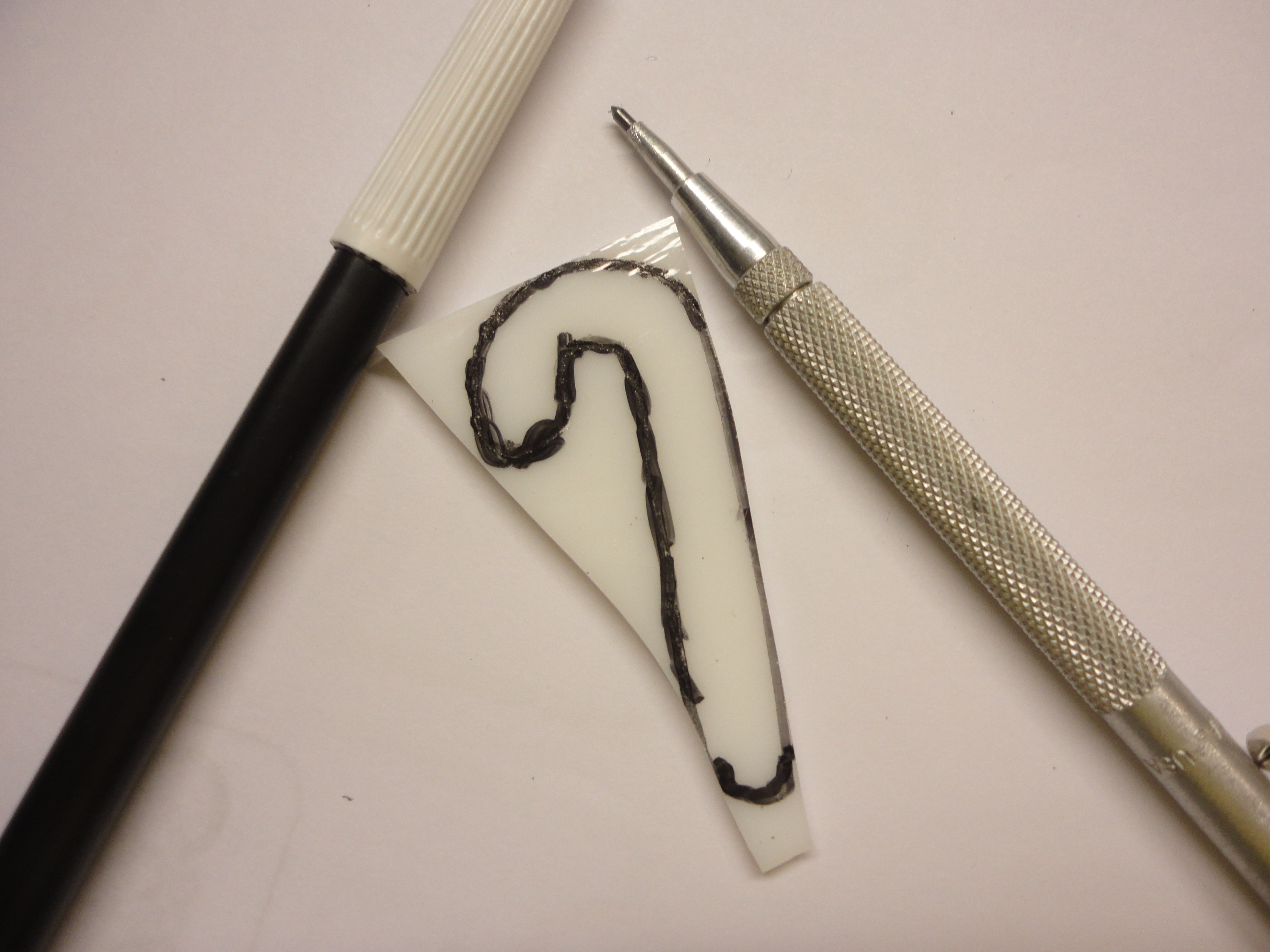
The little candy canes are time consuming, but so stinkin’ cute! These are 2 1/8″ long, and made the same way I make larger ones for patchwork candy canes. I’ve read many tips for keeping marks on glass while using a glass saw, but using my scribe and marker has never failed me.

After tracing your pattern, go over your line with a pencil scribe. You could probably use an electric engraver for this too, but I haven’t tried it yet. Fill in the scribe line with black marker and let it dry a little bit. Lightly wipe the marker off, leaving a noticeable line for saw work.

DSC09903 DSC09906 DSC09917

All of the cutting can be done on a ring saw, but I like to use a band saw to cut the inside line of the cane. Use a regular glass cutter to cut the outside line. On a ring saw, I shape and grind the inside arch and side of the cane first, then go to the glass grinder for the outside edge. Decorate and fire.

Joann Fabric had the perfect piece of fabric for my tree skirt. But, in all honesty, my sewing machine has not seen the light of day for probably two years. I don’t hate sewing, it’s just not in the list of my top 10 things I like to do. With that being said, I asked our close family friend Alison to make my tree skirt for me. Fantastic Job Alison!

My daughter graciously offered her collection of small glass vintage Christmas balls. They’re lovely, old and faded, and in all the right colors. I’m just guessing here, but I’ve seen her eyeing my garland .. She’ll probably want to borrow it next year to go with her Christmas balls. I know how these things work.

The bay window in my kitchen doesn’t offer much of beautiful view this time of year, just out buildings and empty fields. But it does offer a lot of light to shine through the beads and glass, and it will be safe from little curious hands.

I’ve never decorated one of these trees before. There’s a lot of empty spaces, and a little different with no lights, but I’m pleased with the way it turned out. It’s been raining here all day, really dreary. I’m looking forward to seeing it in a whole new light tomorrow.

It was not a good day to take pictures either, I’m afraid. I worked for hours trying to get a real clear shot of my tree. I added light from lamps, a snow blanket background over the window, nothing helped. I waited until dark and tried again. Sorry, they aren’t fantastic, but better than the earlier ones, and the best I have for now.

I invited some little elfish friends to play under the tree.

I hope you and yours enjoy a wondrous holiday season.

Merry Christmas & Happy New Year!


My Vintage Style Christmas Tree – Part One

“Kitschy” – 1) A style of decorative art and design in which ordinary objects have vintage appeal, “old-fashioned” characteristics. 2) Art, decorative objects or design considered by many people to be ugly, lacking in style, or false but enjoyed by other people.

A lull in activity, last week, afforded me some much needed time to catch up on a few Christmas orders and start making a little something special for myself too!

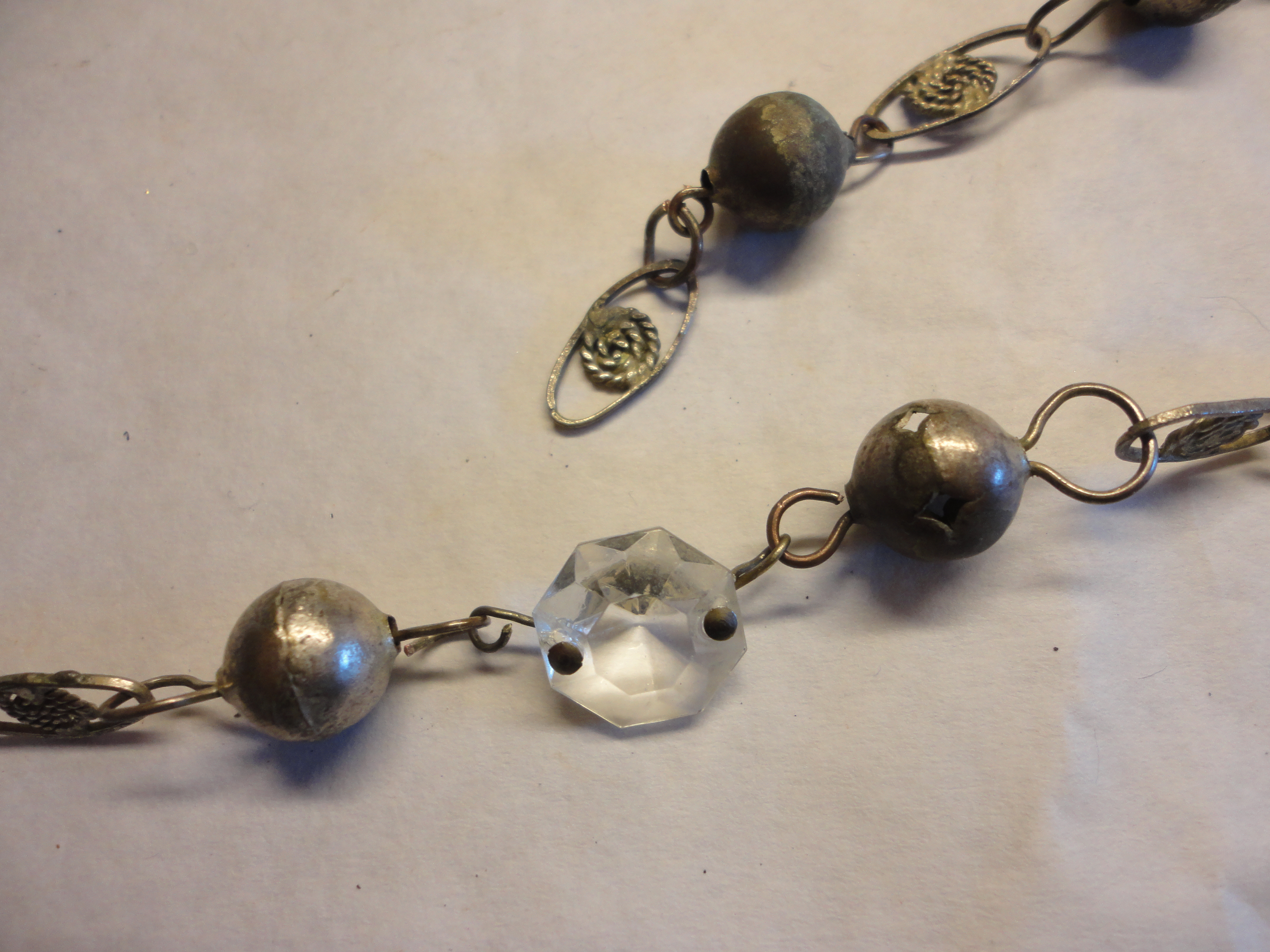
Over a year ago, while making garden garlands, the vision of a smaller, beaded, Christmas garland began forming in my mind.  I could just see it draped on one of those little foil trees; not the bright silver one, but the darker, tarnished looking one.  Ideally, it would be glass and metal, with a vintage, bohemian, kitschy look.  But, although I had plenty of beads, crystals, and such, I didn’t have an outstanding metal element.  That was, not until I set eyes on a lovely old, tarnished silver necklace in a popular local shop, Reclaimed Treasures on Main, in Haverhill Iowa. It could not have been more perfect!  Isn’t it sweet?

DSC08871

I loosely draped a string around my tree, and measured it, to determine that my garland needed to be about 90″ long to look it’s best.

Not wanting to disassemble the necklace before having some sort of plan, I laid out a mess of beads and baubles, in the colors and sizes I thought I might use, and gave them a good look over.

DSC08893  DSC08909

I decided the best way, for me, to approach this project was to break it down into small steps, and watch my progress as I went along.

I removed the jump ring that connected the necklace ends together.

To add some length quickly, I linked together 9 beads that I liked.  There were enough beads to make six identical lengths, but I wasn’t really concerned about them matching exactly, I would have substituted some if needed.  I inserted one of these beaded lengths after every other solid orb in the necklace.

Most of my beads already had wires, which was a huge plus. If there wasn’t a wire, I robbed one from another bead or made one. Some reclaimed crystals were added between the other silver orbs, and two of the little floral ovals were moved to each end.

DSC08945  DSC08957

I loved the look of the grungy pearls, so I went back and added another one beside the small purple crystal beads.

Repeats of some of the beads I used were added to each end before going back and securing all the connections.

I thought I was done here, but as I was putting things away, I came across some awesome pale green pearls, and couldn’t resist tucking them in next to some of the red crystal beads.  Now, its finished, well … for this year anyway.  I have a sneaky feeling this piece will be a tempting one to keep adding to, don’t you agree?

DSC08963   DSC09403

garland with watermark    DSC09874

We’re not done yet, the real fun is just beginning!  There’s decorations to find, a tree skirt to make, and ornaments to get in the kiln.  I hope you’re able to join me as it all comes together this week-end for Part Two of My Vintage Style Christmas Tree….  Enjoy Your Week!


In The Spirit of Christmas!

A friend and I were visiting the other day and trying to decide exactly what you would call our obsession with saving scraps and bits.  The term “junk collector” isn’t really fitting and sounds so cold.  We are more like “gatherers”.  We like to gather and save all kinds of intriguing things, big and small, until we discover or create a way to use them.  With a husband in the scrap business, I may get to do more gathering than most, but I really enjoy the challenge of creating with my finds.

After pinning another great Pinterest post on crafting with Epsom Salt, I figured it was time to give it a try.  But, what was I going to put it on?
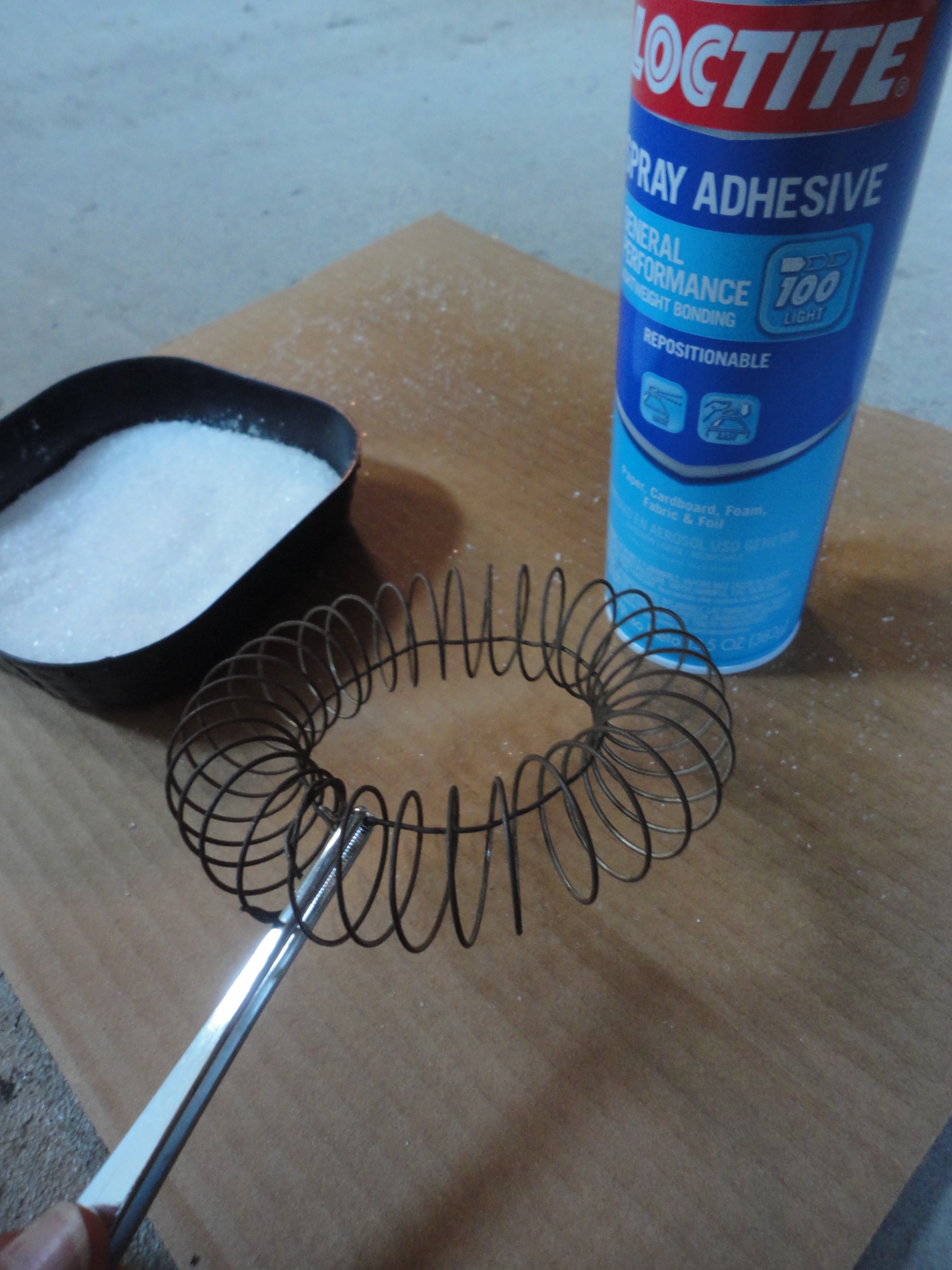
During short breaks from glass work the last couple of weeks, I’ve been having fun rusting wire, bells, and a few other tidbits.  Looking through them. I found a couple large notebook spirals that rusted nicely, and thought they would look good as flocked wreath ornaments.

9303 watermark 9294 watermark

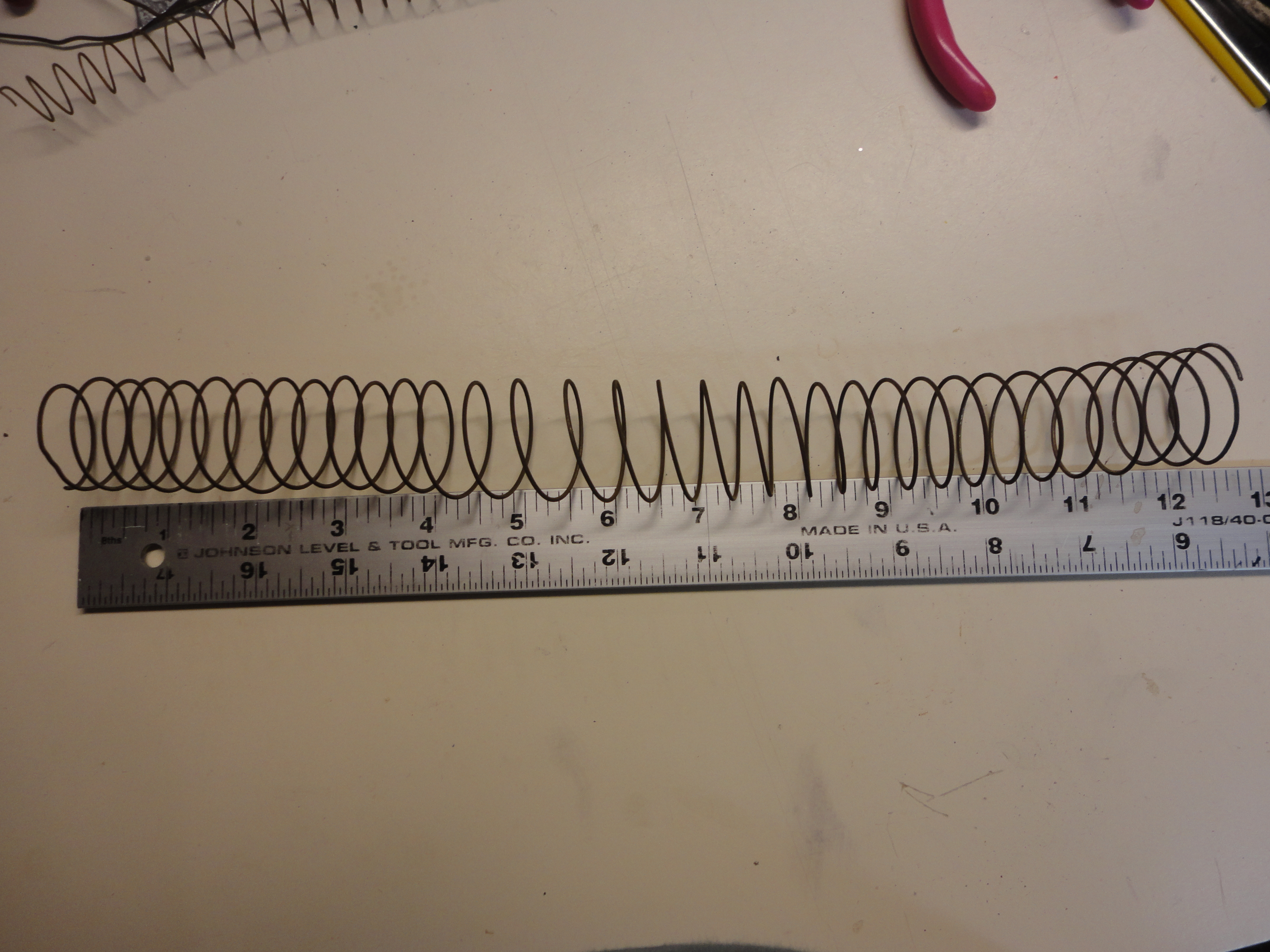
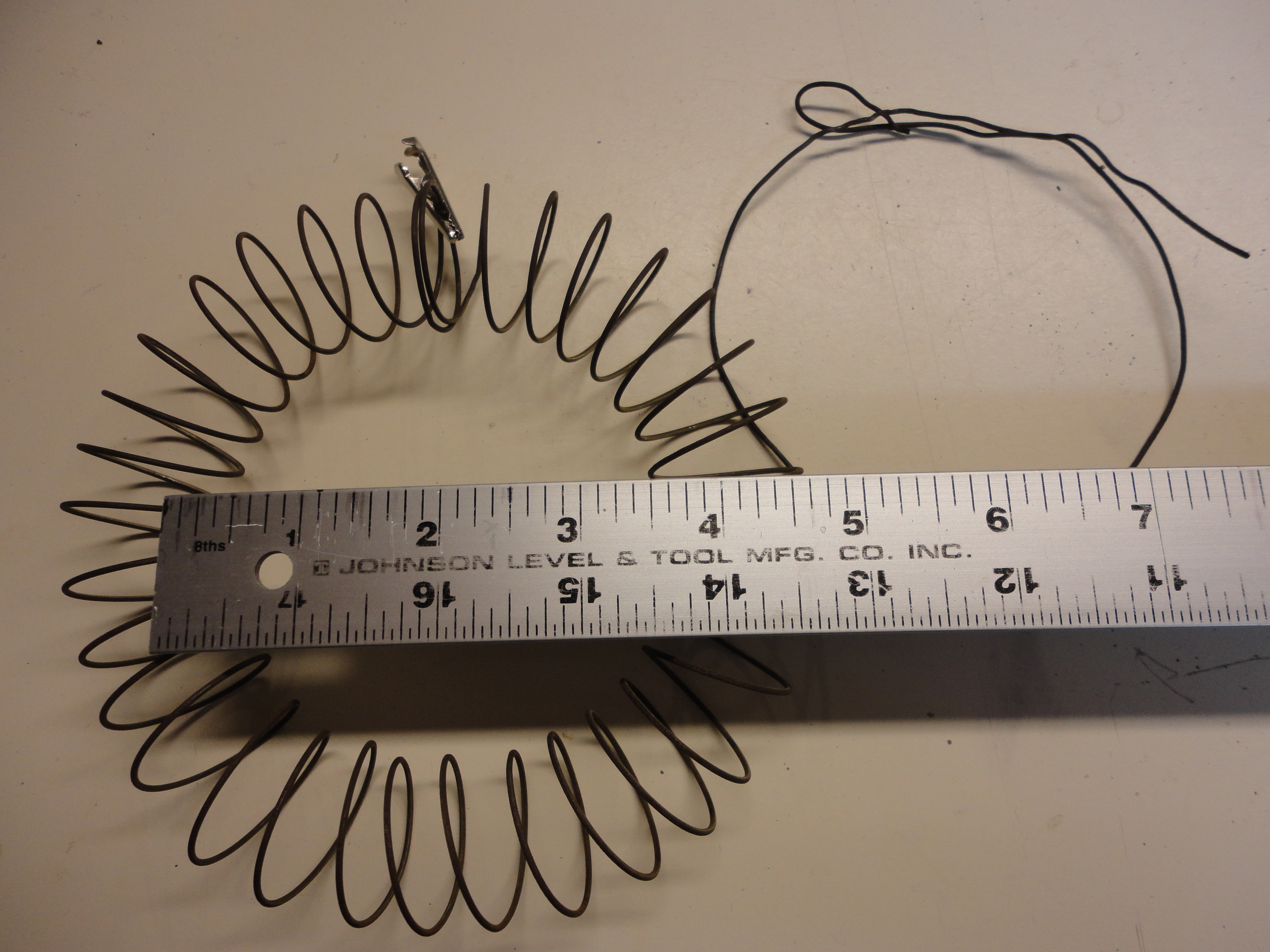
I started with a large rusted spiral approximately 12″ long.  Shape in a circle and clip ends together to determine the diameter of the wire circle you will need for an inner circle, to prevent sagging.  Pre-shape a length of rusty wire into the circle size needed, with a little extra on the ends.  Scrunch the spiral in your hand and thread wire through.

DSC08762 DSC08769 DSC08776

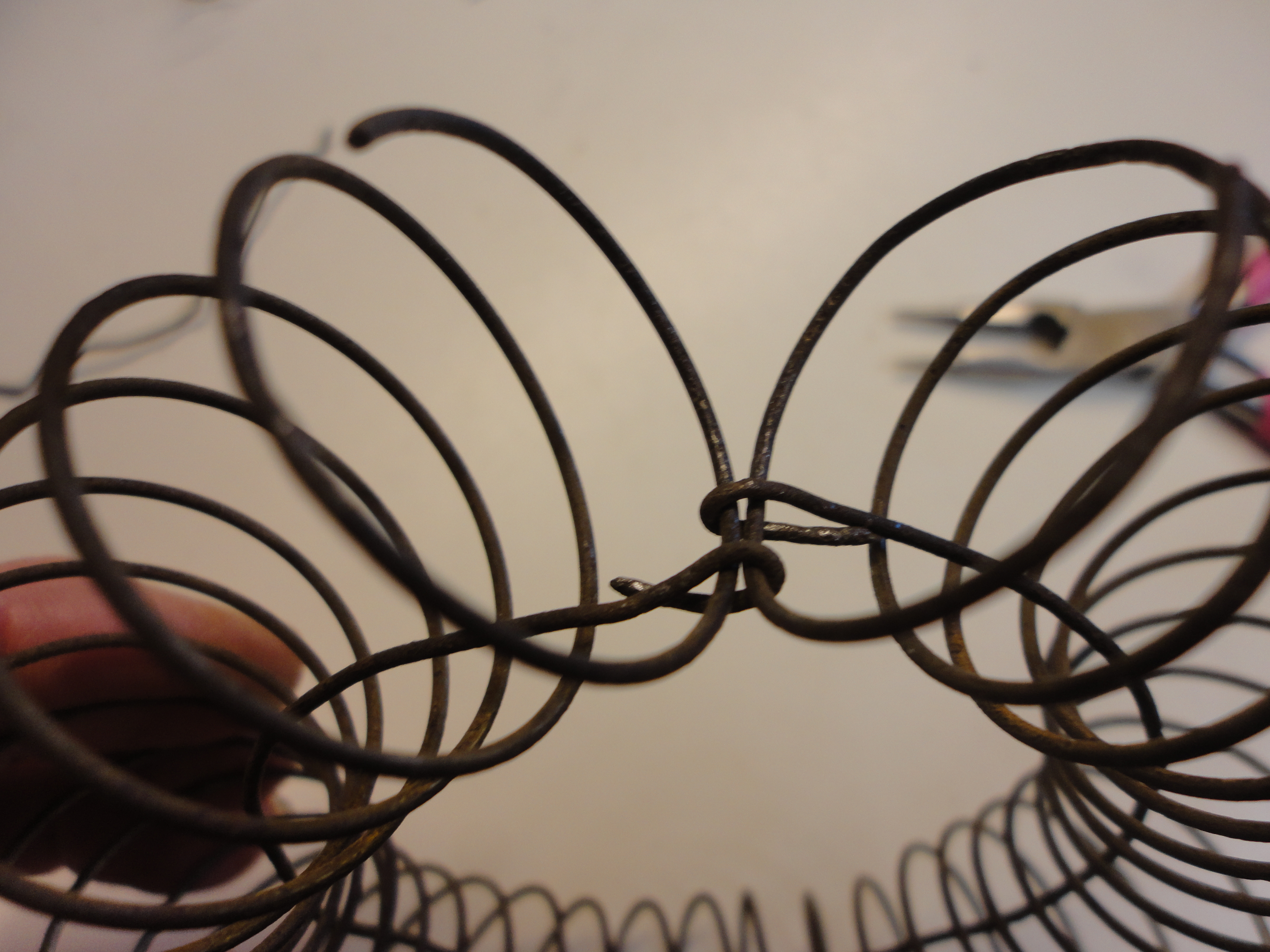
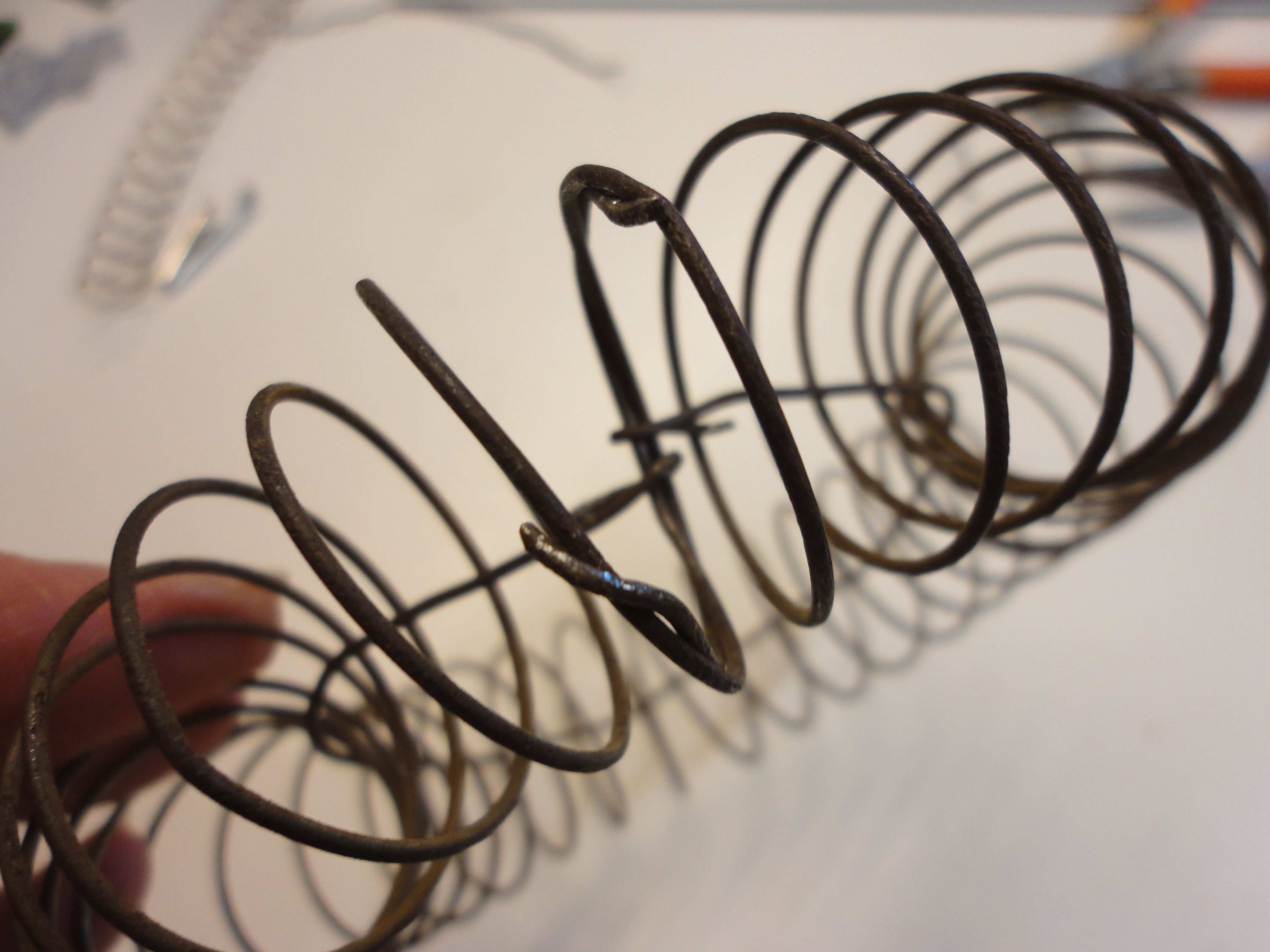
Trim off excess wire and form small hooks on wire ends.  Cross hooks over and connect the spiral together to form the inner circle.  Pinch hooks tight.  Wrap the loose coil ends of the spiral to the coil opposite of it (right to left, left to right) to complete the outside edge of the circle.

DSC08800 DSC08808

Not wanting fumes to choke everyone out of the house, I moved to the garage for spraying and coating my wreaths. Using long tweezers to hold the wreaths worked like a charm, and they cleaned up easily with a wipe of  mineral spirits.  Spraying over the garbage bin kept sticky overspray residue at bay.  Adhesive sprays may differ; please follow manufacturers directions.

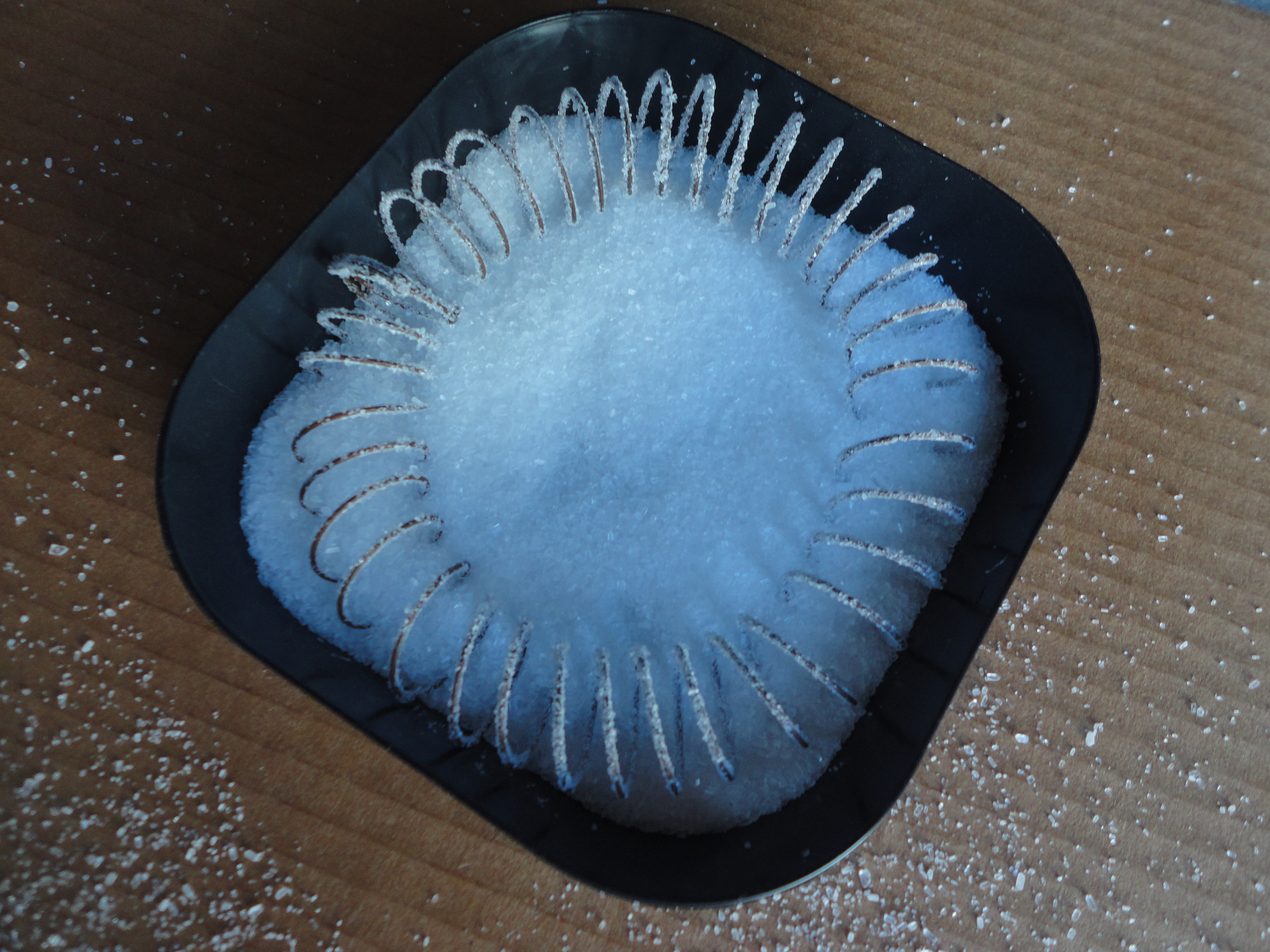
After spraying, coat wreath well in a shallow container of Epsom Salt.  I waited about 10 minutes, then sprayed the wreath again, before sprinkling it with crystal clear glitter.

You can stop here if you like the look.  Wanting a heavier, fuller appearance, I waited about 20 minutes and repeated the coating step. Then moved the wreaths inside to dry thoroughly.

DSC08821 DSC08683 DSC08829

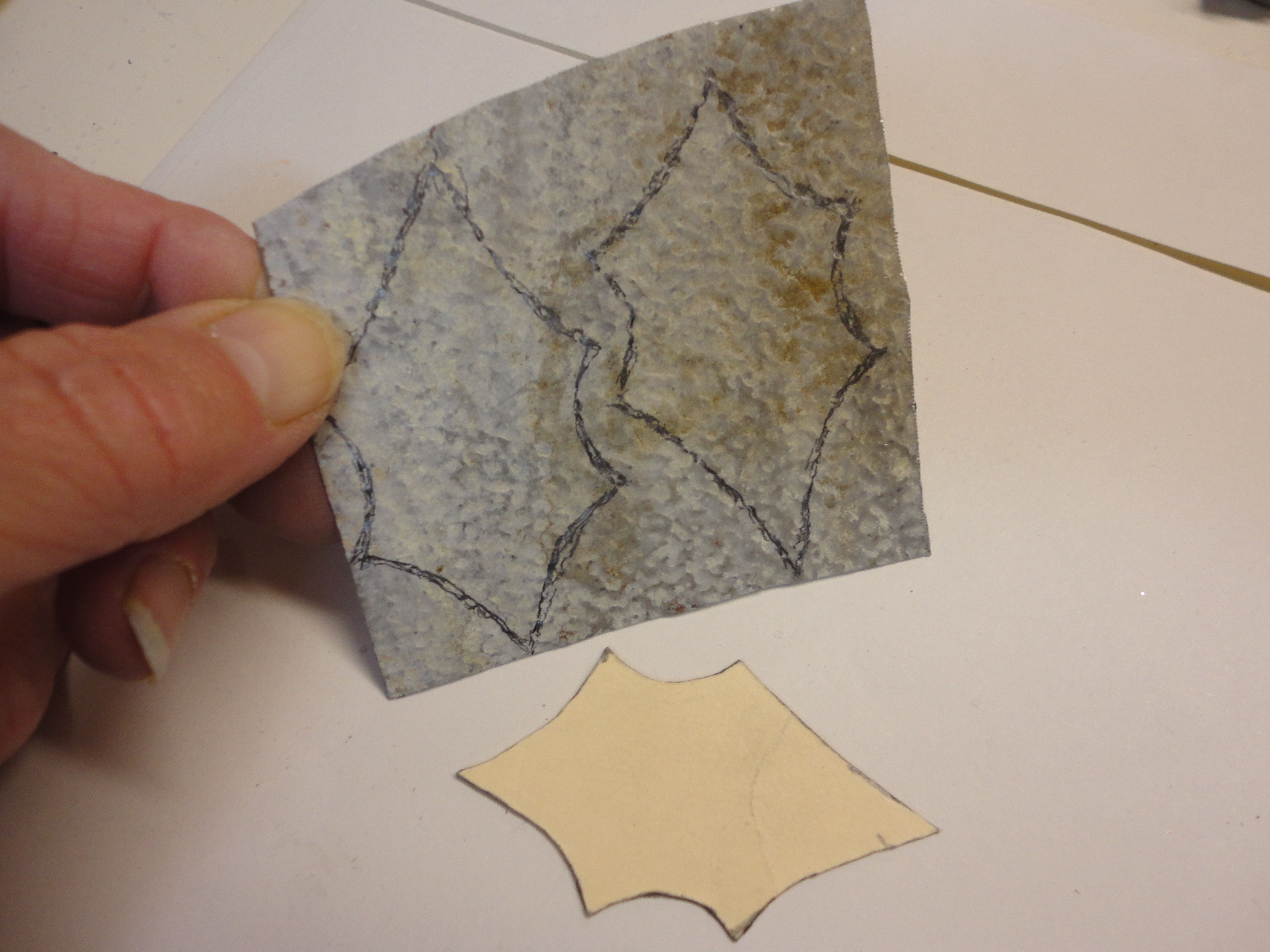
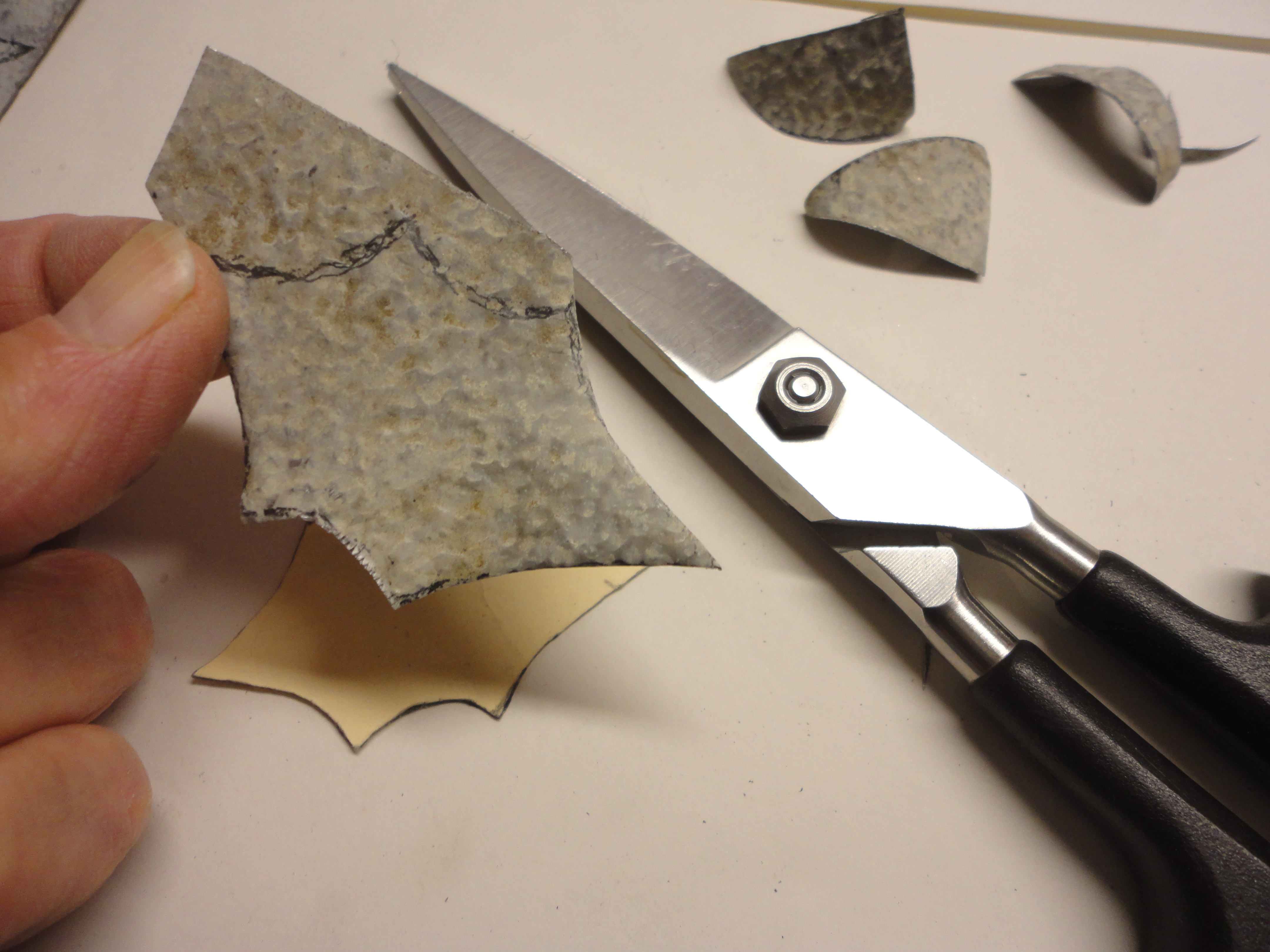
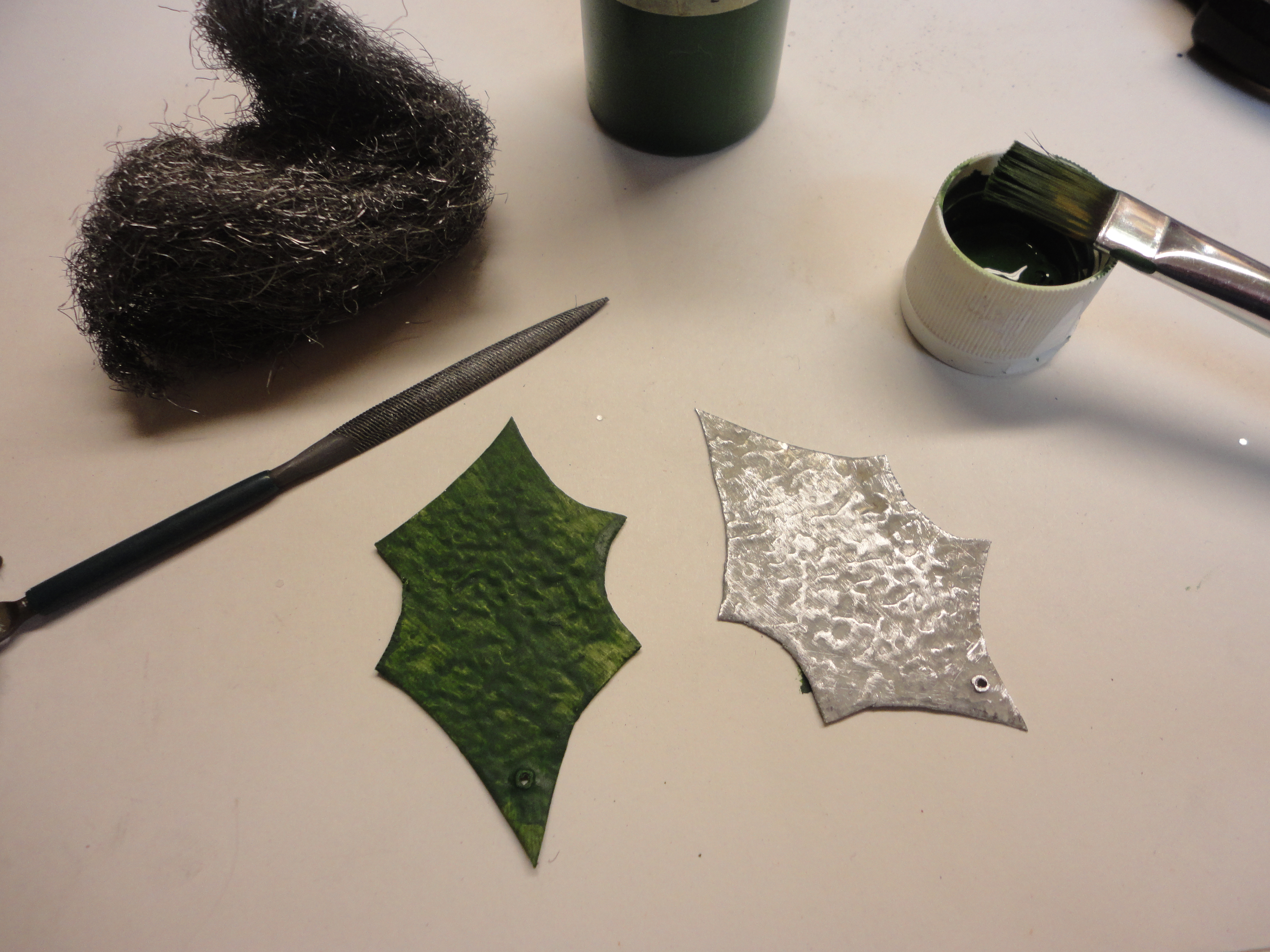
Flatten a small piece of textured scrap aluminum for the holly.  Trace first leaf, then flip the pattern before tracing the second leaf.  Cut them out with tin snips or all purpose scissors.  Be Careful Please … edges may be sharp!

DSC09161 DSC09164 DSC09165

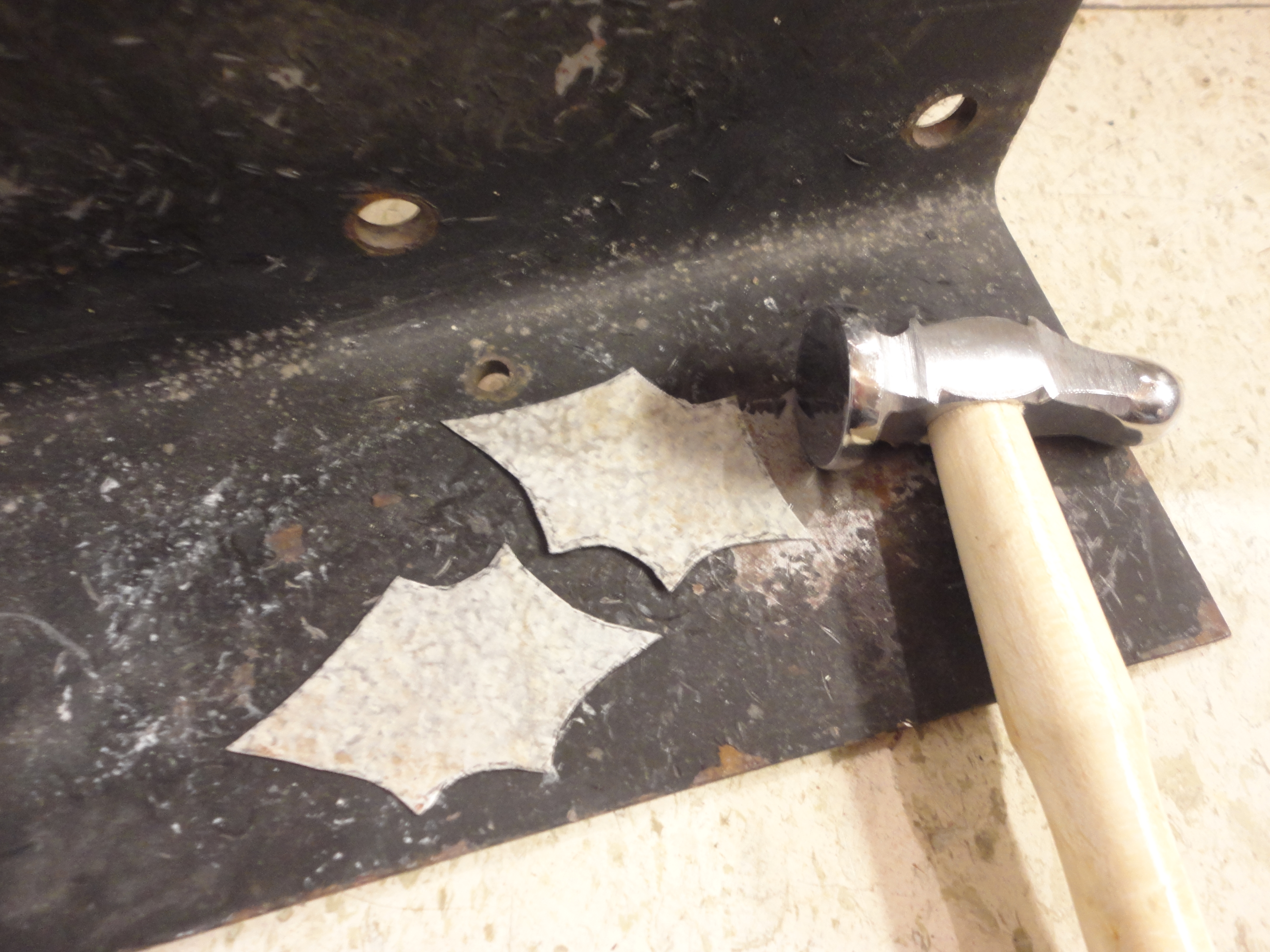
Re-flatten the leaves and punch a small hole for a wire.  File the edges, sand with steel wool, and paint them with a Christmas green craft paint.

DSC09169 DSC09175 DSC09177

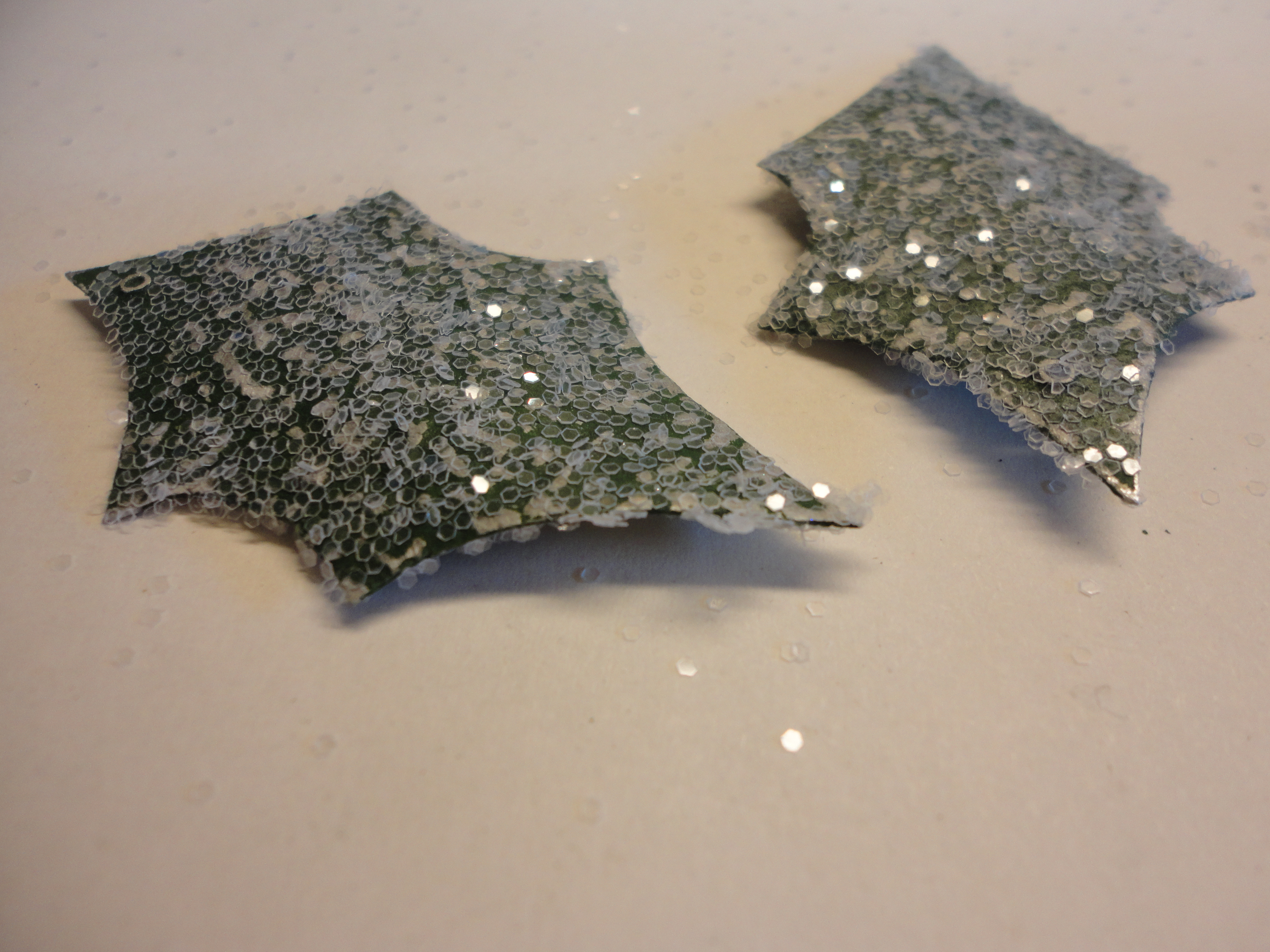
Sandpaper the leaves to distress the green paint.  Spray lightly with adhesive and coat them lightly with glitter.  If the glitter gets too heavy, brush it off with a soft bristled brush.  Let dry well before using your fingers to curve the tips of the leaves, to add dimension.

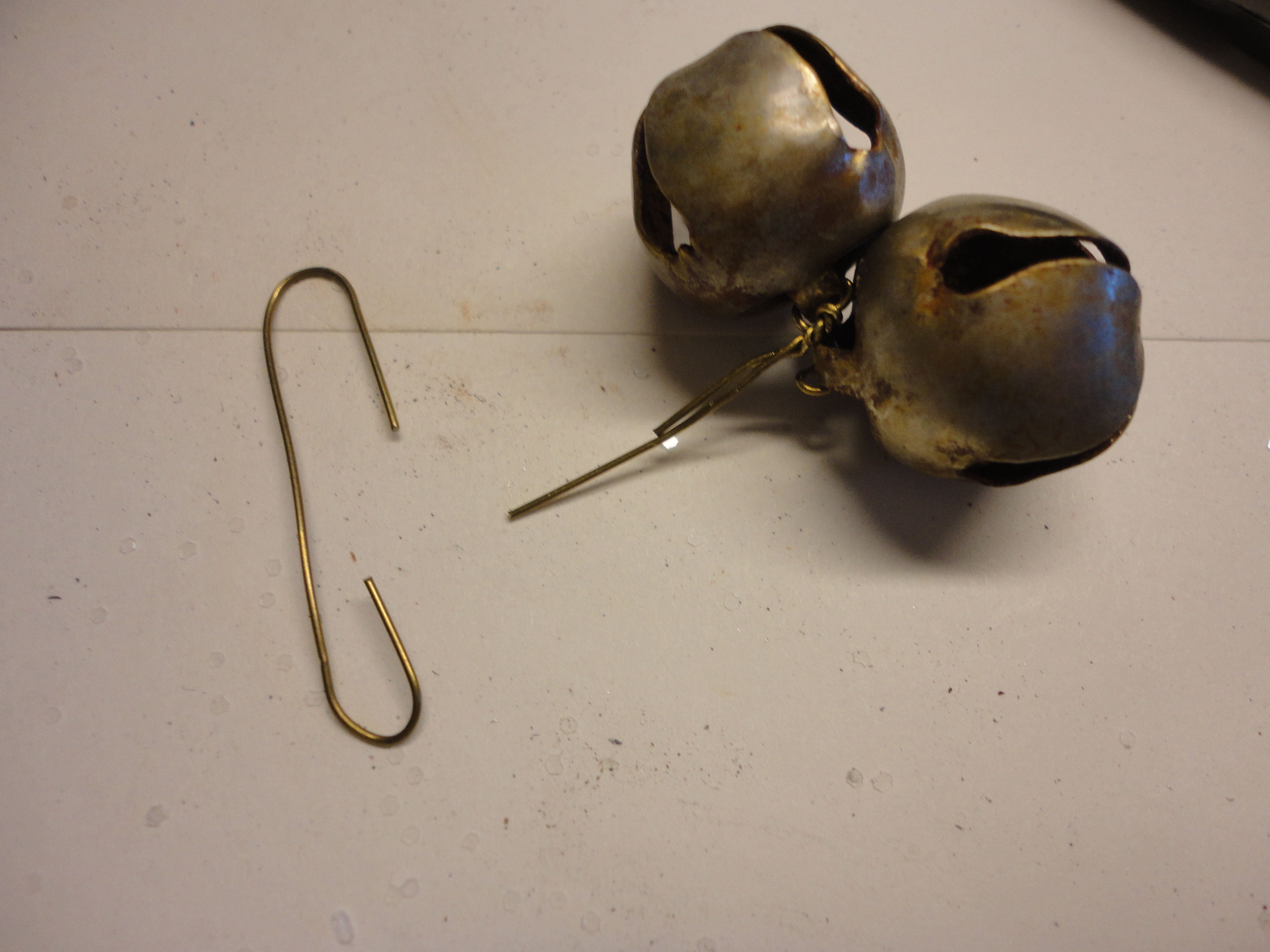
Many small gauge wires will work for the leaves and bells.  I used Christmas hook wires because they were on my workbench and easily accessible.

Form a small circle on the end of a straightened, long green plastic coated Christmas hook.  Bend it to the side.

DSC09183 DSC09201 DSC09204

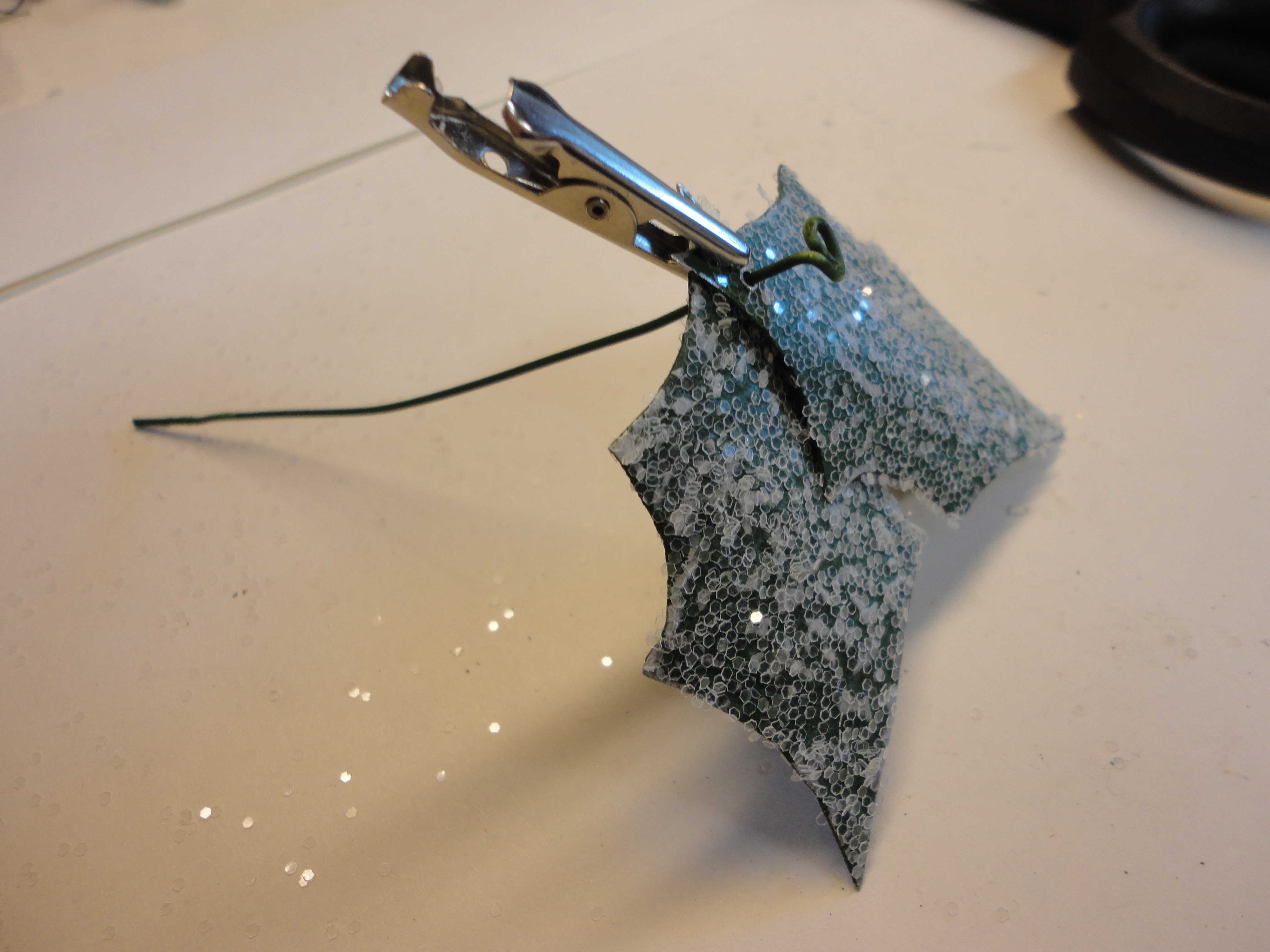
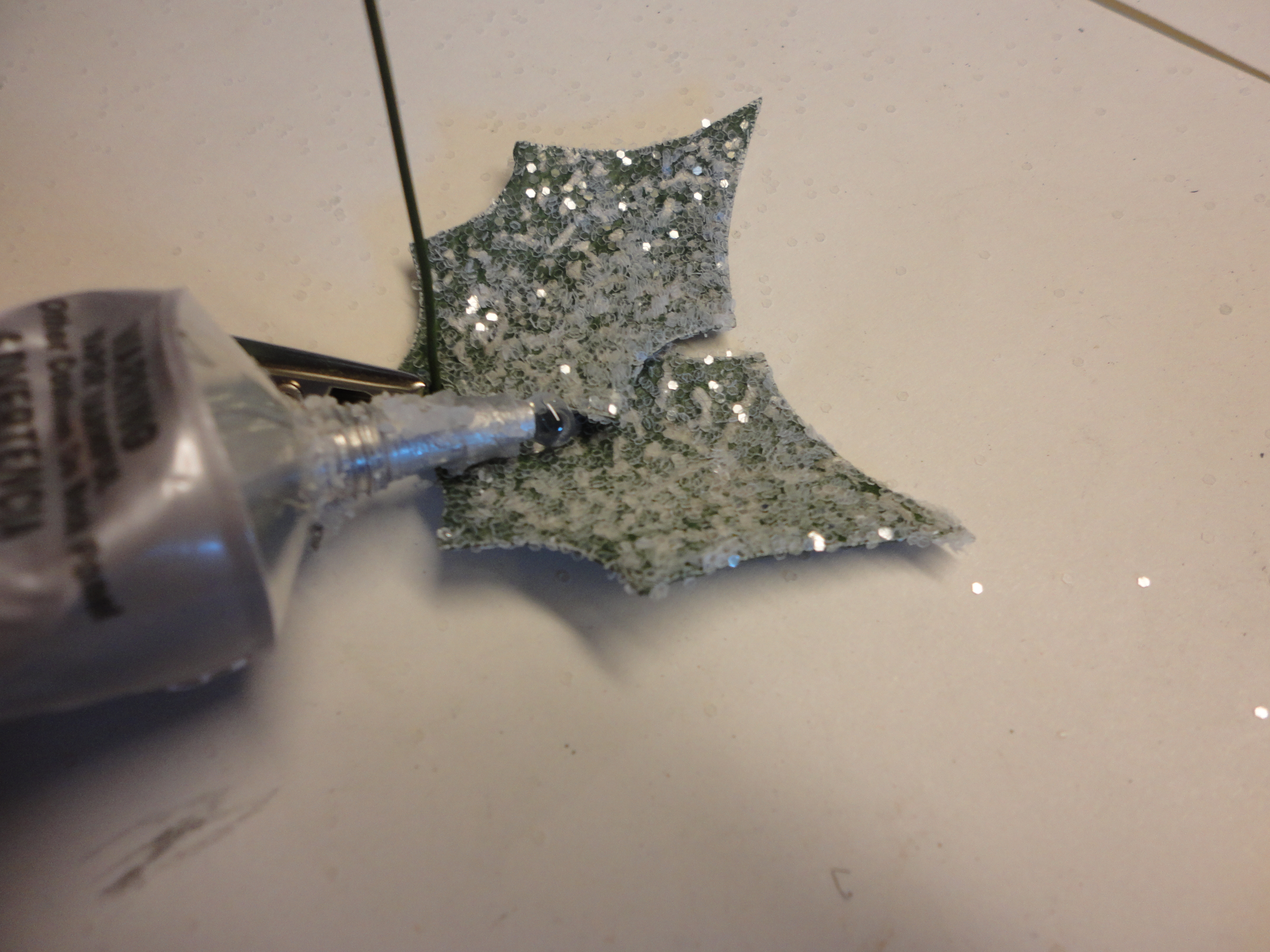
Over lap the ends of the holly, lining up the holes, and clip them together.  Insert the shaped wire.  Squeeze a little E6000 in the gap, where they meet, on the backside.  Let dry.

DSC09208 DSC09212

Spray two 3/4″ rusted round bells with a clear sealer.  Wire them tightly together.  Hold leaves and position the bells as you view them from the front.  Hold in place and hot glue them enough to hold them in place on the backside of the leaves.  Lay them down to secure with more glue.  If there is a lot of adhesive and glitter on the leaves, you may need to lightly sand the area before gluing.

DSC09217 DSC09223 DSC09225

Push the long leaf wire through the coils of your wreath, from the front, covering the spiral connection.  Keep leaves firmly positioned while wrapping the long wire around the inner circle wire and coils.  Use small pliers to help thread it through the coils and keep it pulled tight.

DSC09231 DSC09237

Do any additional shaping on your leaves.  As a finishing touch, give the crown of the bells a quick spritz of adhesive and a little sprinkle of glitter.

9297 watermark 9272 watermark

Hope this little project has inspired some Christmas crafting.  If you’re willing to share, I’d love to hear how you are using Epsom Salt in your creations.

For now, I guess it’s back to a little glass work for me … there’s candy canes to be make!  glassicartistry.etsy.com

8368 watermark

Thanks for visiting glassic touch!


A Little Something For Fall!

We’ve had a couple very windy days, but, there’s no complaining about the excellent Iowa harvest weather we’ve been enjoying so far this month.

Windy conditions can play havoc on seasonal yard decorations, however.  With the exception of pumpkins and gourds, I’ve wired and tied things down, to still see them blown across the yard, or disappear all together.  So now, I opt to add a bit more seasonal flair with small wreaths inside my home.

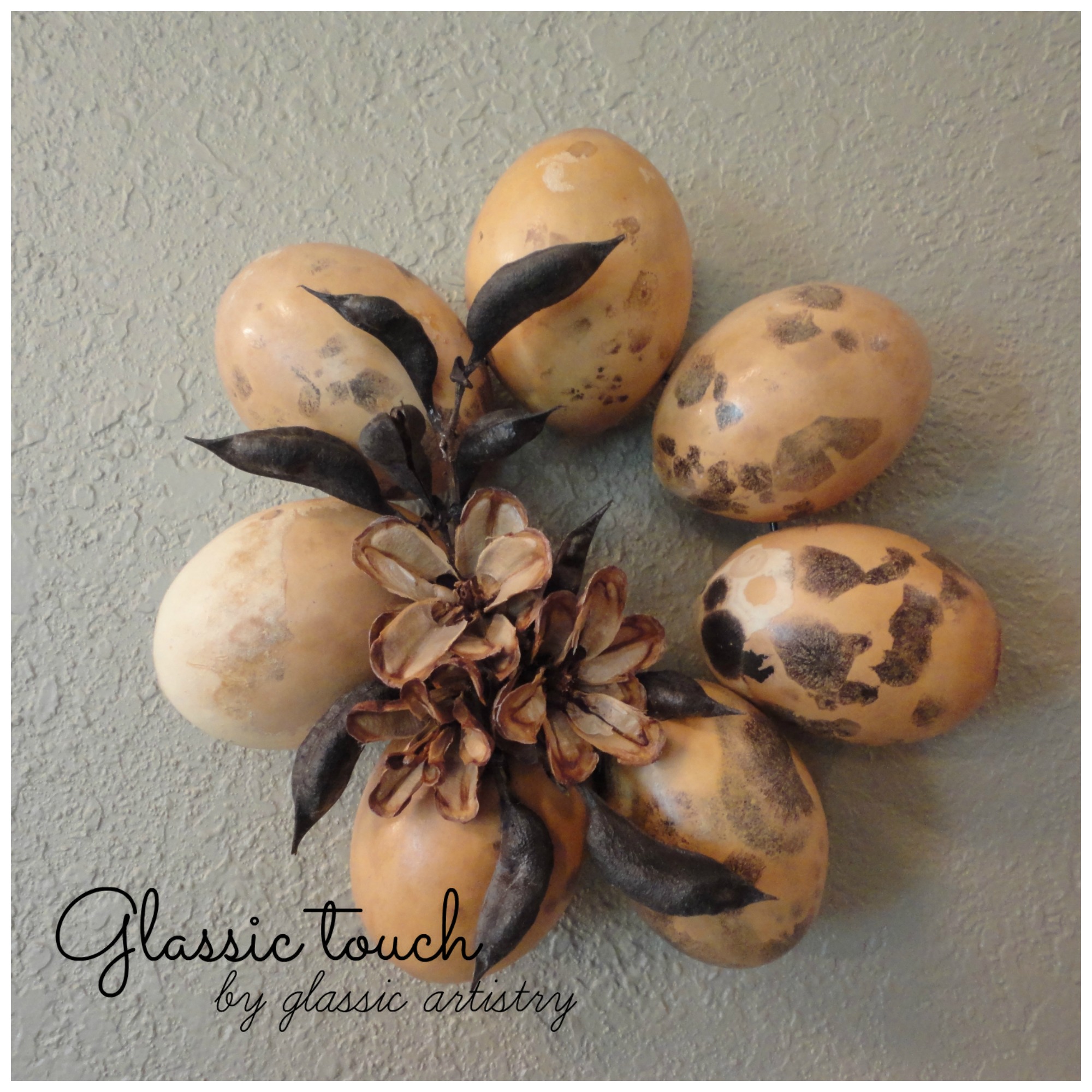
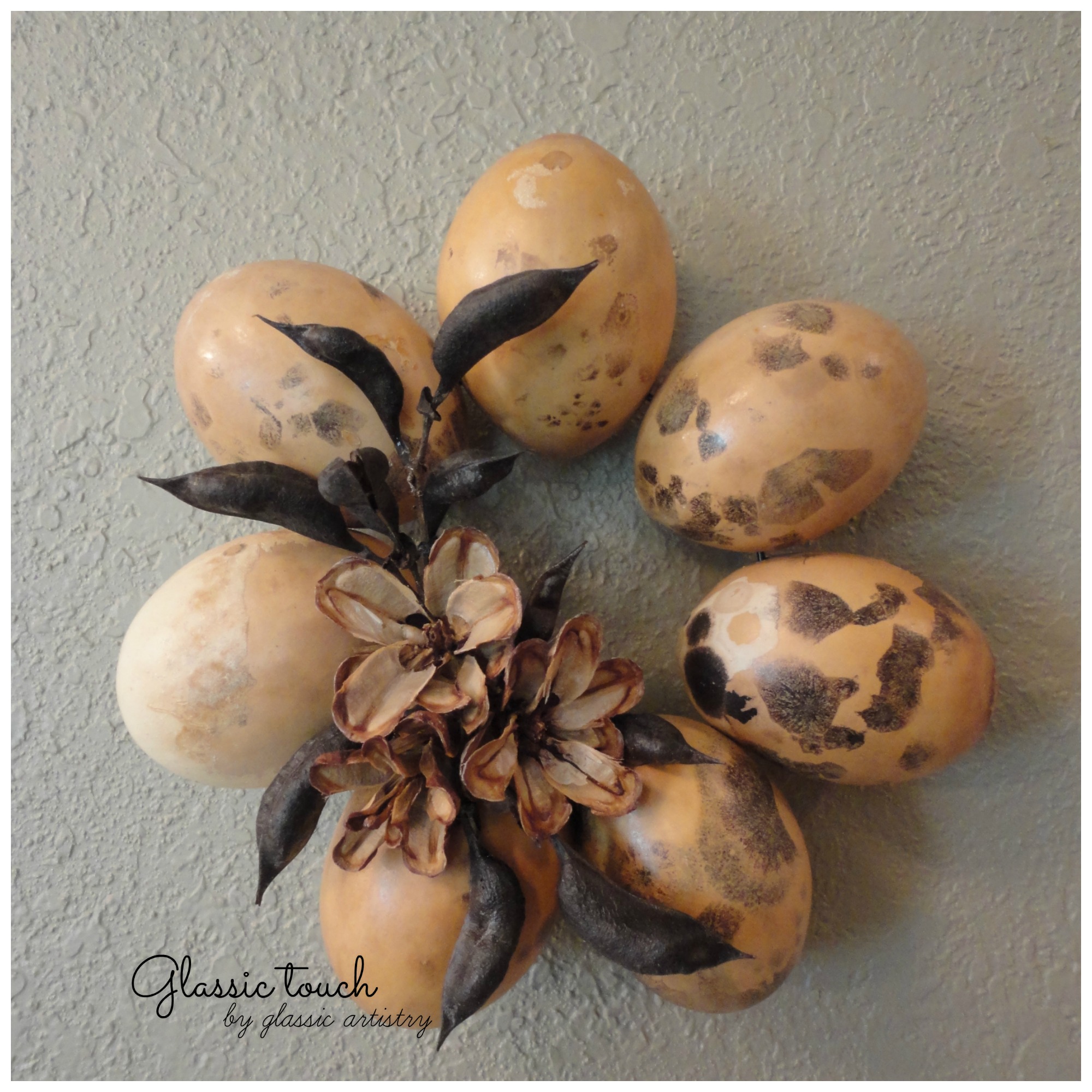
An abundant crop of egg gourds, dried, and stored in my basement, has been on my mind a lot since summer.  I’ve been wanting to make something with them for a long time.  I got to thinking that, some of them, a few of my favorite things, and what Mother Nature had to offer, would make for some pretty fall décor.  Simple and inexpensive, just my style!

8284 watermark8235 watermark8204 watermark

I’ve never been able to decorate a wreath when its lying on a flat surface.  I like to hang a prepared wreath on a paper covered board, and work on it at eye level.

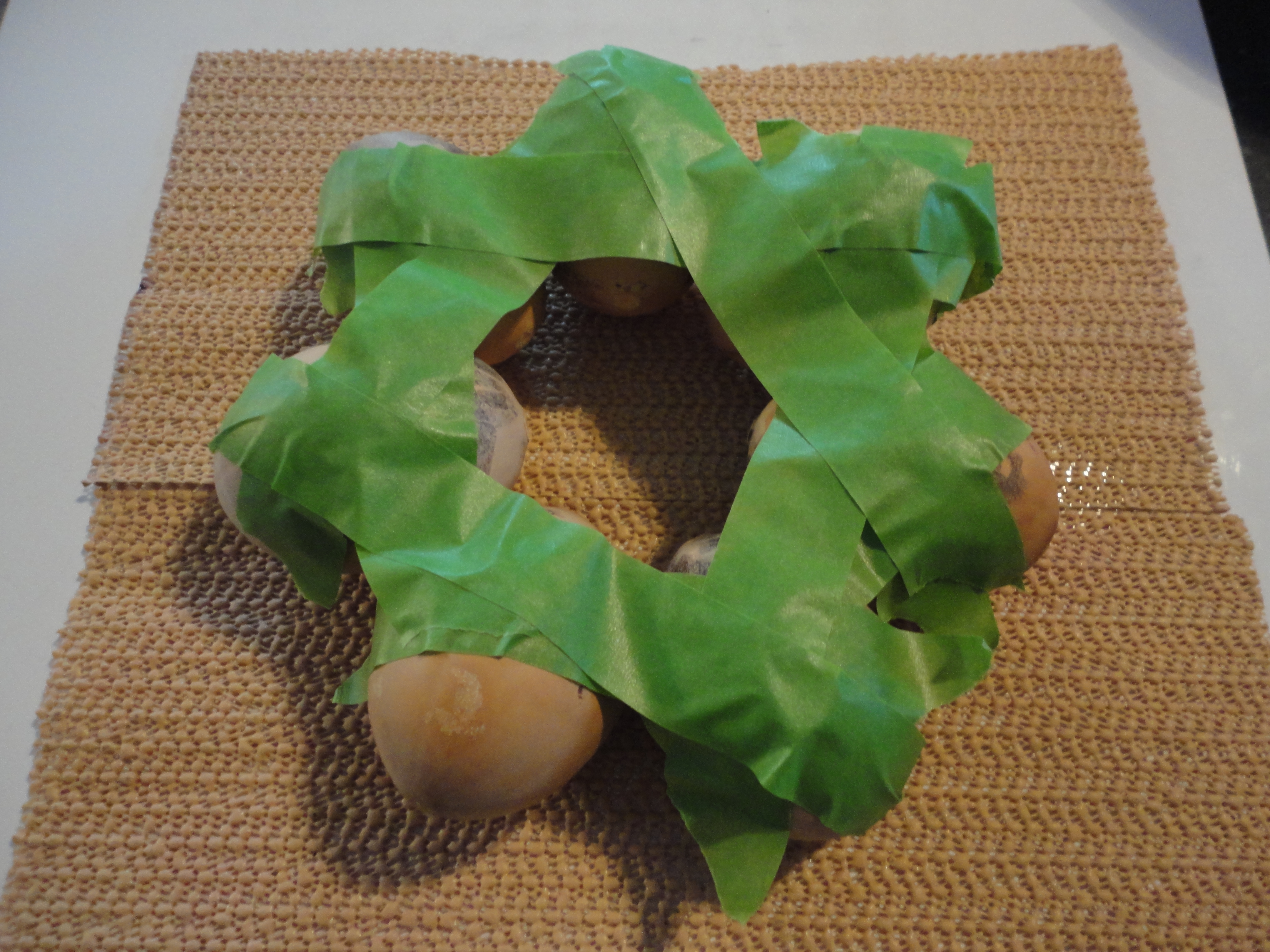
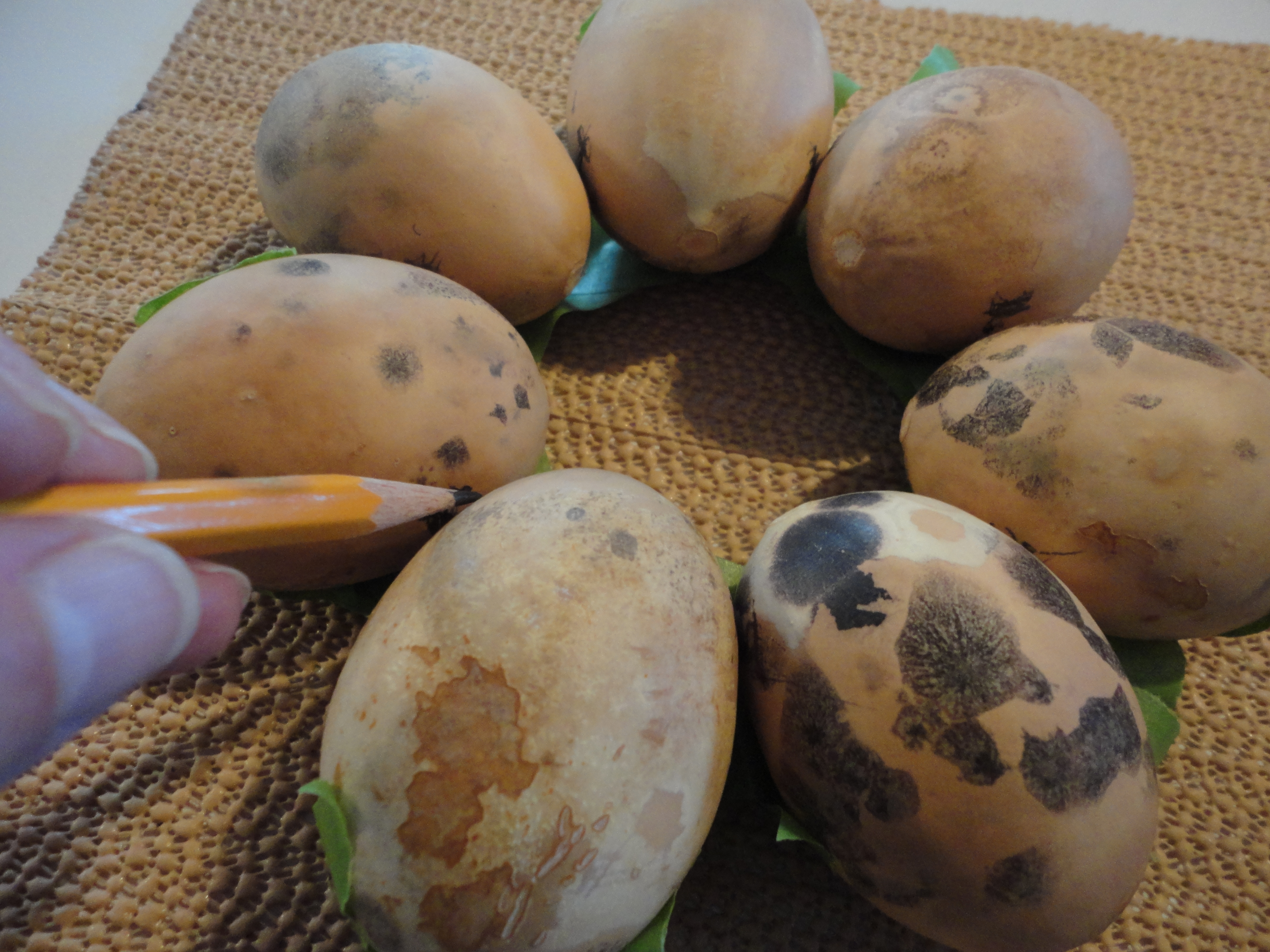
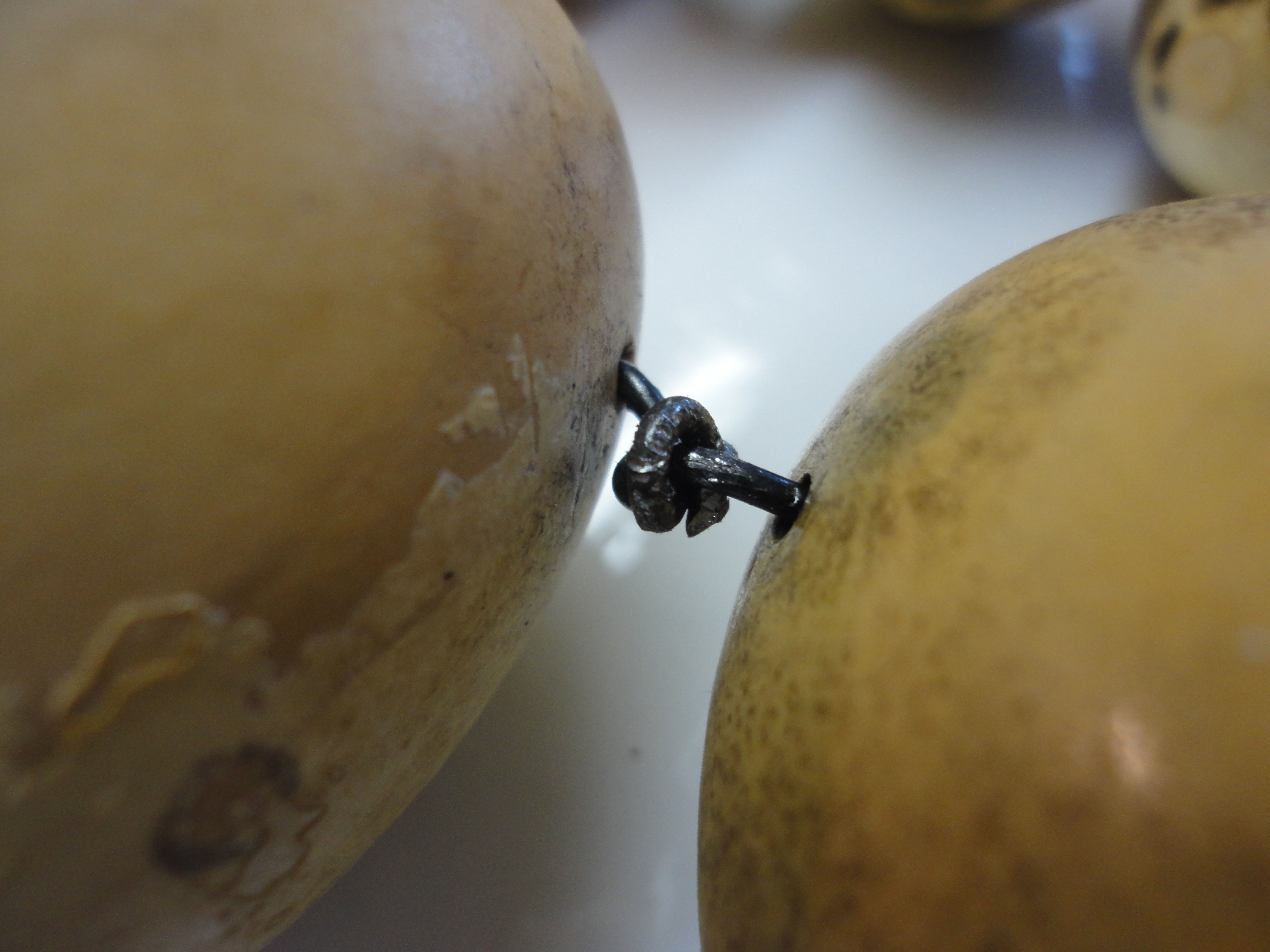
Gourd Wreath – Choose seven egg gourds of similar size and shape.  Soak overnight in bleach water and scrub clean.  (A small plastic basket, used for holding baby bottle rings and nipples in a dishwasher, works great for this step.  It will hold the gourds and its easy to weigh down under the water).  Dry gourds. Wax and buff with Briwax or any furniture wax. On a non-skid surface, arrange the gourds in a circle, and secure together with painter’s tape.  Gently turn them over and mark with pencil where they meet each other.  Remove the gourds from the tape, one at a time, drill holes with a Dremel and 3/32″ bit, then replace gourd on tape.  When done drilling, turn gourds face up and remove tape.

DSC07859 DSC07863 DSC07871

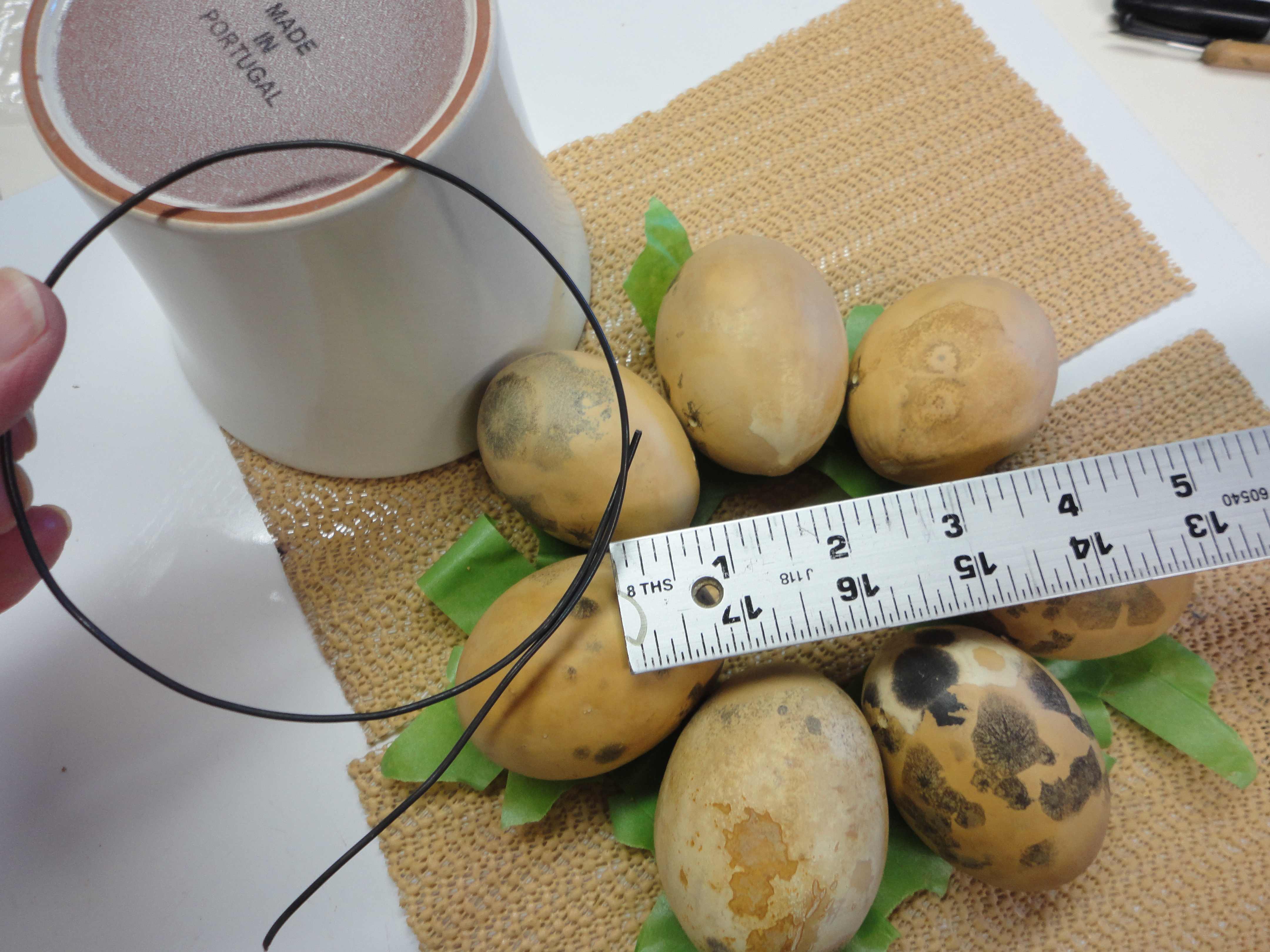
Measure and estimate the diameter of the wire ring you will need.  Pre-shape a length of 16 gauge wire around a container of the same diameter.   Mine was about 3 1/2″.

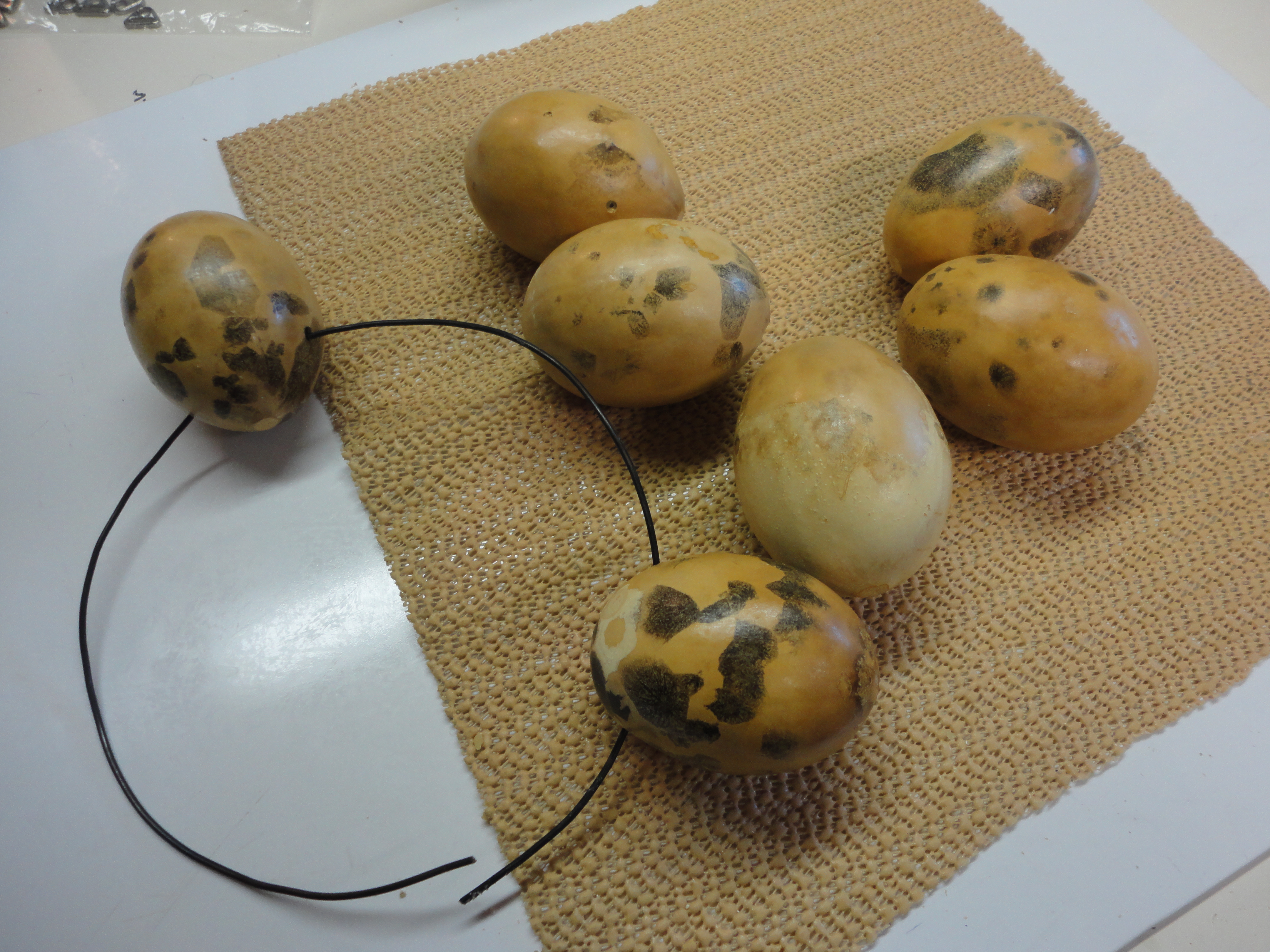
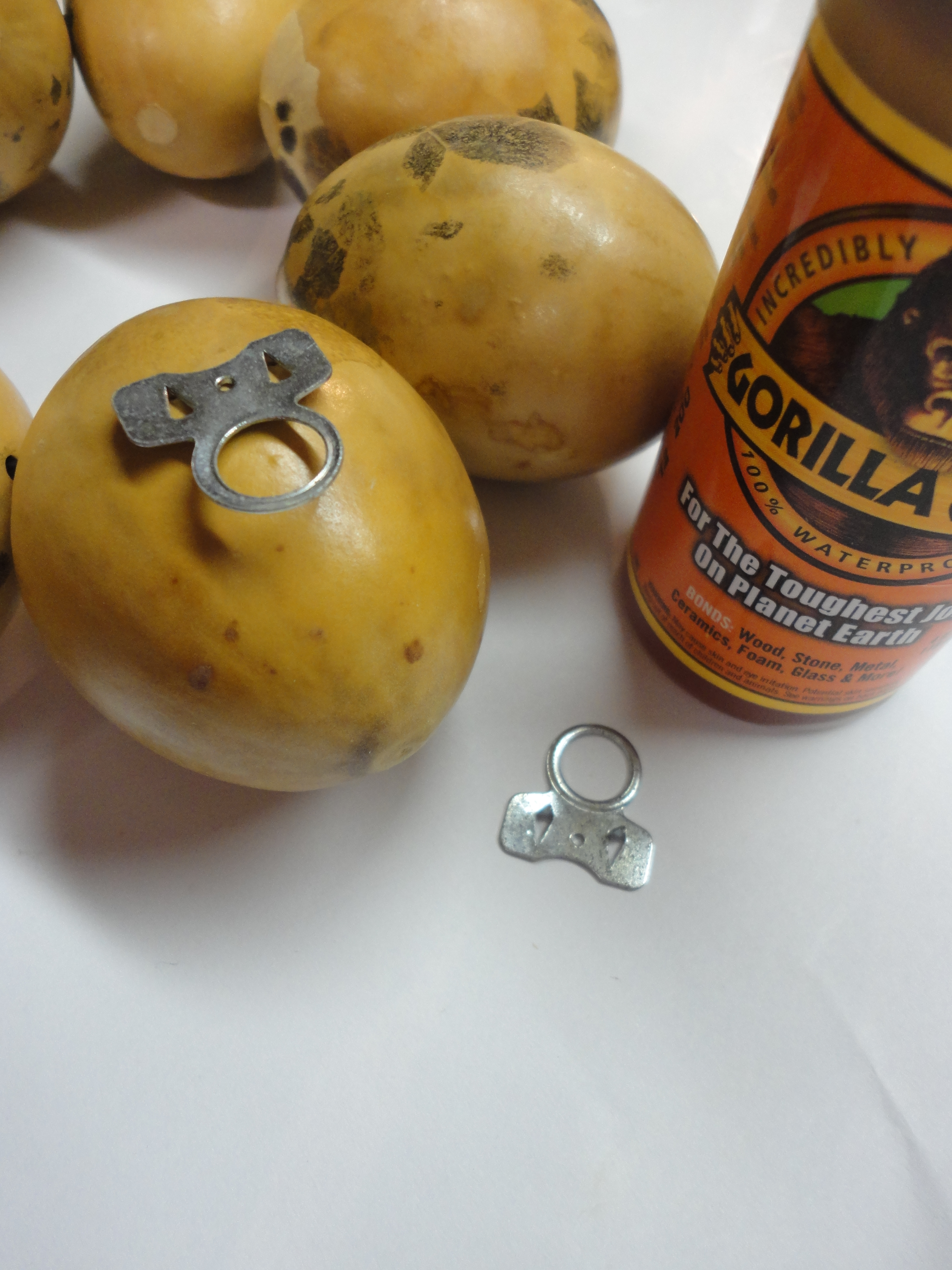
String gourds on to the wire.  Cut off excess wire and twist ends together.  Turn over, face down, and attach a push-in hanger with Gorilla Glue.  Let dry.

DSC07887 DSC07934 DSC07940

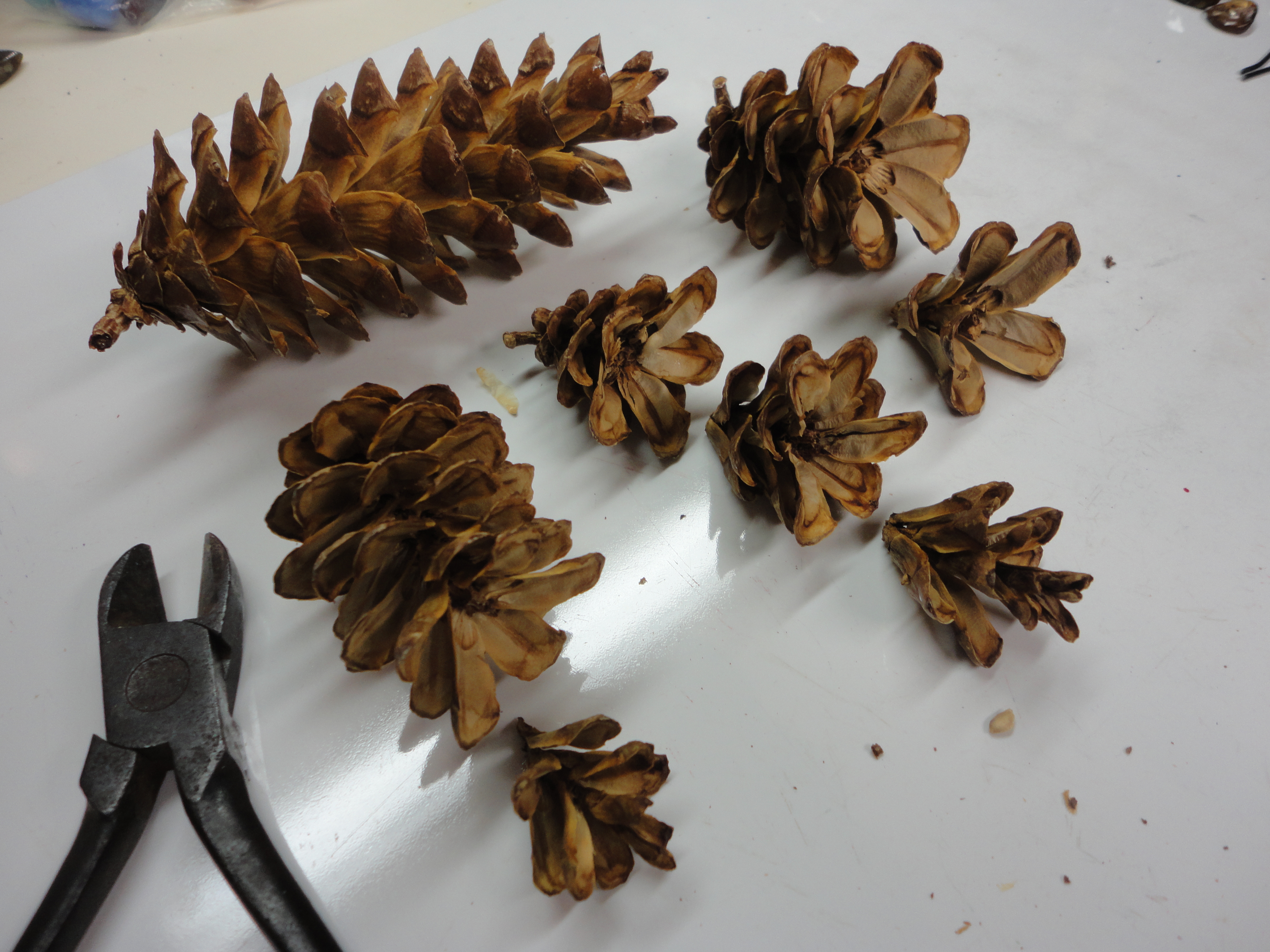
With side-cutters, cut a few long, bleached pinecones, to form flowers.  Spray pinecone pieces and False Baptisia pods with Clear Matte Sealer.  Attach the prettiest pinecone pieces with hot glue.  Embellish with pods.

DSC080508285 watermark

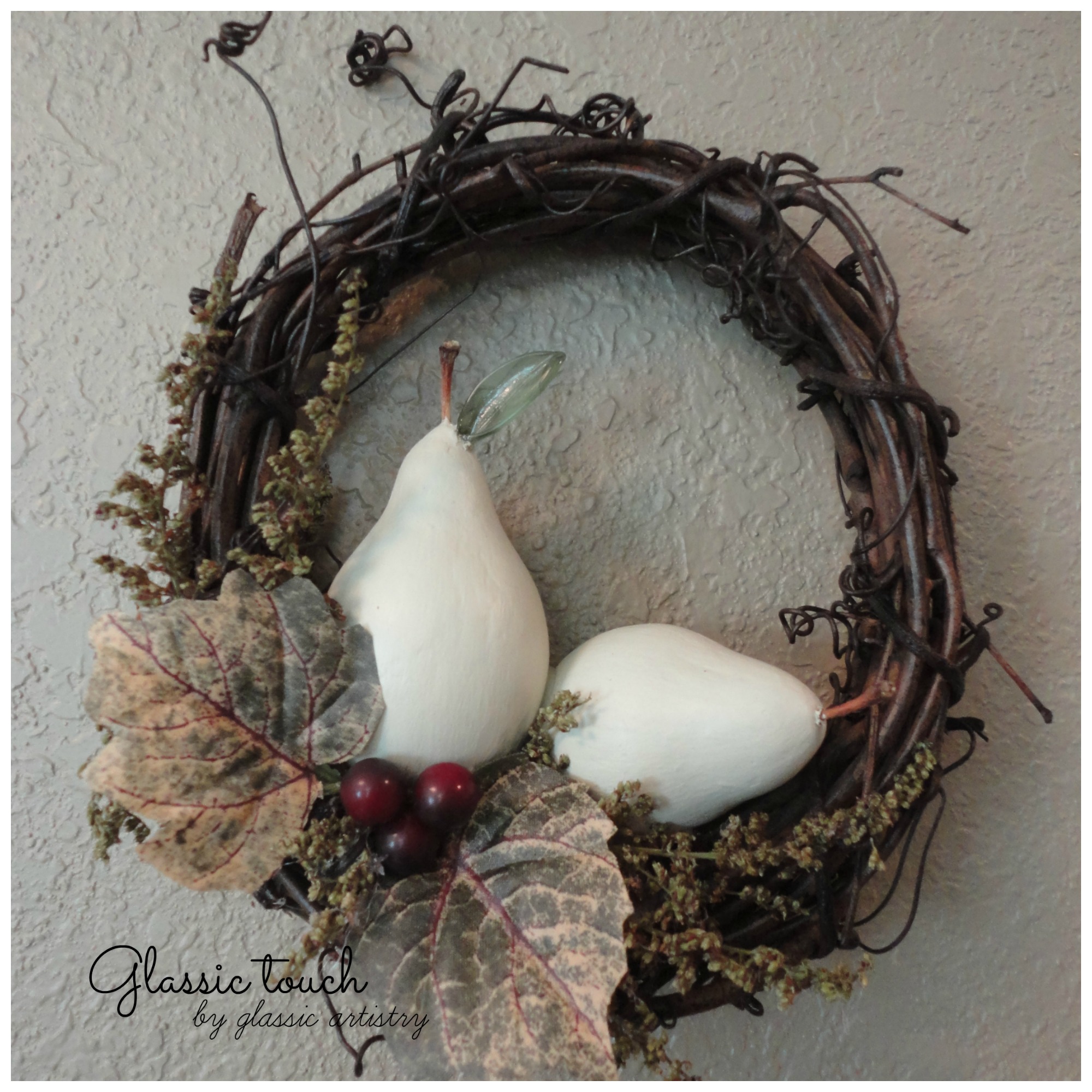
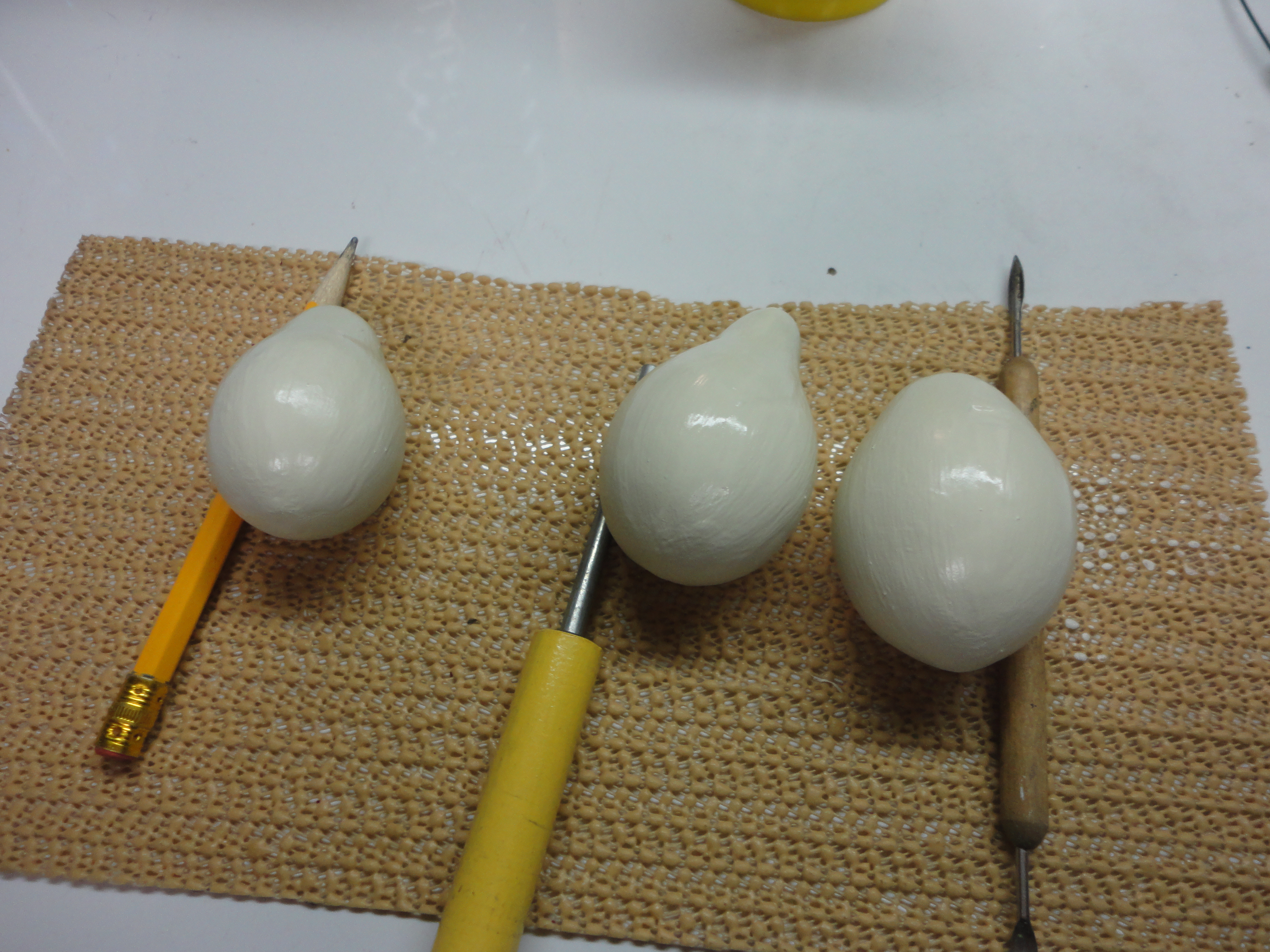
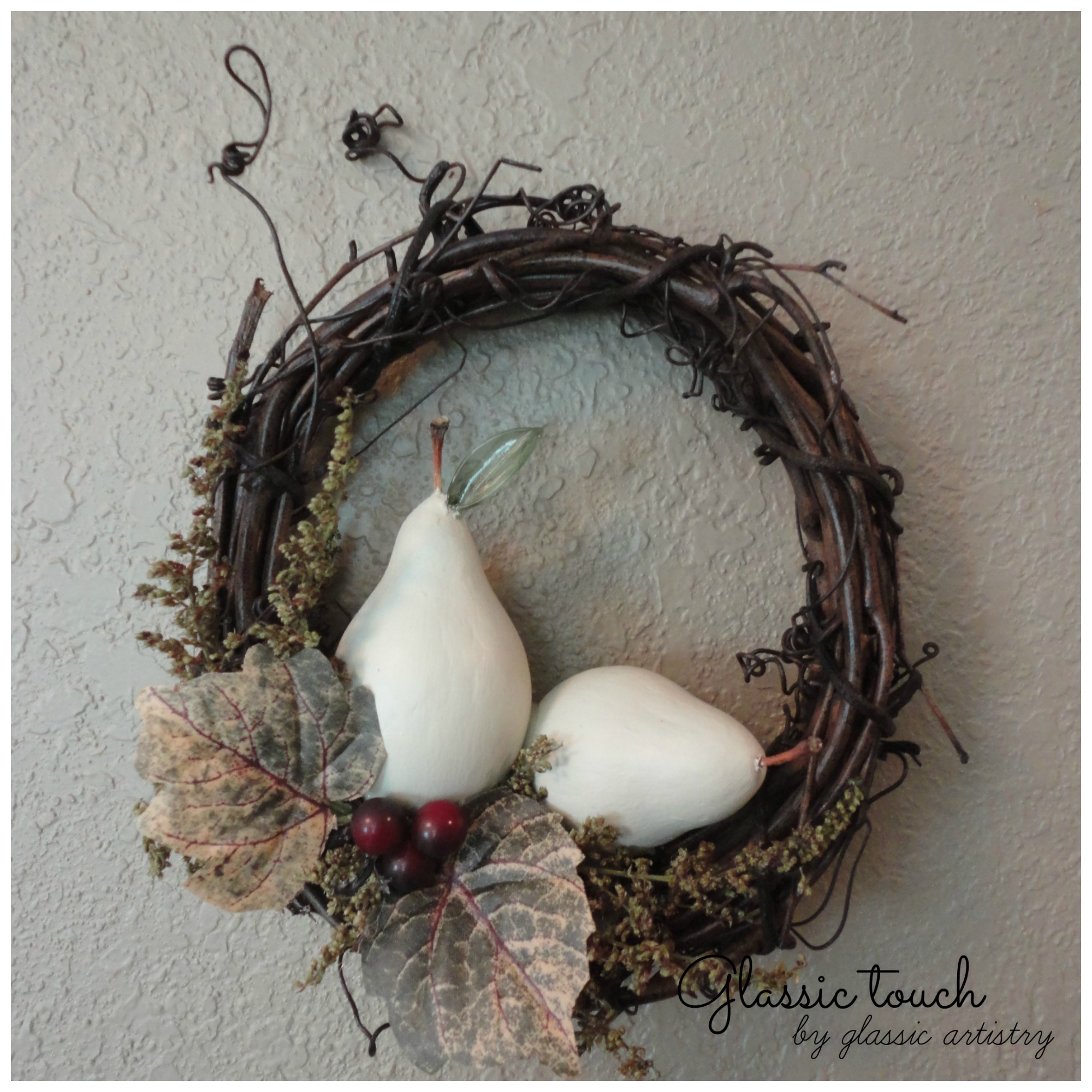
Pear Wreath – I like pears and couldn’t resist when I found smaller egg gourds that resembled their shape.  Always remember to soak and scrub the gourds.

I mixed a small amount of white and green wall paints for the palest of green color.  For a special touch, I used a small slender glass leaf I had, but, you could trim down an artificial leaf, or use no leaf.

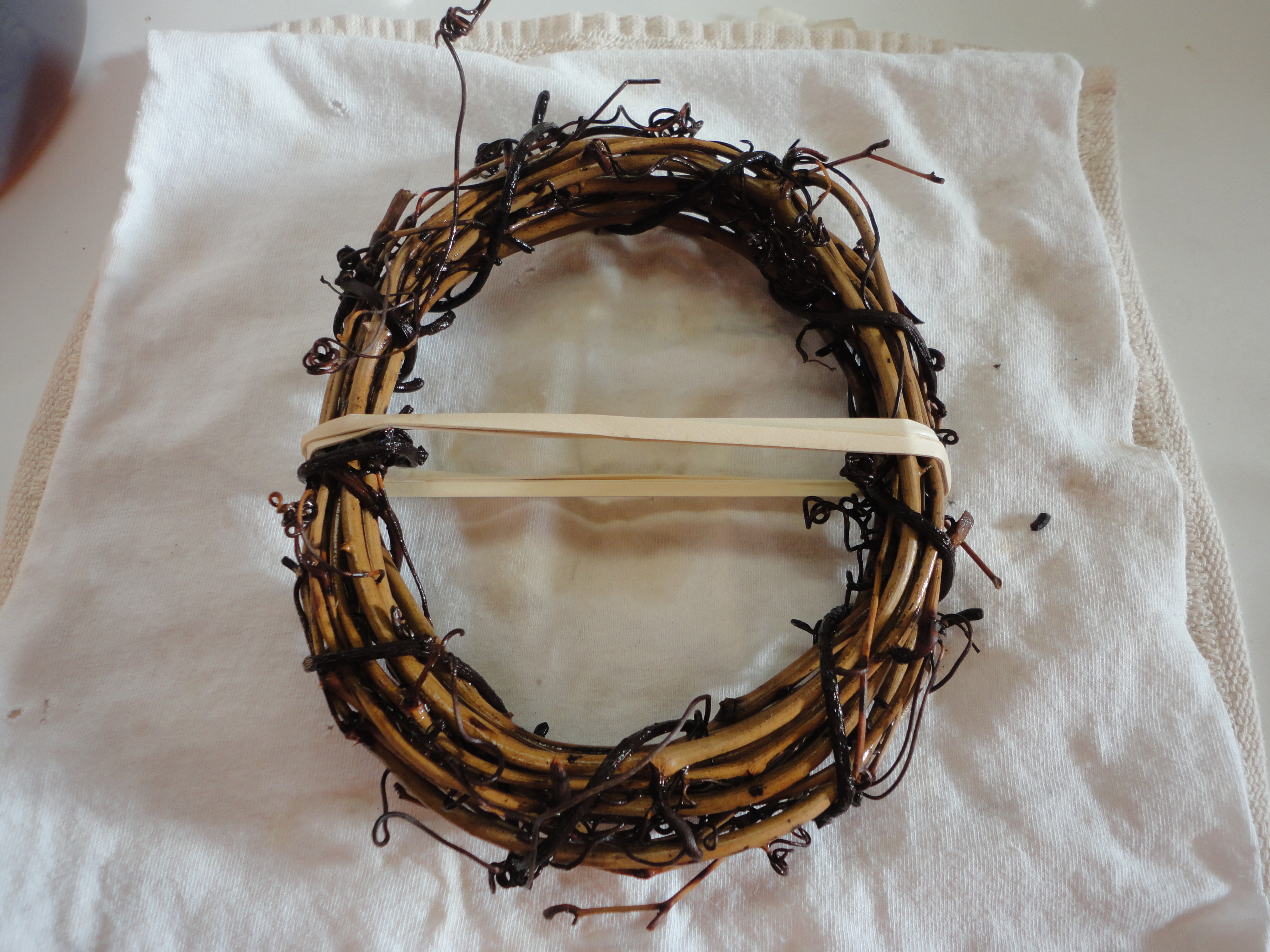
After soaking a 6″ grapevine wreath overnight, slide two thick rubber bands around it’s center to form a more oval shape.  Let dry 24 hours. While the wreath dries, give the gourds 2 or 3 coats of paint, one side at a time, and sanding lightly between coats.  Be careful, they like to roll!

DSC07924 DSC08004

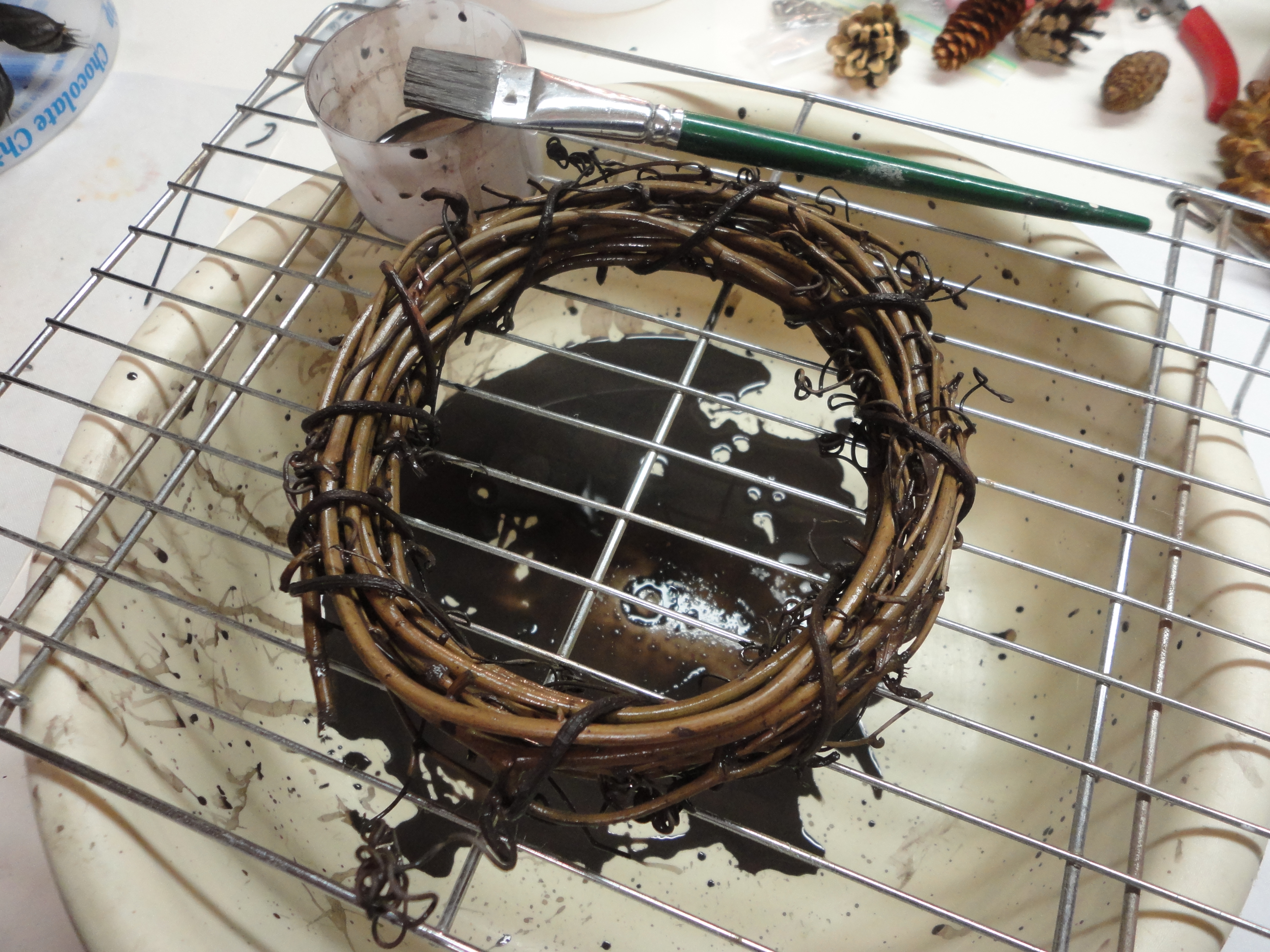
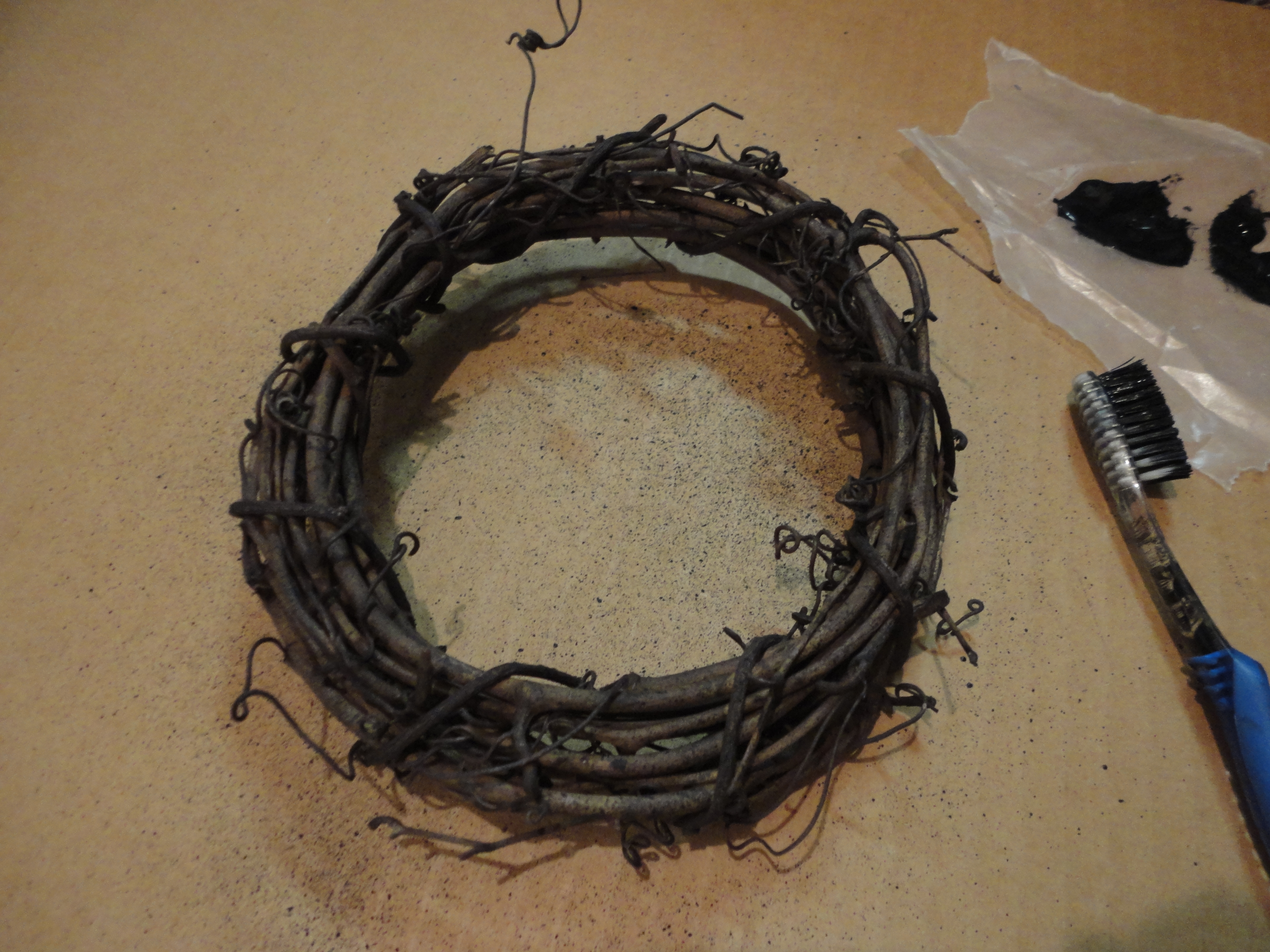
Cut the rubber bands from the dry wreath and lay it on a wire rack, over a bowl.  Water down a small amount of dark brown craft paint and lightly brush it over the wreath.  Let dry.  Speckle the wreath, lightly, with black craft paint.  Let dry and seal with Clear Matt Spray.

DSC07969 DSC08163

Using a Dremel, I drilled a small hole to accommodate the base of my leaf, and glued it in with a small dot of hot glue. Spackling was used to fill in around the leaf.  Once dry, it was sanded smooth and repainted.  Small indentations were drilled in the top of the gourds to hot glue apple stems in place.  Touch up paint around the stems.

After gluing the pears on the wreath, two leaves and some berries, saved from past projects, were added.  The pretty green, dried Astilbe, tucked in and around, was cut from the bush outside my backdoor.

8237 watermark

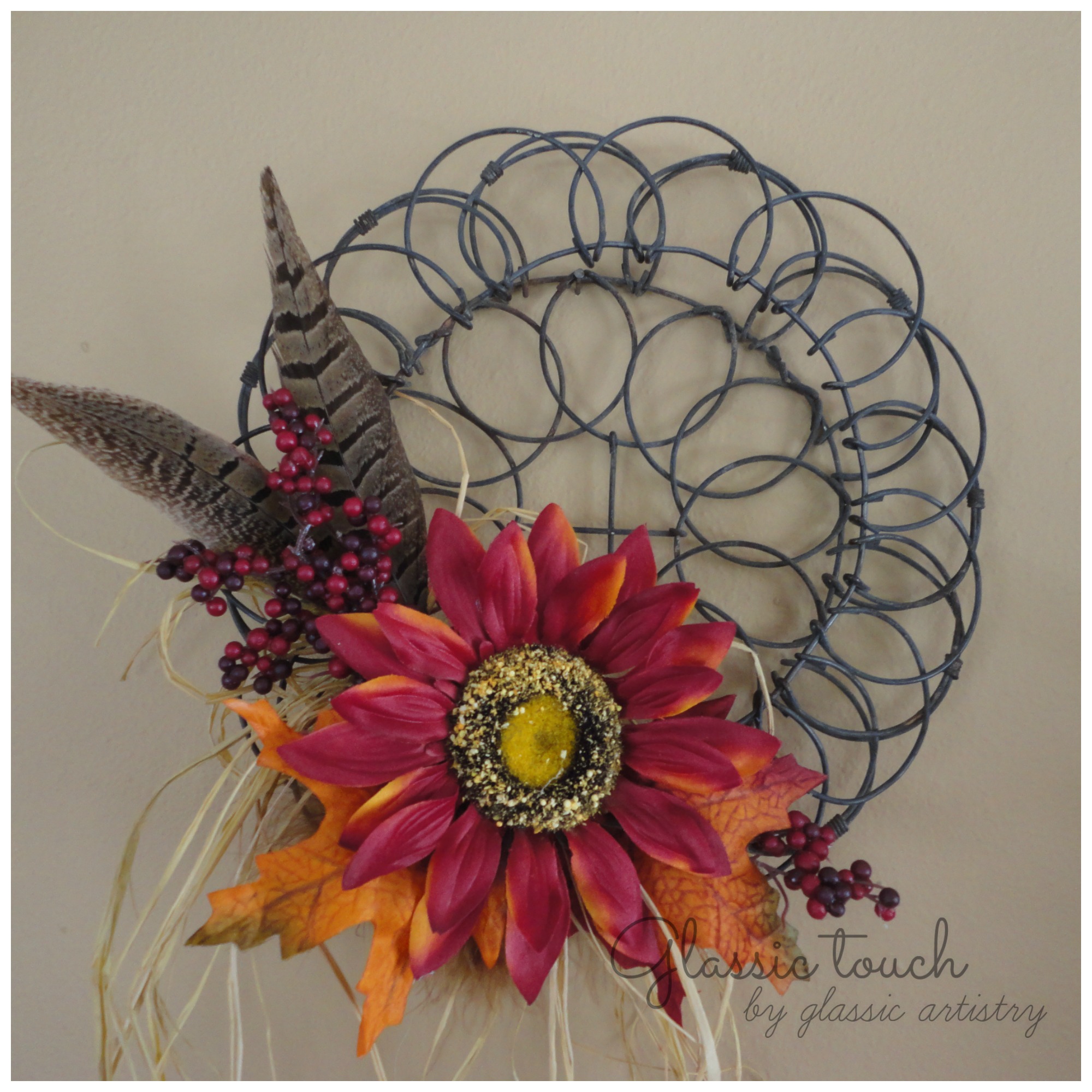
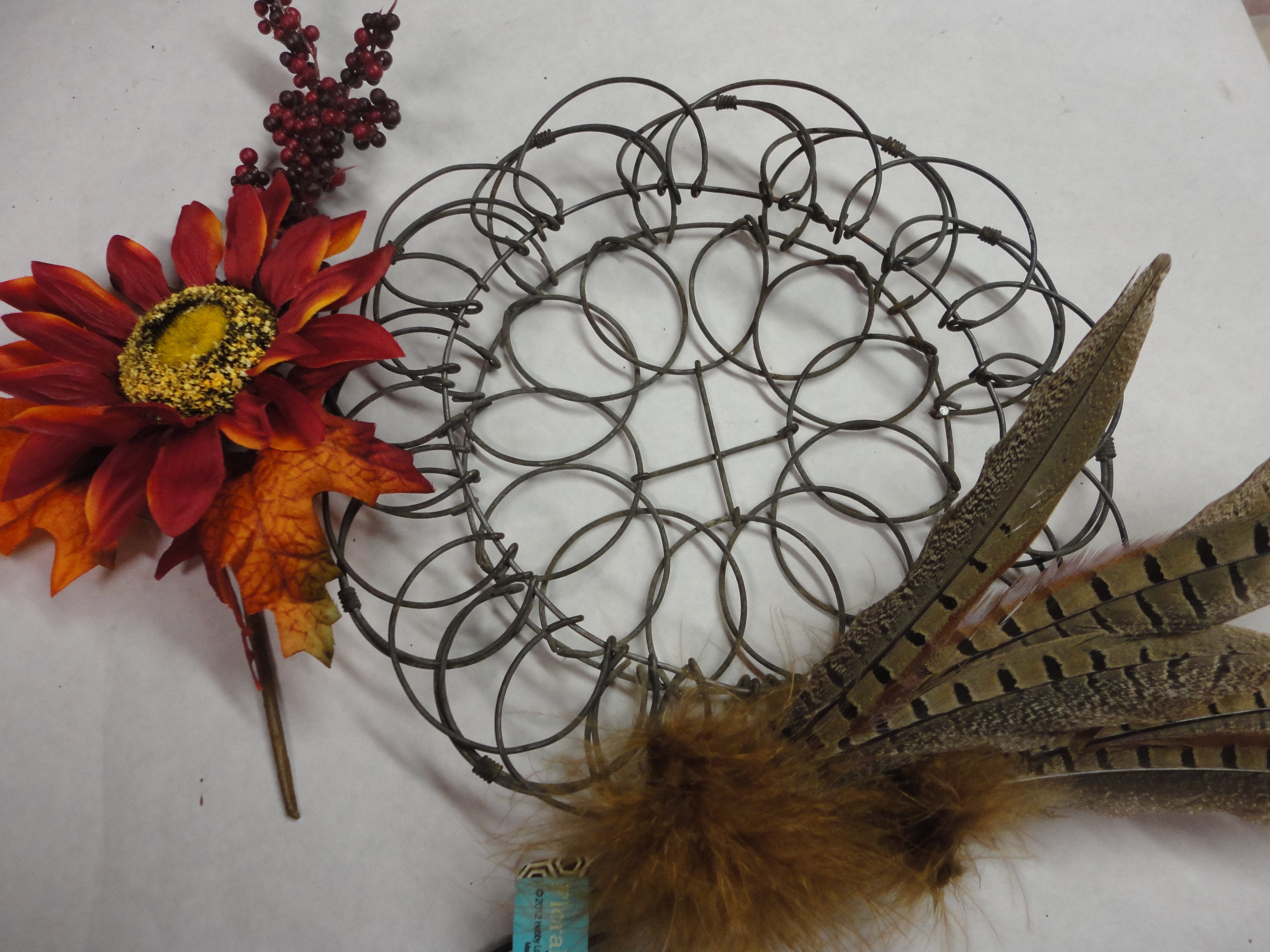
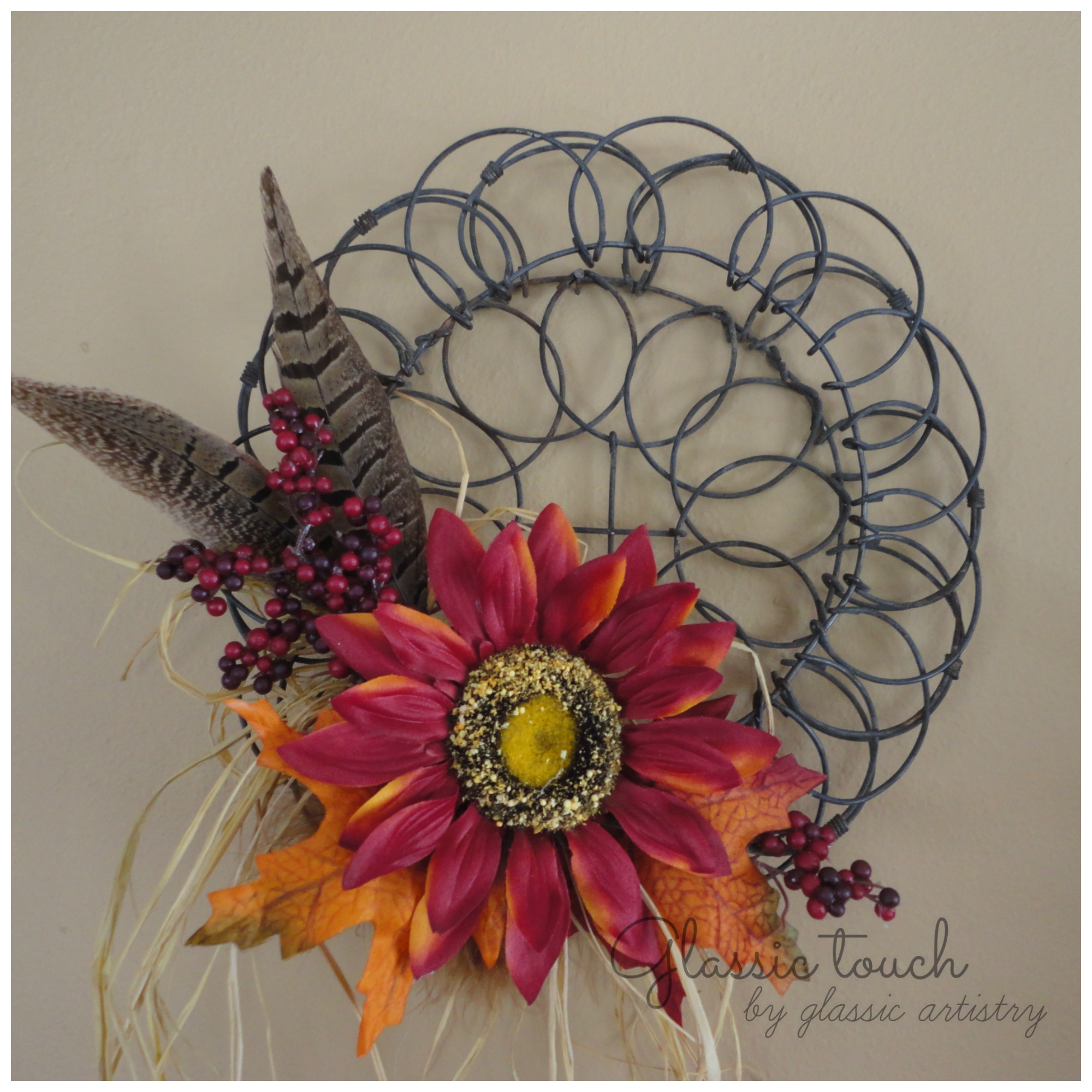
Egg Basket Wreath – I have a thing for collapsible wire egg baskets, they’re cute!  And, so easy to decorate!  I found a flower sprig and feather sprigs for 50% off last month … a total of $3.00, YEAH!  I cut and reconfigured my flower sprig a little, but you needn’t.  Simply arrange your sprigs the way you like them, cutting off the long stems if needed, and add a raffia bow for a quick colorful wreath!

DSC08155 8204 watermark


A New Concrete Boot Scraper

It was a few wet days, last month, that spurred an unexpected project. After admiring many creative and inspiring concrete/hypertufa boards on Pinterest, I was so dreaming of designing garden pathways and stones, as my first concrete endeavors, but instead… it was a boot scraper.

DSC07822

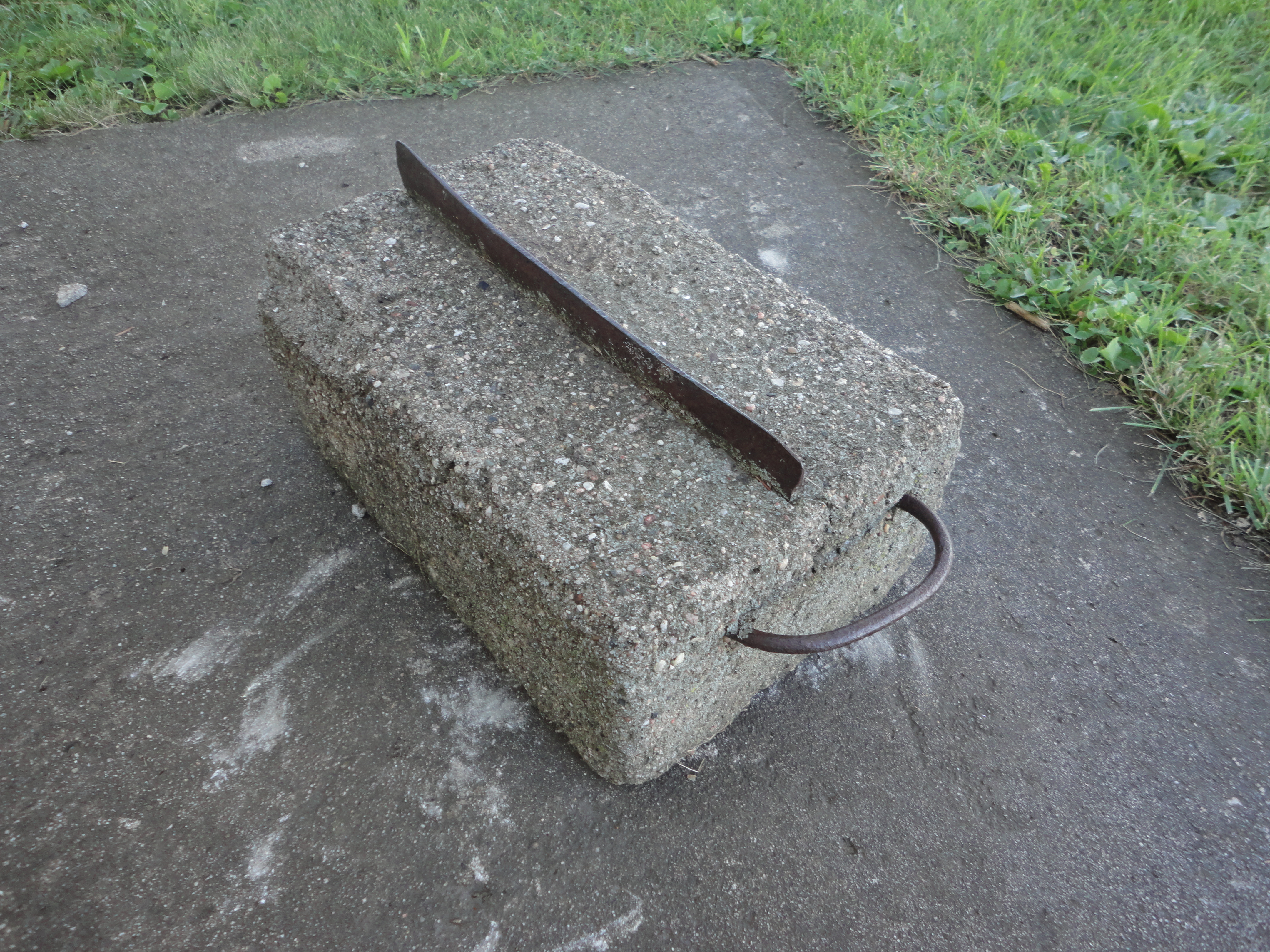
Our old boot scraper was already settled comfortably by the back door when we moved to the family farm over 25 years ago.

DSC07611

It found it’s way here in a load of salvage long before our arrival.  It has scraped many boots and shoes, propped boards to be painted, secured papers, and dog leashes.  No one ever gave it much thought until we were trying to wipe mud from our shoes, in wet grass, before entering on the other side of the house. That’s when I said, “We should make one of those mud scrapers for over here.”  My husband replied, “Wouldn’t take much, just a box of concrete and a piece of steel.”  It took me a minute to absorb…. “Hey!  I think I got something we can use!”

I’ve always had a tendency to save pieces and scraps when remodeling or updating, like the wainscoting used to build our bird feeder, in my previous post.  I find it fun to integrate the old with the new.  It’s like letting something catch it’s breath to start a whole new story.

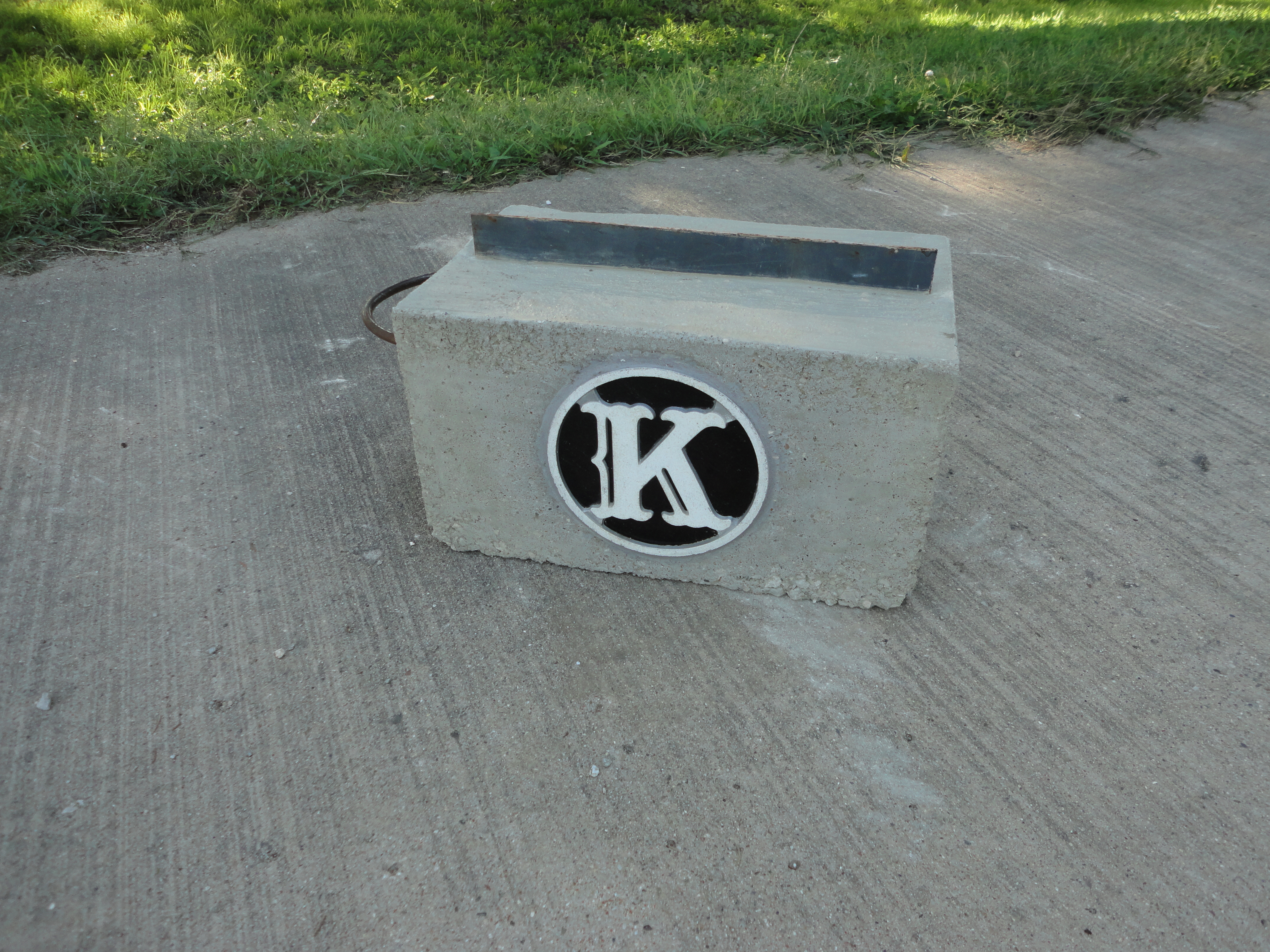
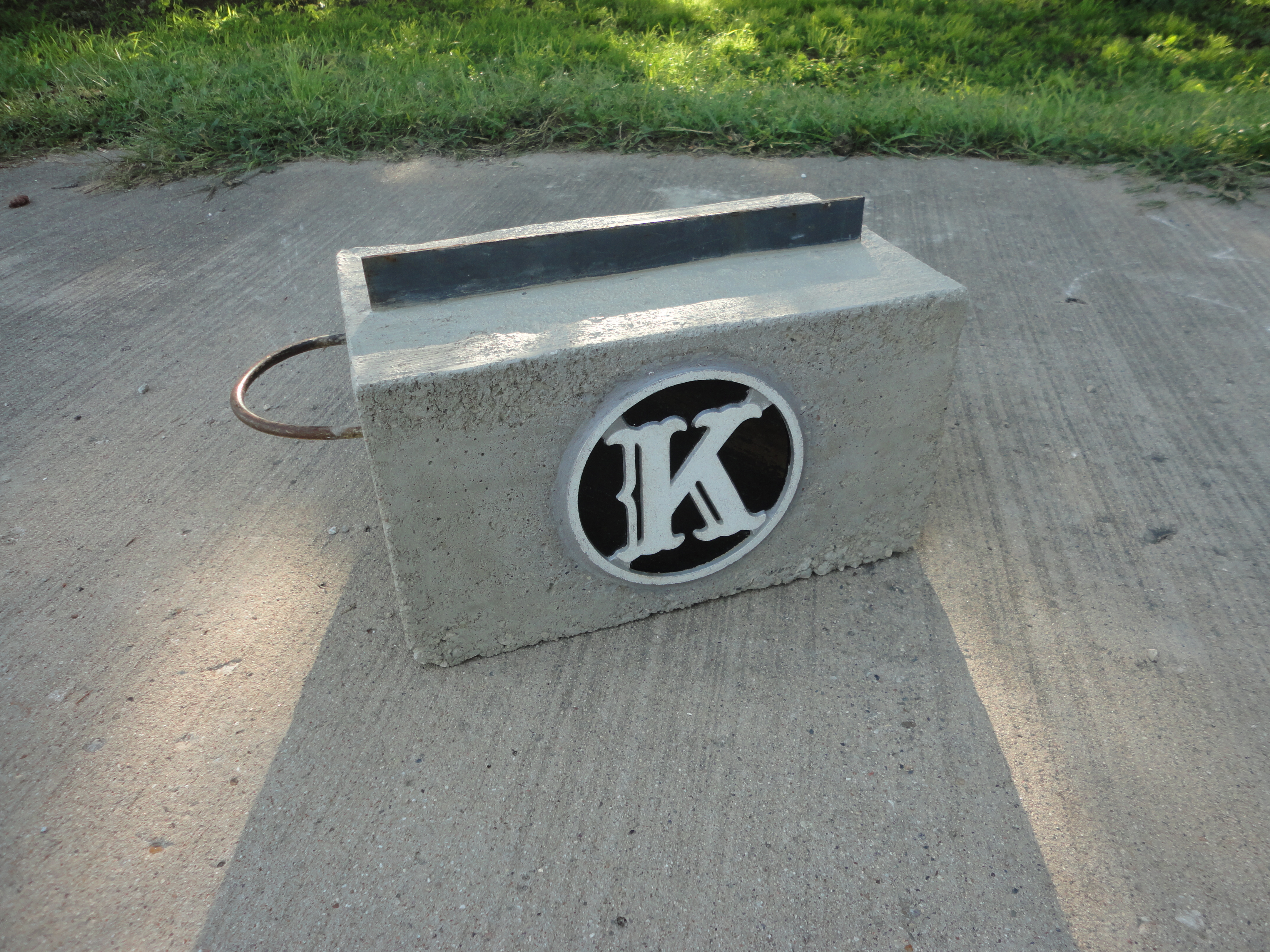
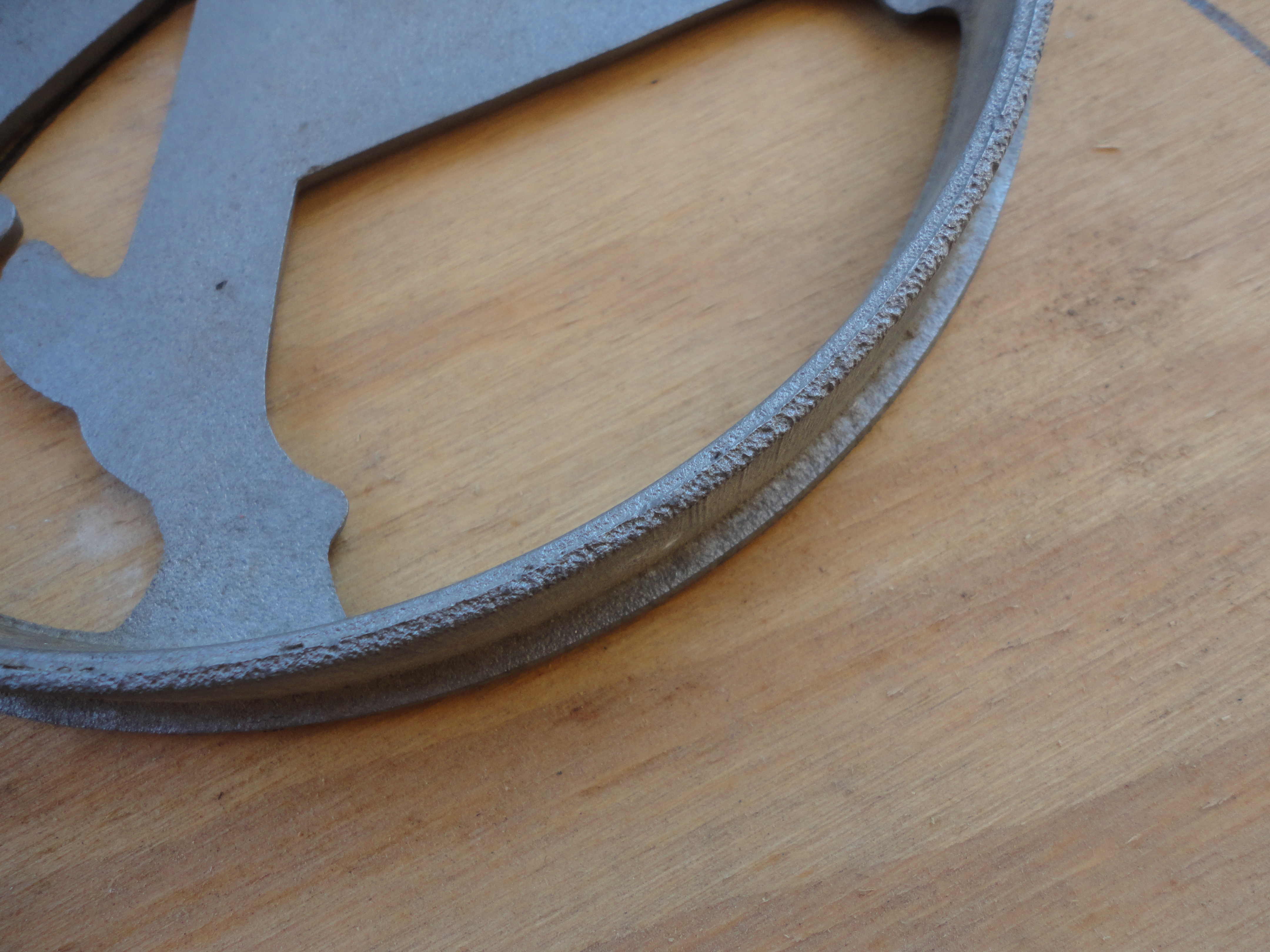
A cast aluminum “K”, from one of the first doors we replaced, has rested on a nail in my garage for a very long time.  I’ve often looked at it as I pulled in, and thought, “I’m gonna find a good place for you someday.” That day finally came … it was the perfect “glassic touch”.

DSC07809

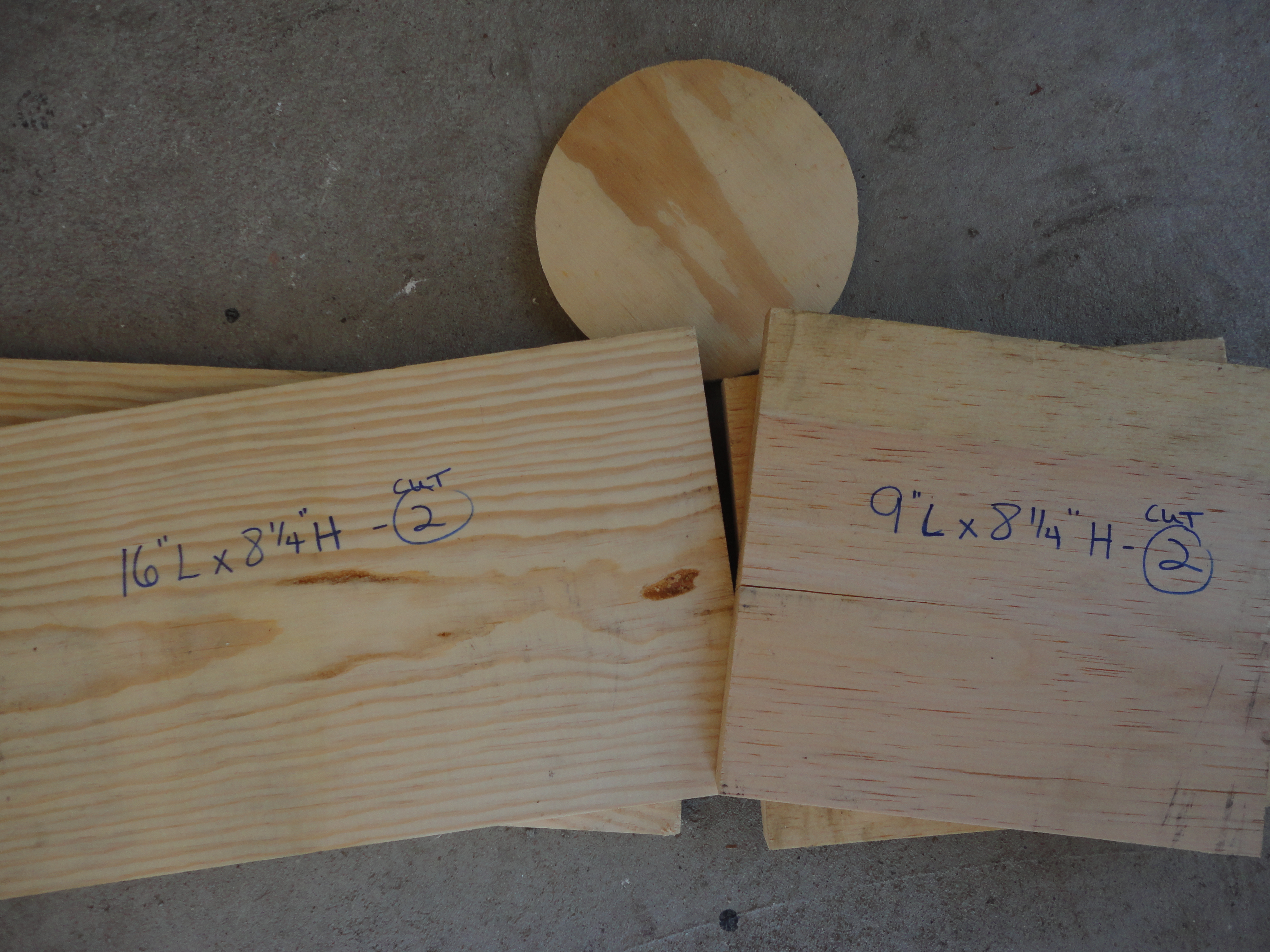
We began by tracing the inside rim of the aluminum piece on 1/2″ plywood, and cut it out with a band saw.

DSC07484DSC07477

Box sides were cut from 1″x10″ pine boards, mindful that the wood grain ran horizontally on the end that the handle would be inserted in, so it can easily be split off later.

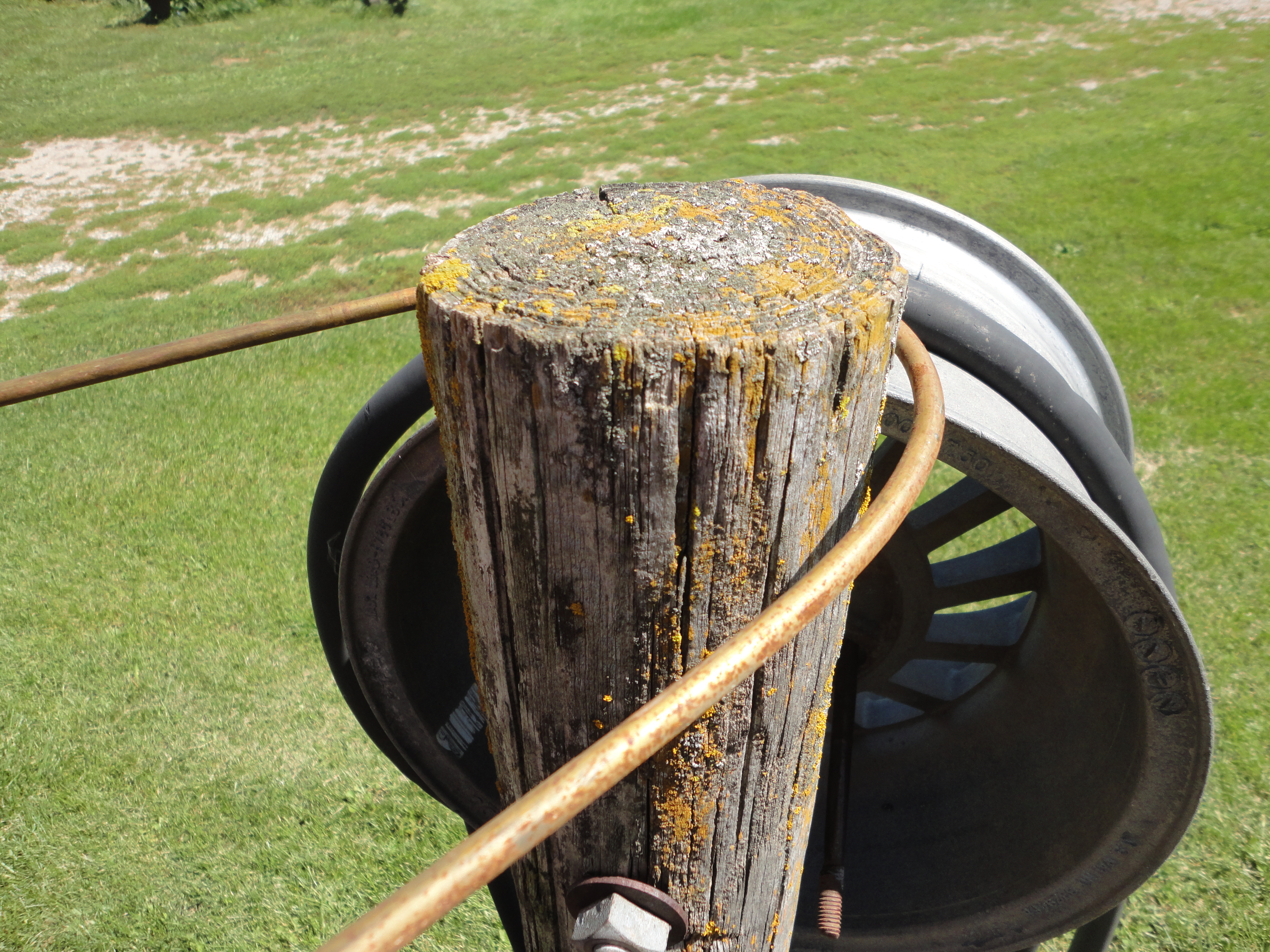
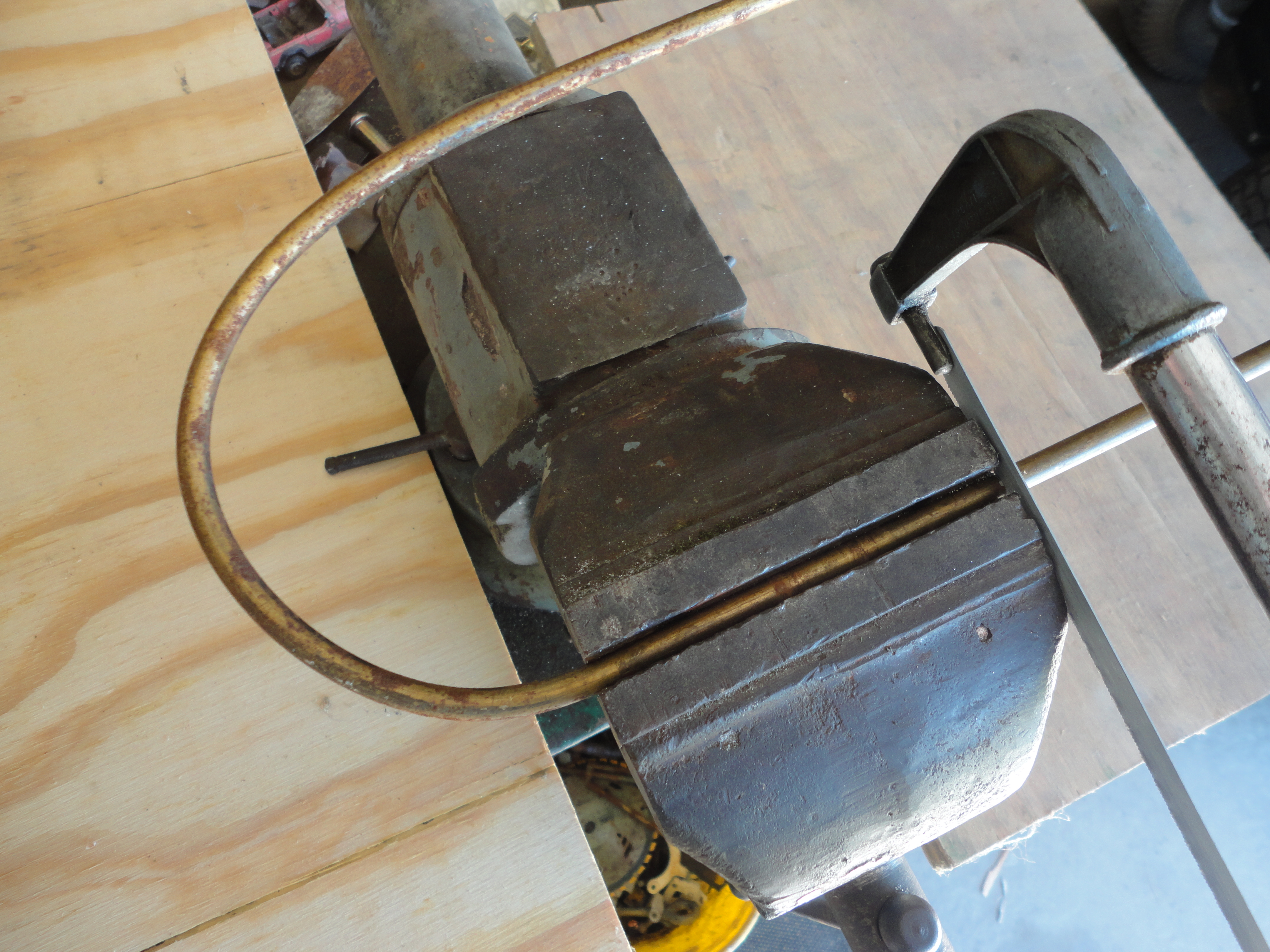
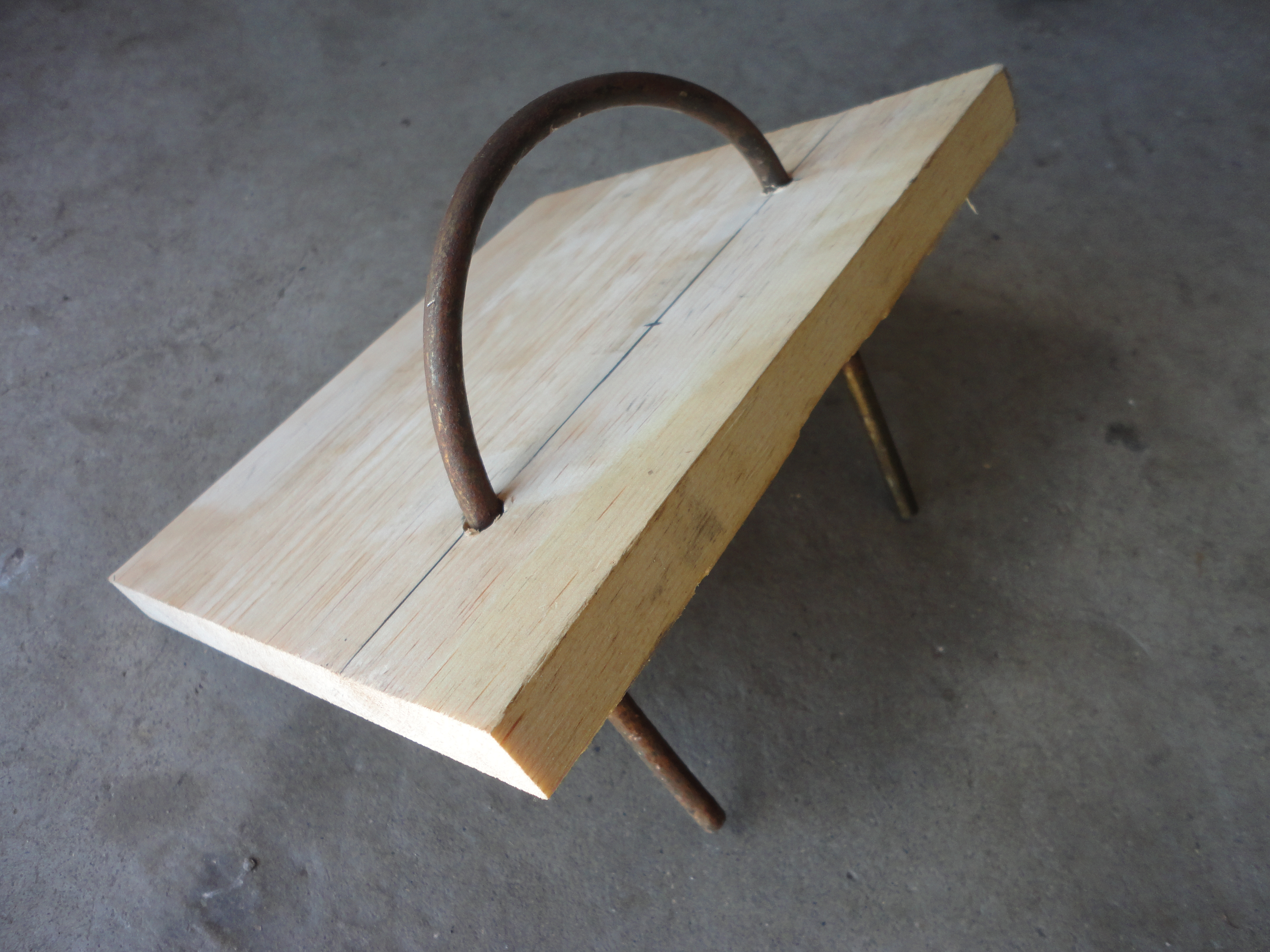
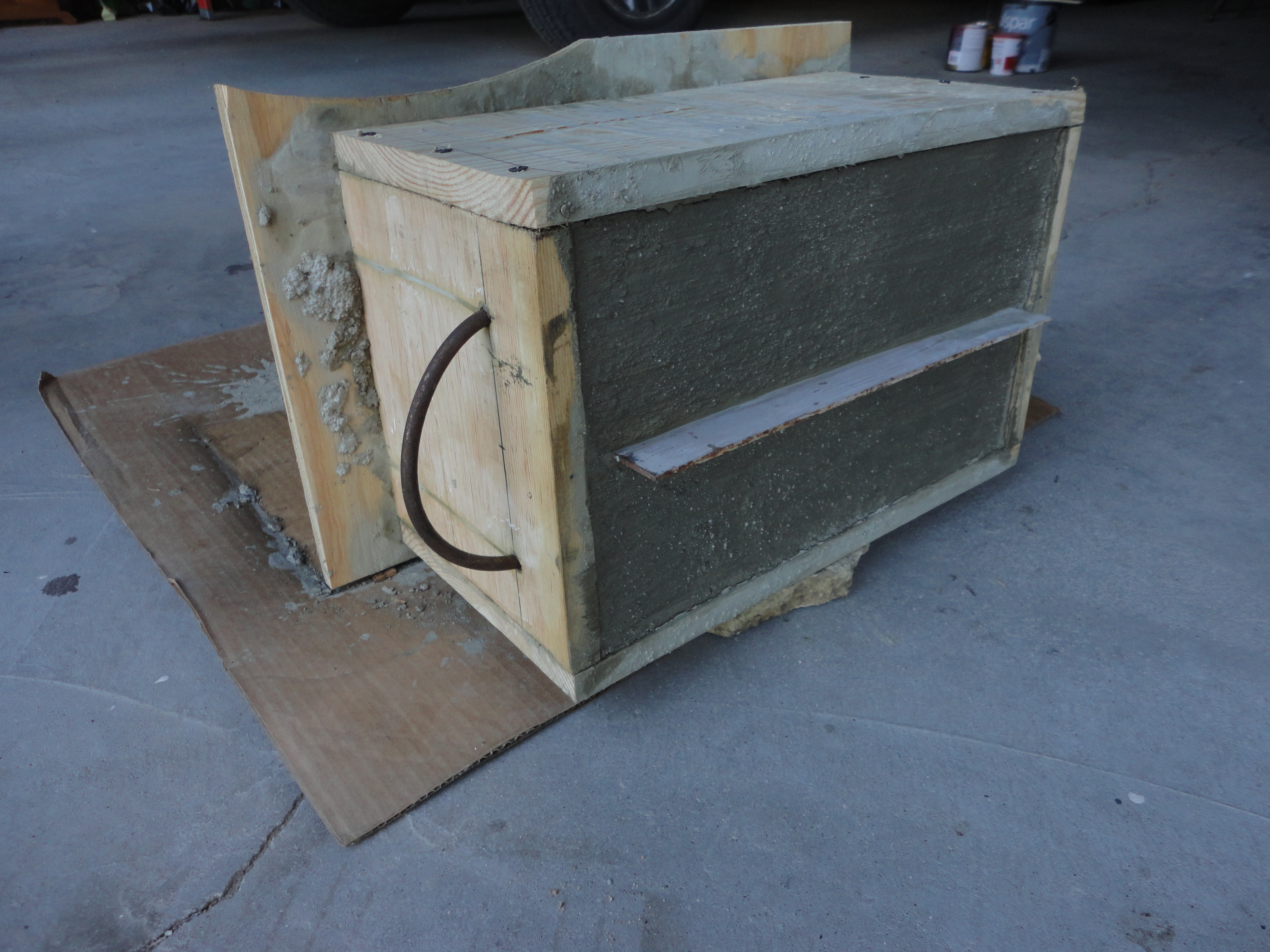
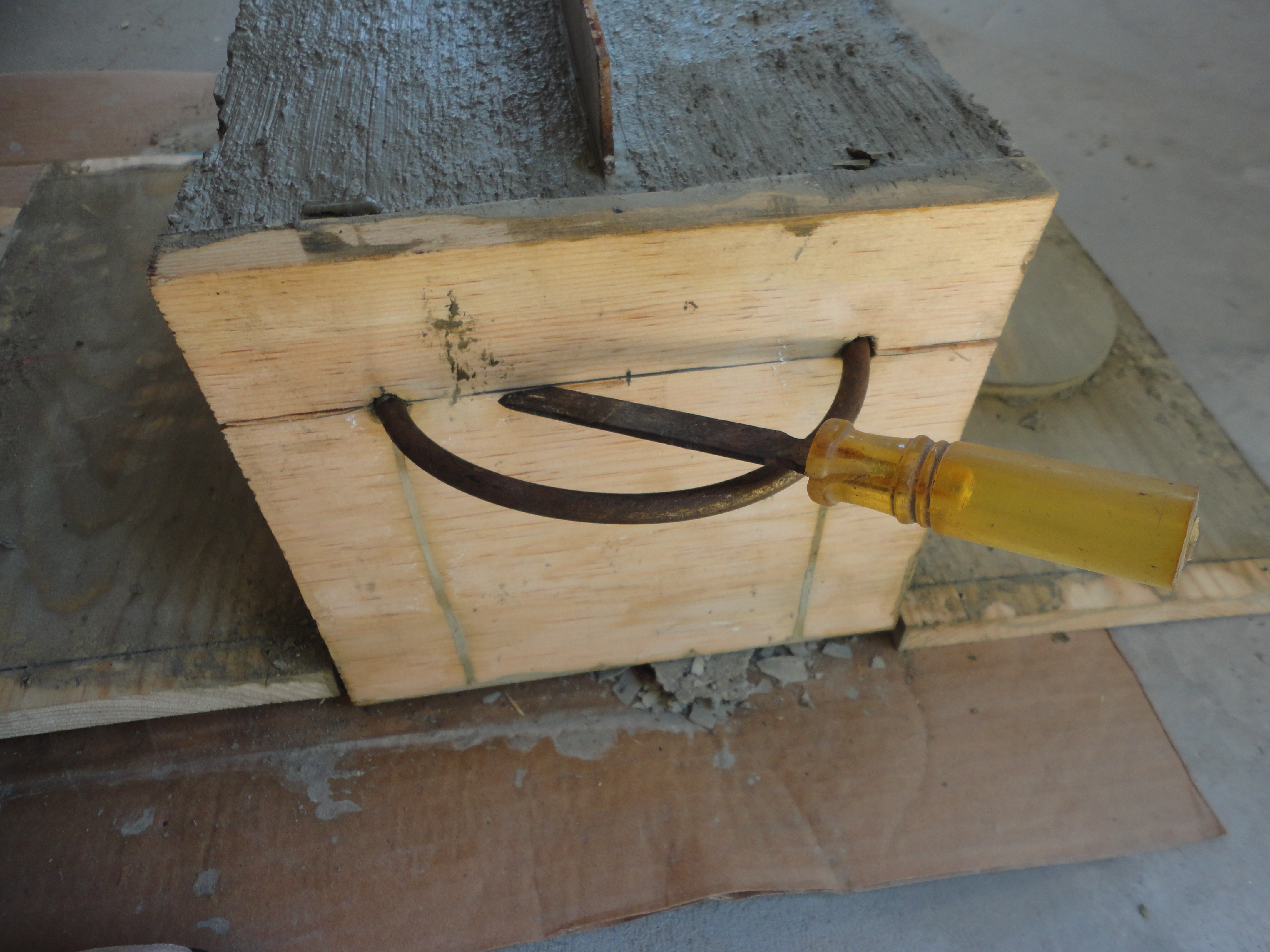
A length of 1/4″ steel rod was bent around a 5″ dia. pole, then put in a vice to trim off the ends with a hack saw. Once handle is shaped, mark the wood for placement and predrill holes. Make sure it slides in easily and fits snugly.DSC07531DSC07533DSC07540DSC07545

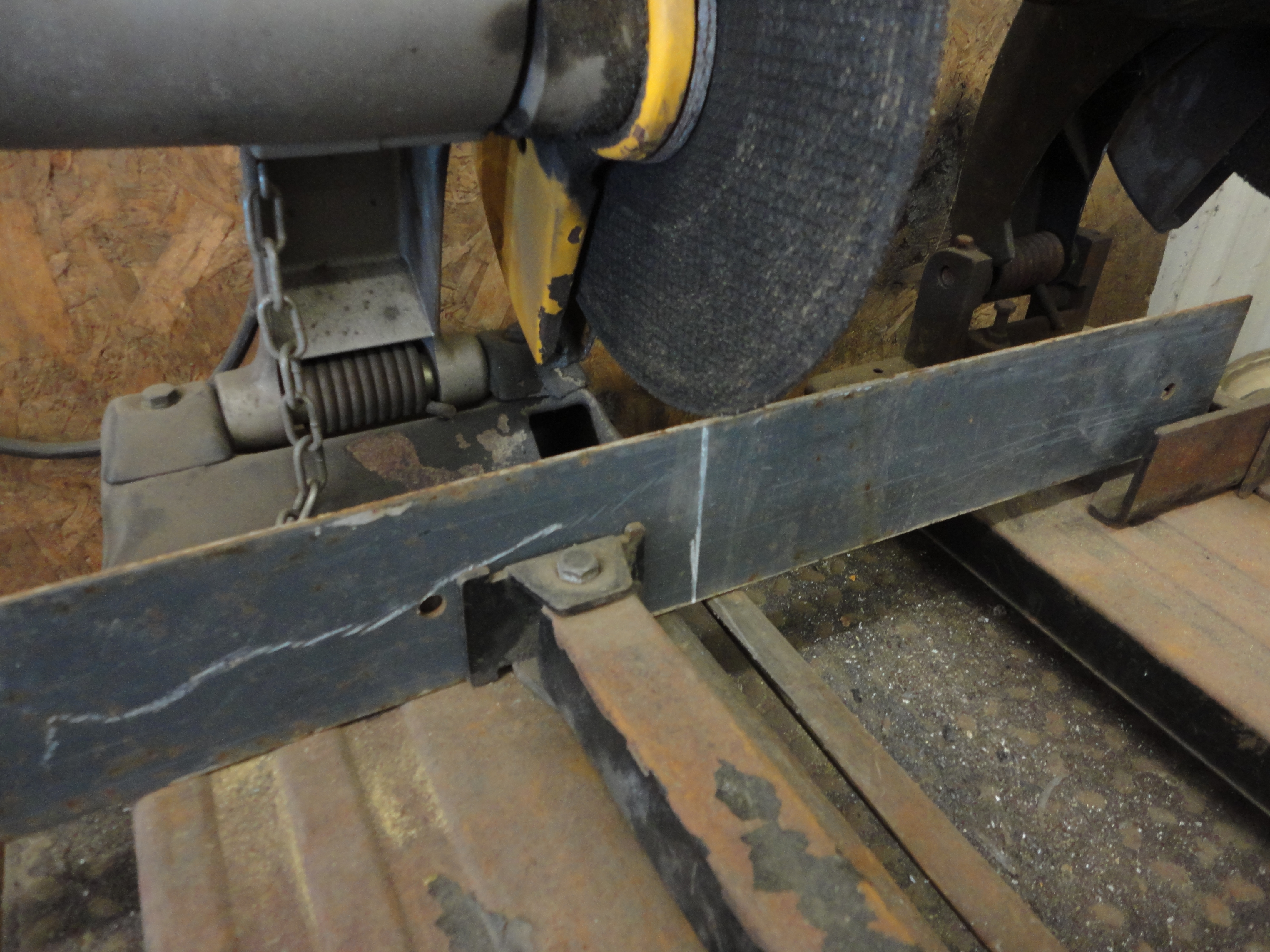
With a chop saw, or hack saw, cut a scrap piece of 1/8″ thick steel.  Ours was 3″ wide and approximately 13″ long.

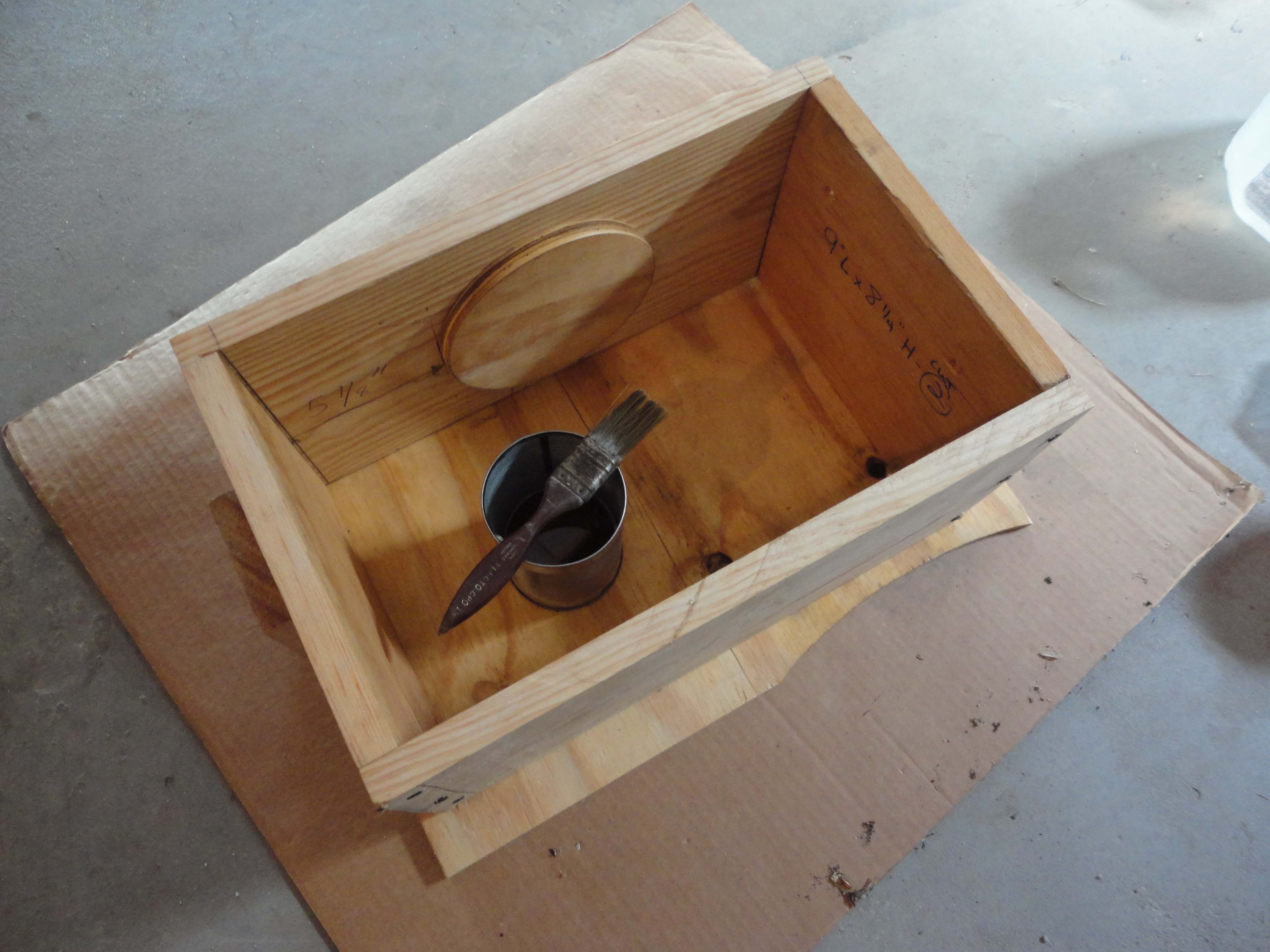
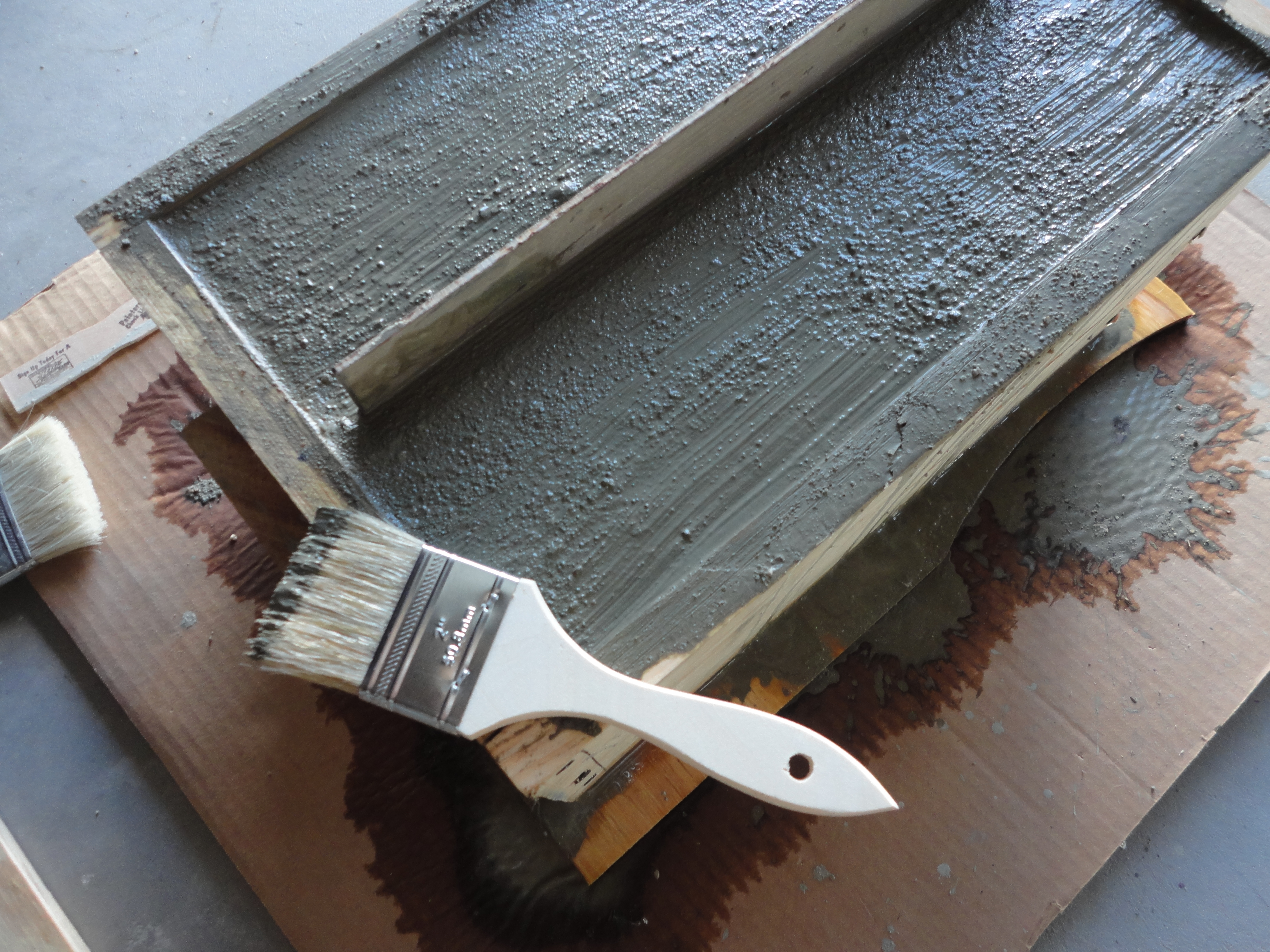
Center and attach the circle of plywood to the inside front piece of wood, then screw the box together. Its important to keep the top edges of the box even, so the concrete can be leveled off after its poured.  Attach a piece of scrap plywood to the bottom of the assembled box, and give the inside a coat of diesel fuel to prevent the concrete from sticking.  Putting a large piece of cardboard under the box will catch any leaking concrete, and make it easier to move around, if needed.

DSC07559DSC07659

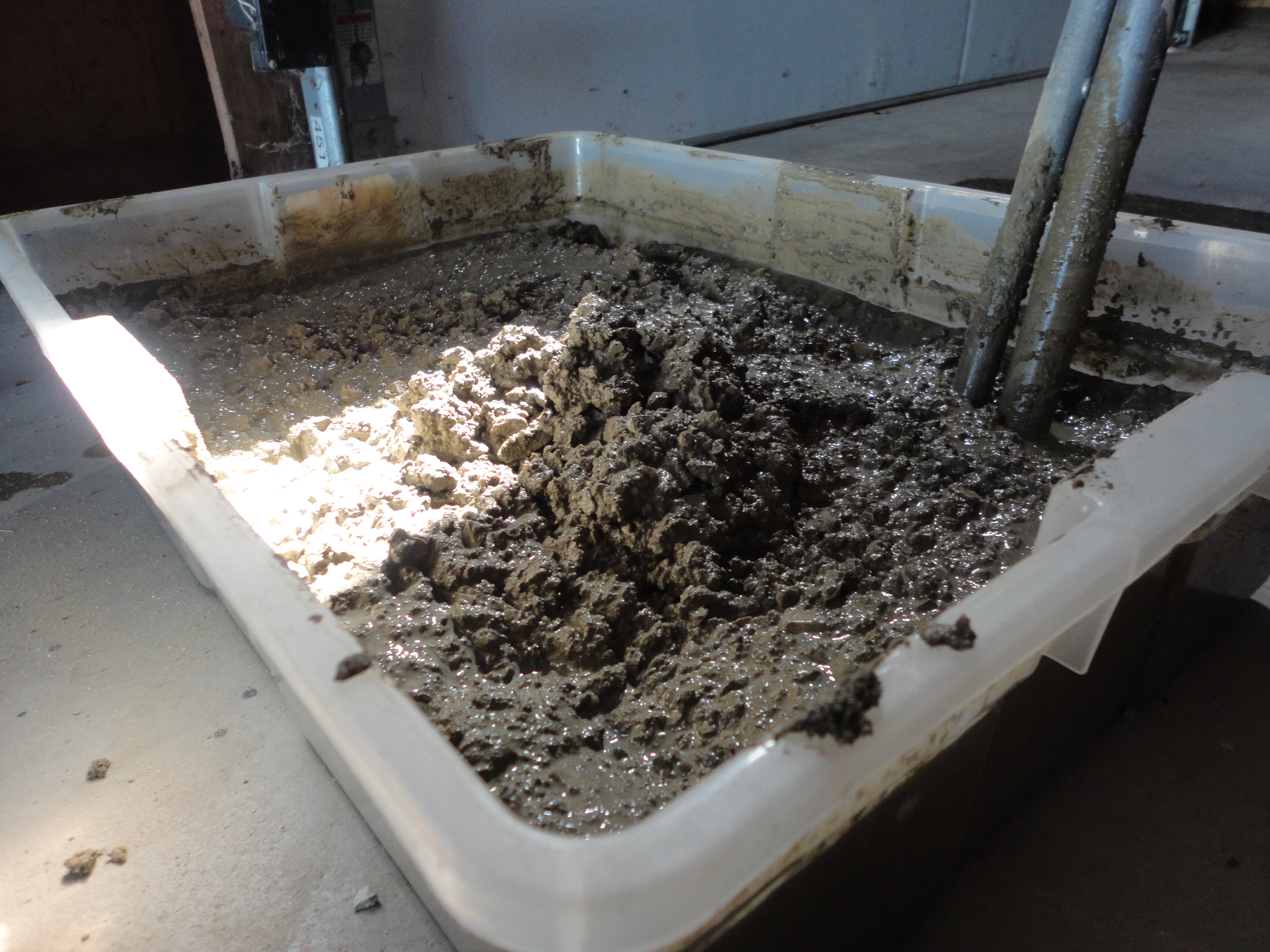
You’ll appreciate an extra pair of hands, and something sturdy to stir with, when mixing up an 80 lb. bag of Quikrete.  We used about 1 1/4 gal. of water and mixed it well.

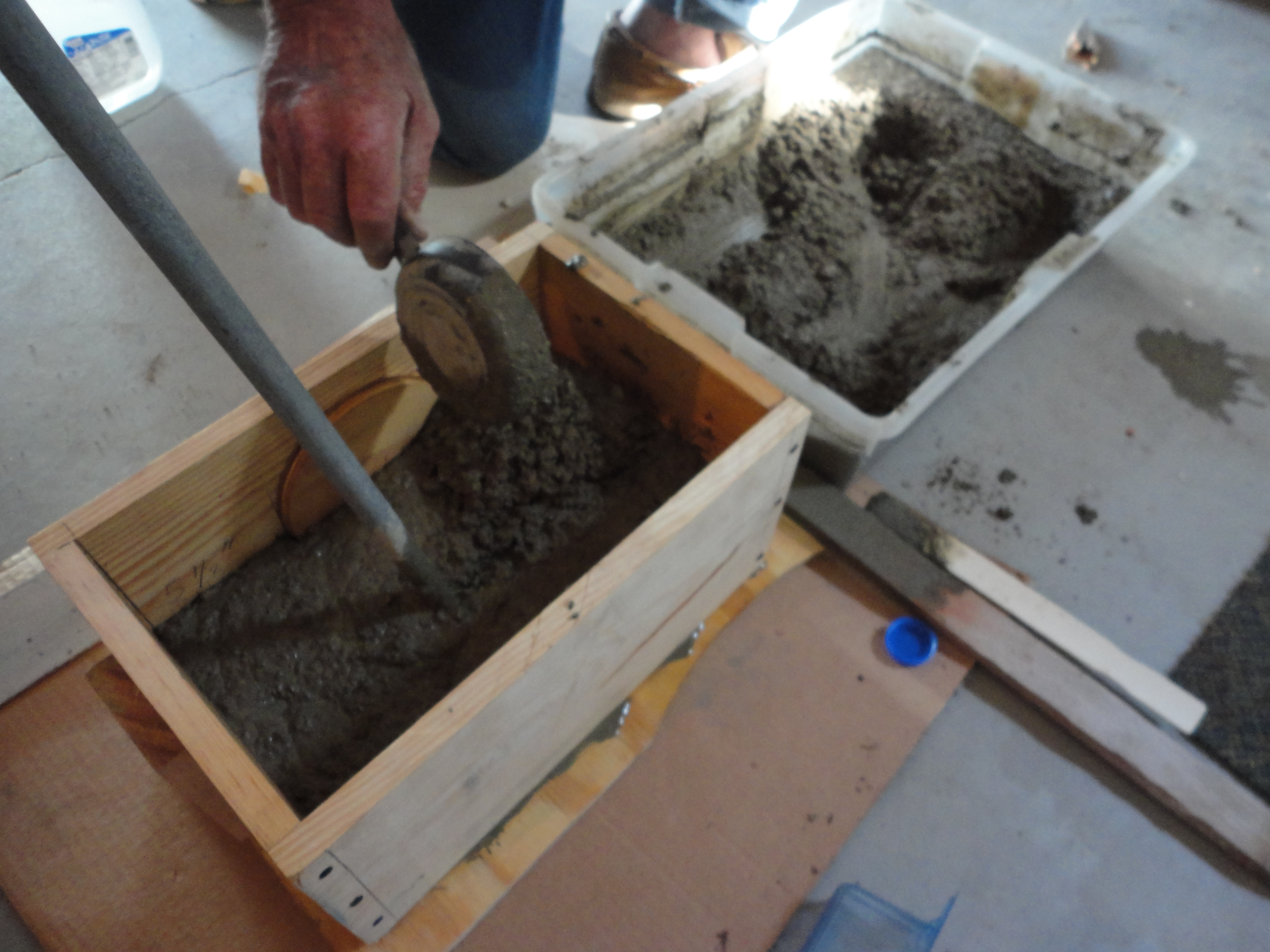
Scoop the concrete in the box.  Use whatever you stirred with, or a paint stick, to tamp and work it down as you fill, especially around the outside edges, to help obtain a smooth finish on the sides when it has dried.

DSC07568DSC07573

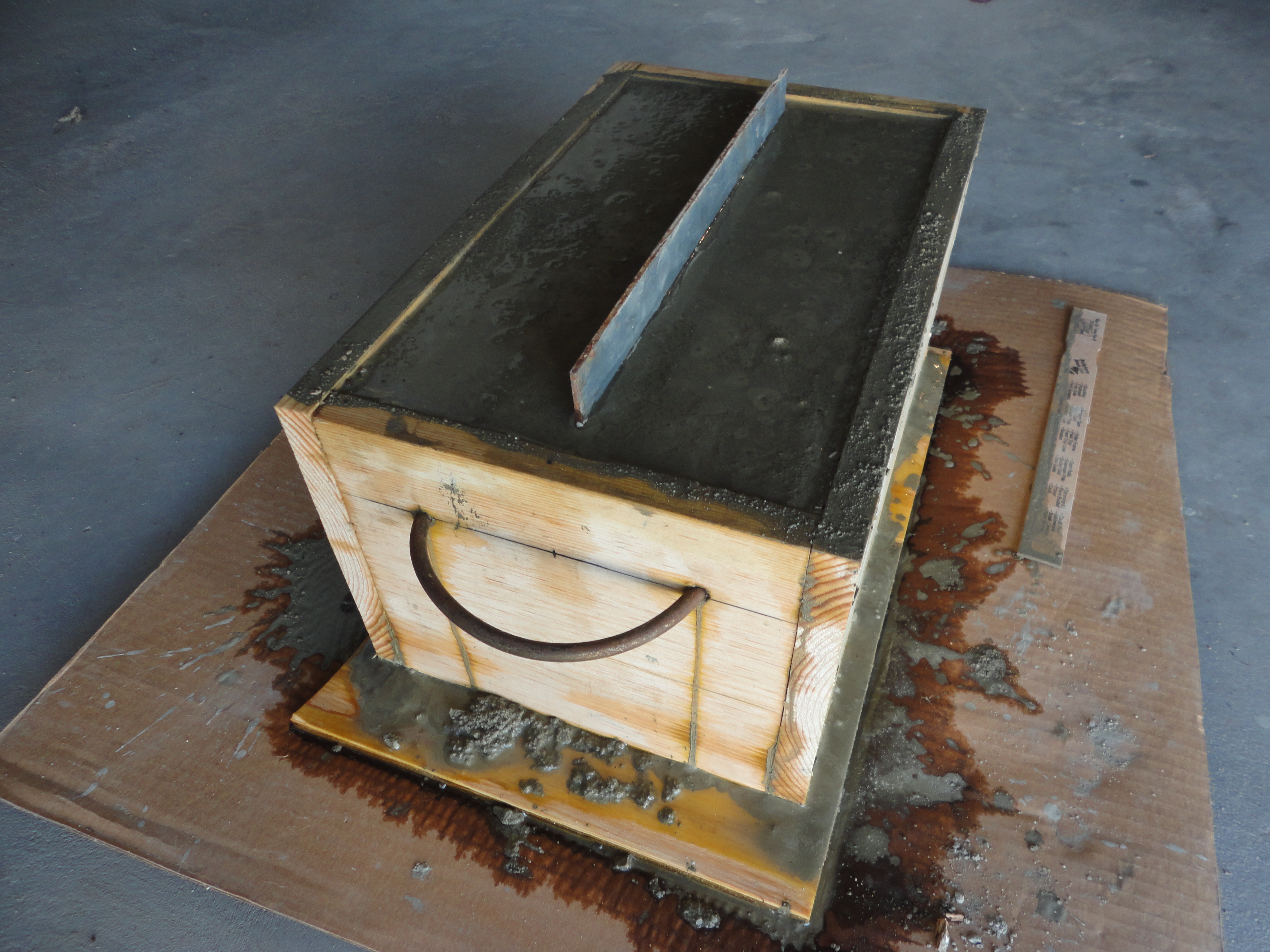
After filling and tamping, slide the edge of a paint stick across the top to level.  Insert the handle into the predrilled holes.

Wait about 20 minutes, level top again with paint stick, and slowly push in the piece of steel, upright.  Let it sit approximately another 30 minutes, then brush the top lightly with a 2″ chip brush. Times will vary depending on how wet the concrete is.DSC07585DSC07590

NOTE: Before mixing concrete, you may want to spray and prepare a few small containers or molds to quickly use up any excess.  Waste Not, Want Not.

DSC07840DSC07617

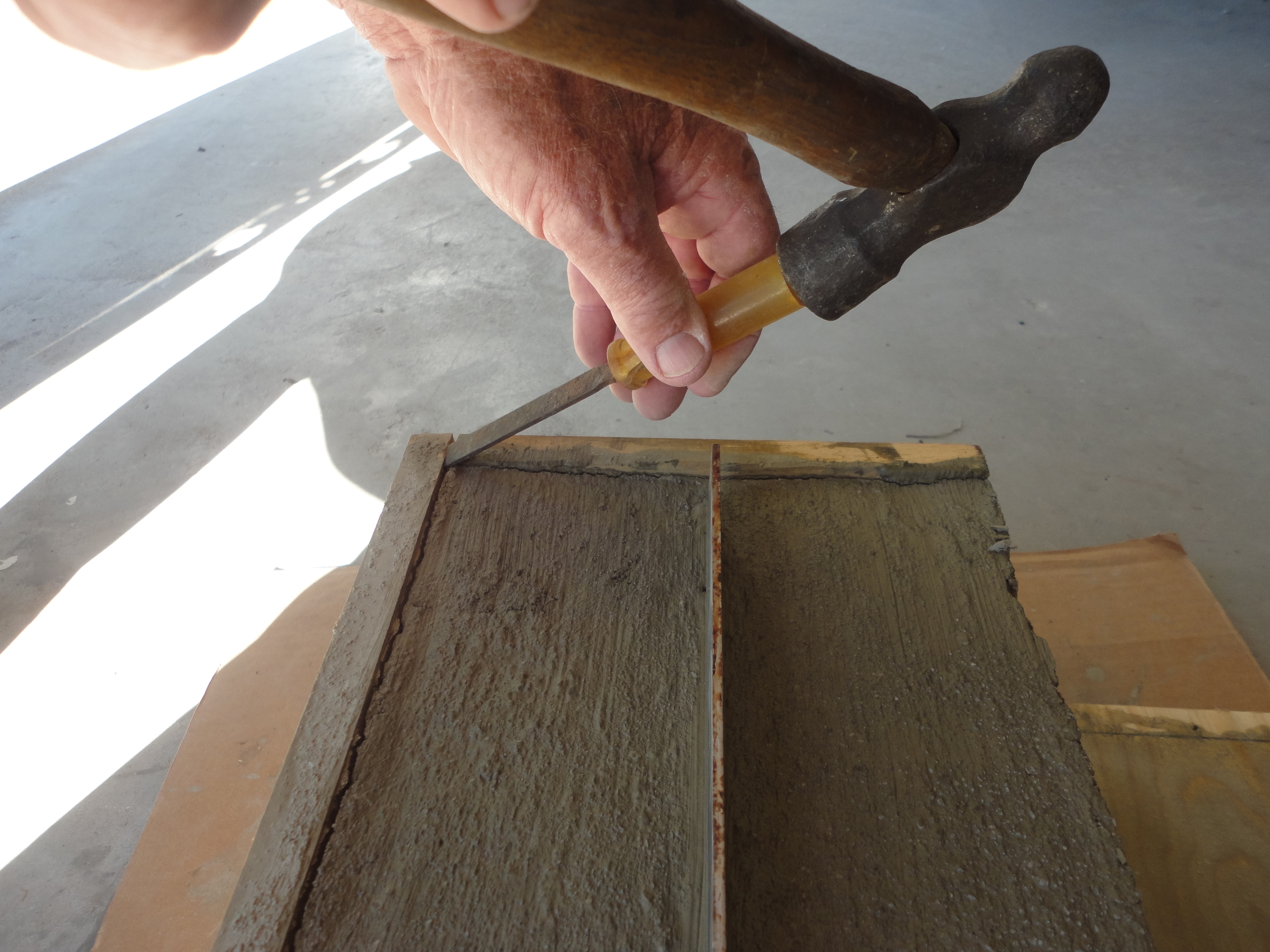
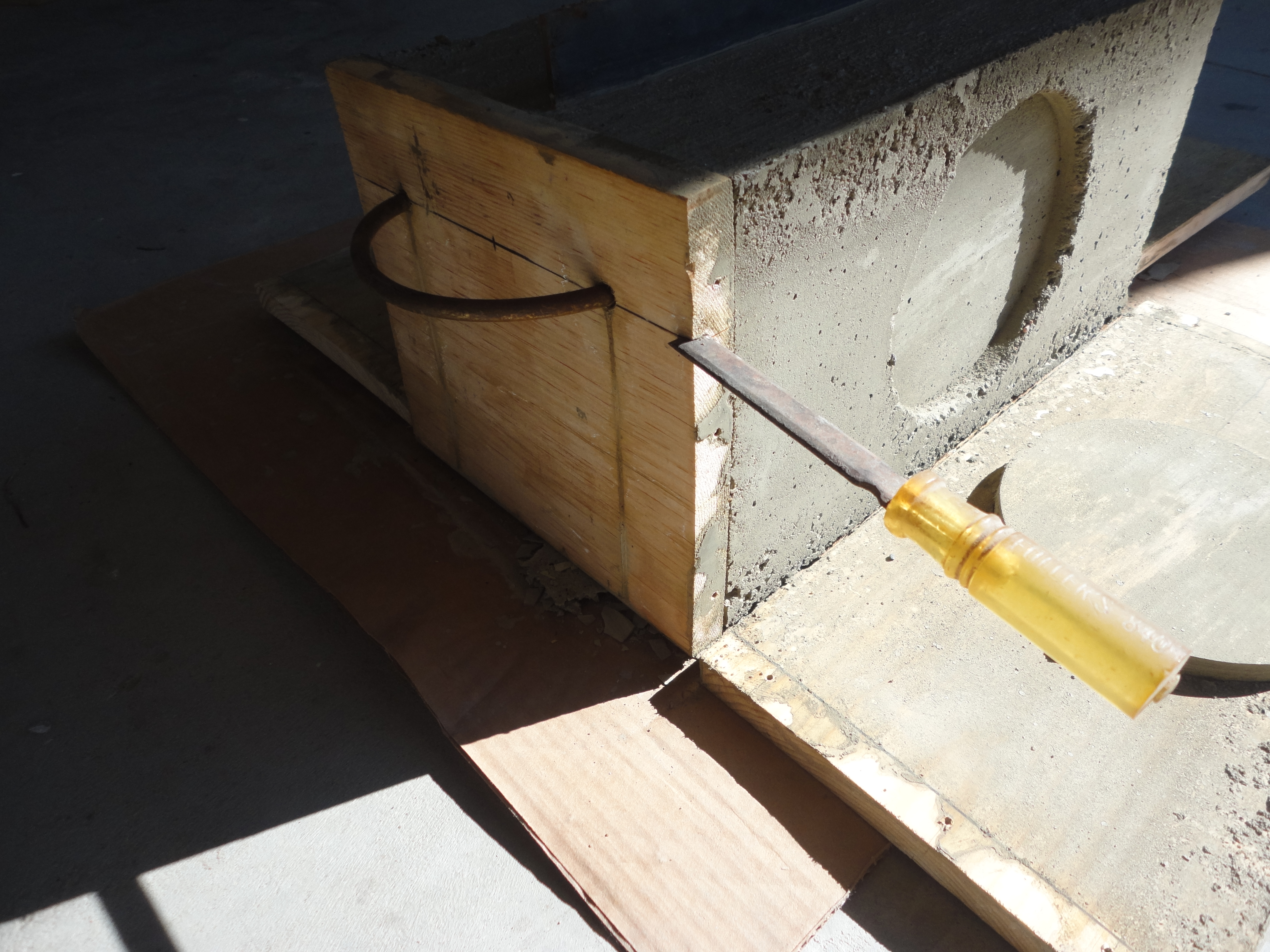
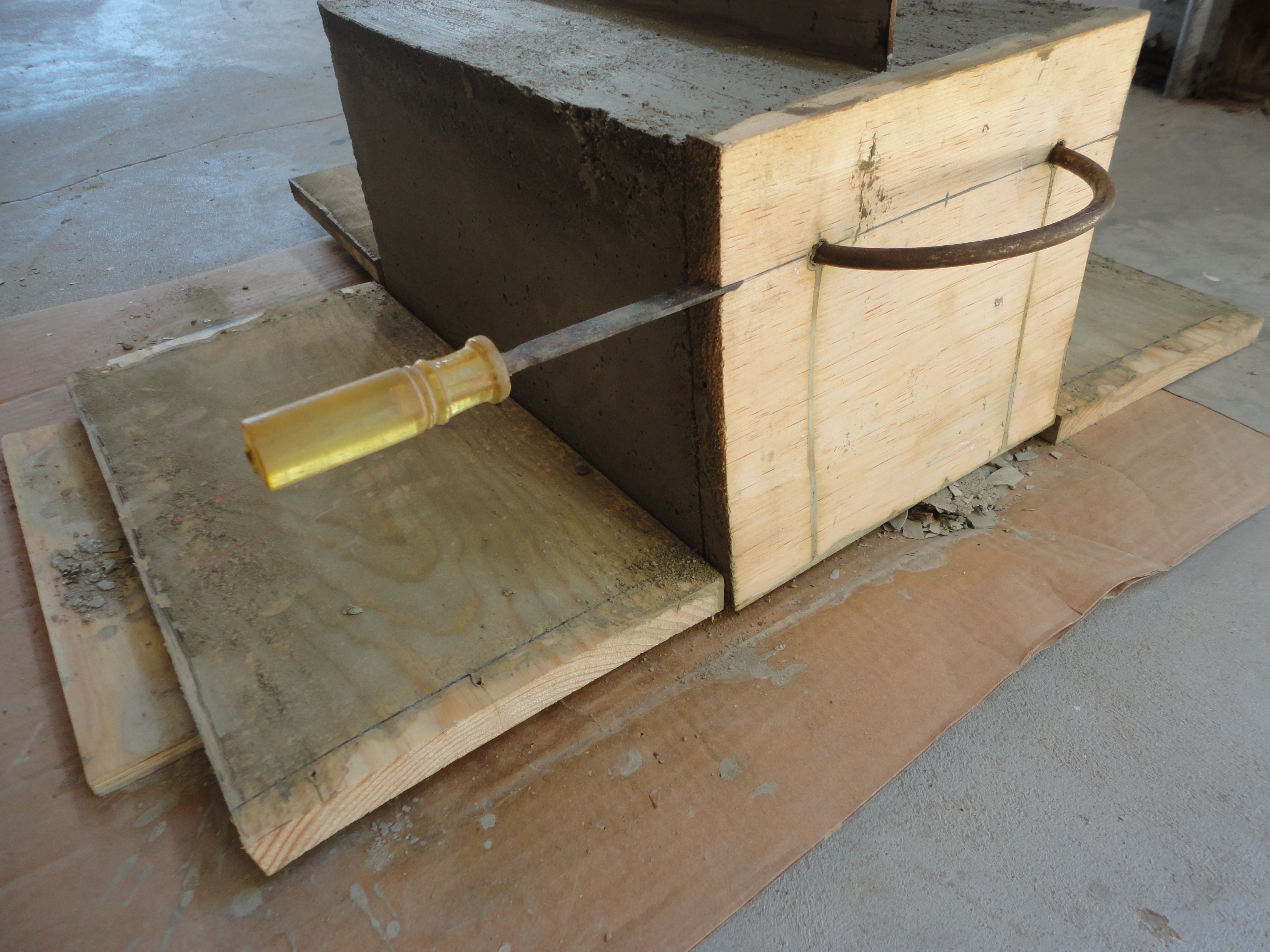
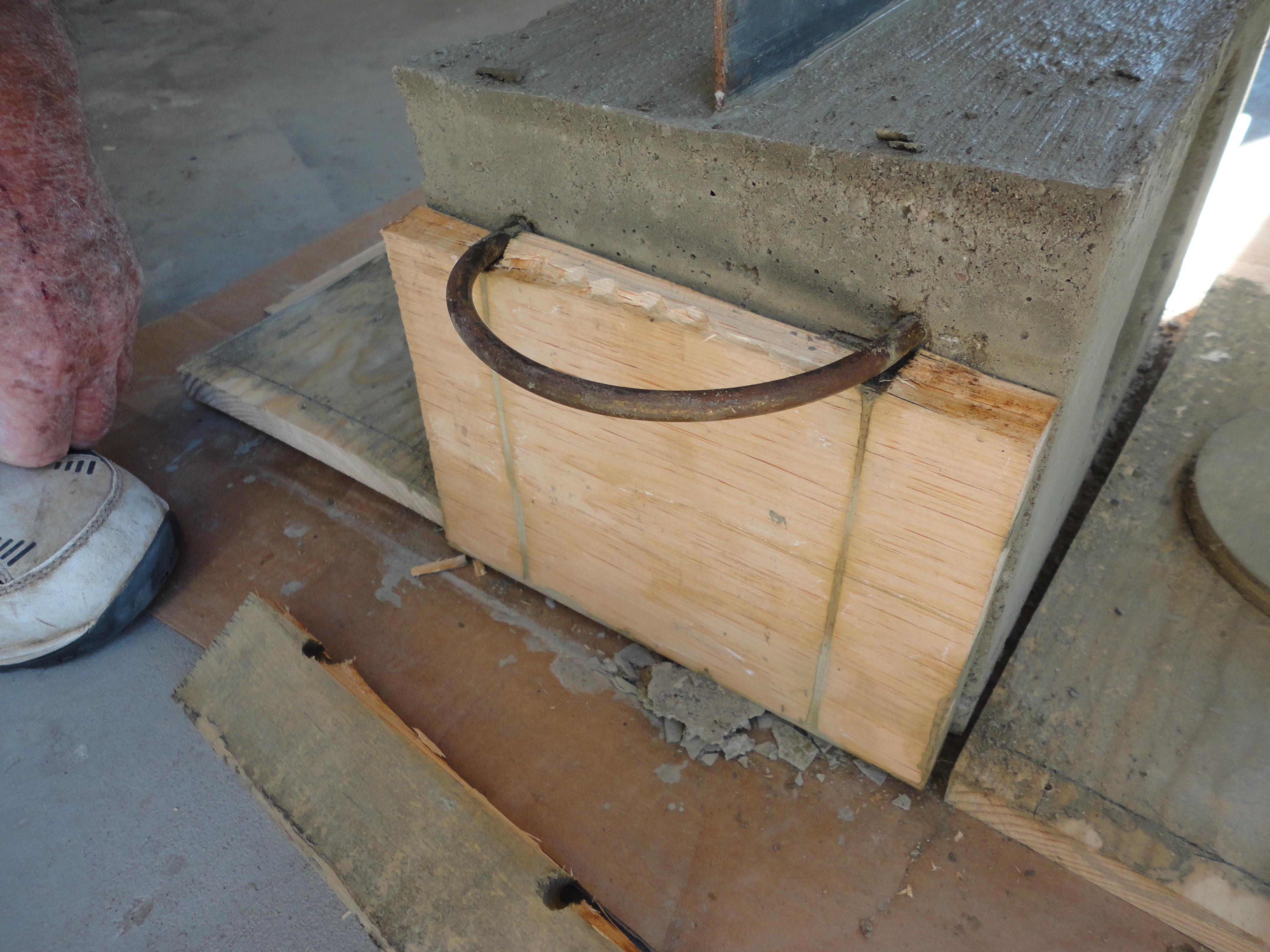
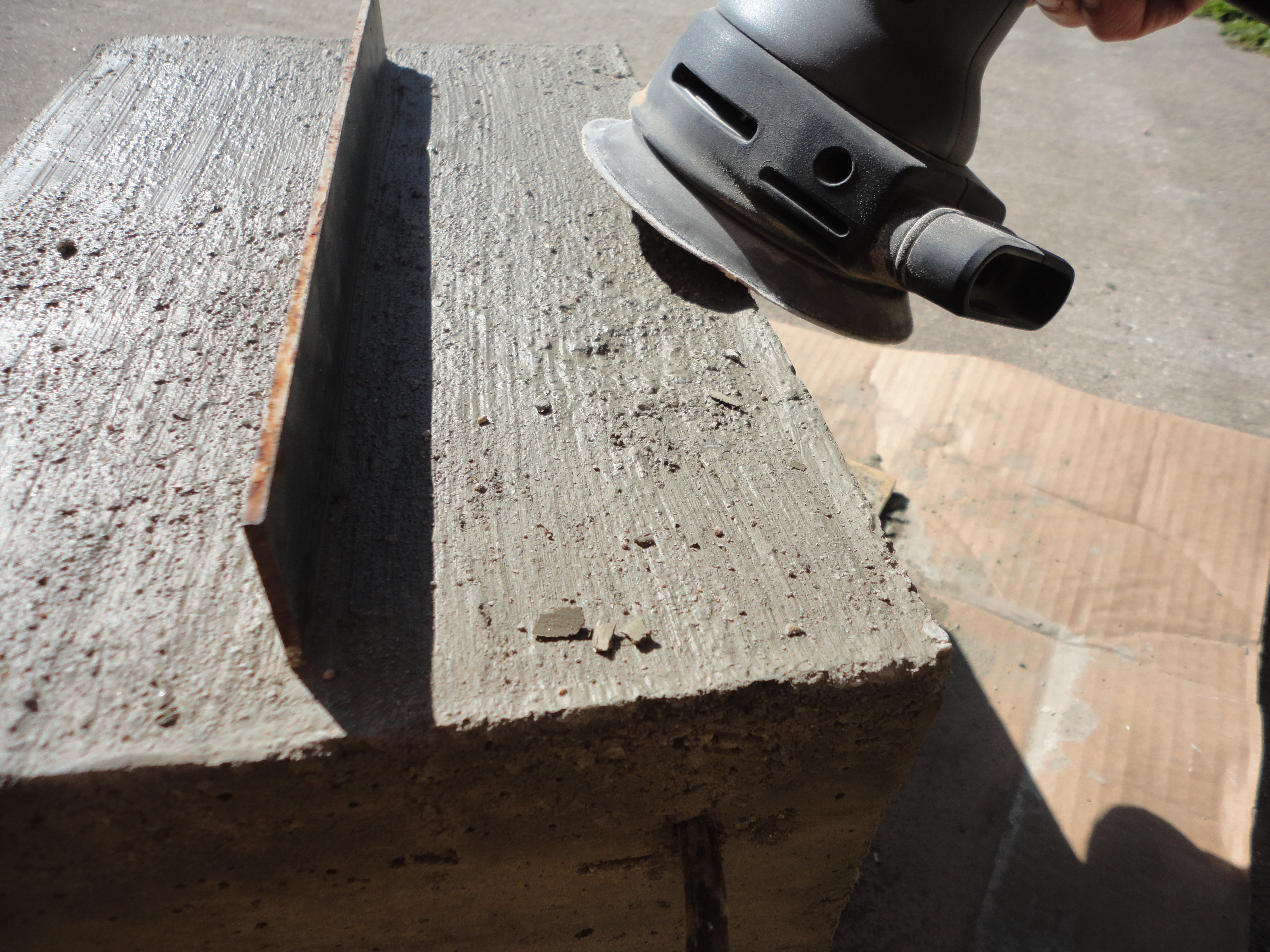
After 24 hours, tip the box and brace it while removing the bottom. Sit it back up on the plywood, sideways, to dry another 12 hours.  Remove all the screws and tap sides off gently.  On the handle end, tap a wood chisel gently into the wood, first from the sides, then across the middle. Repeat until it splits easily; remove. Lightly sand top outside edge of concrete.

DSC07626DSC07628DSC07631DSC07635DSC07640DSC07656

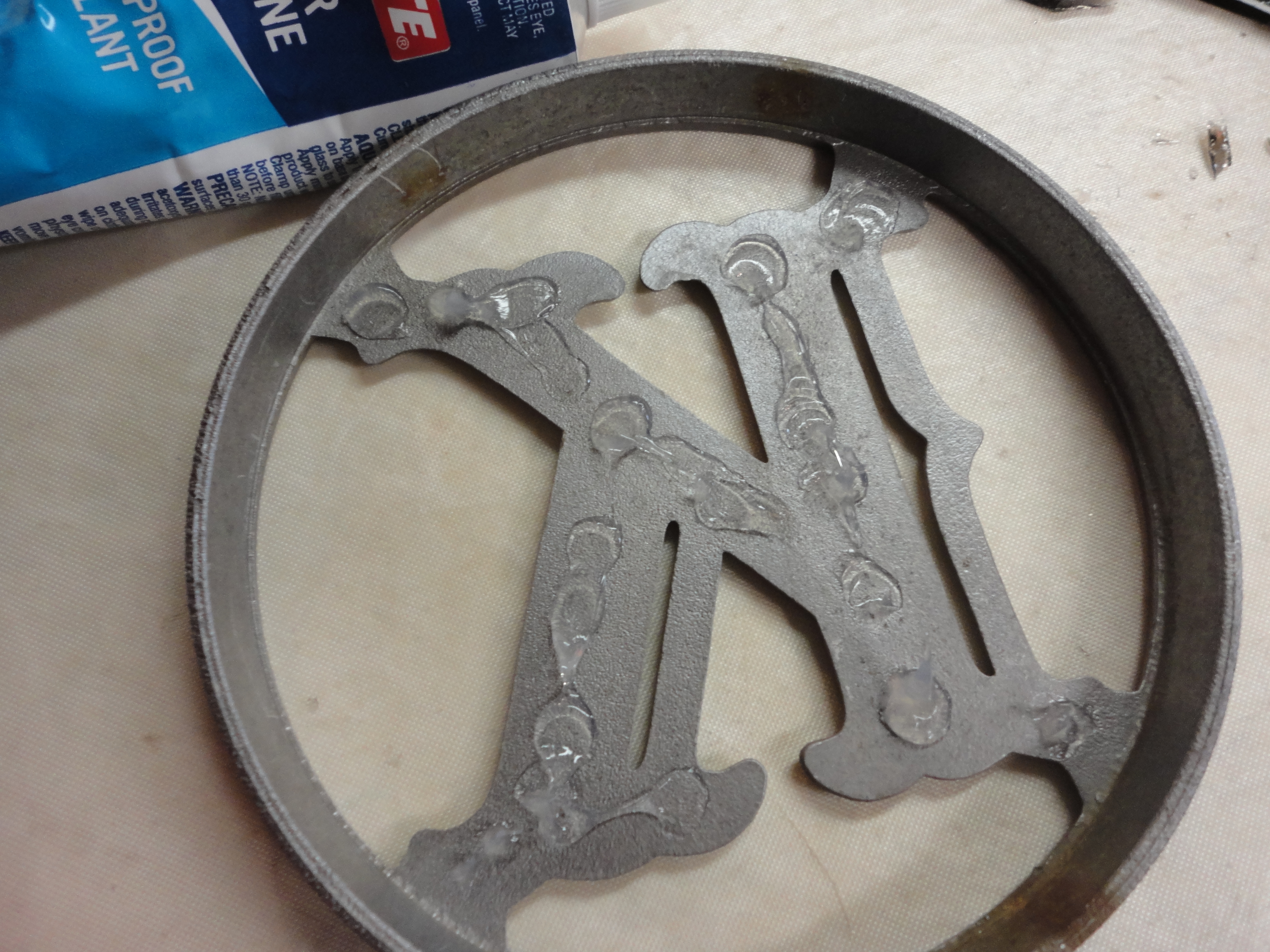
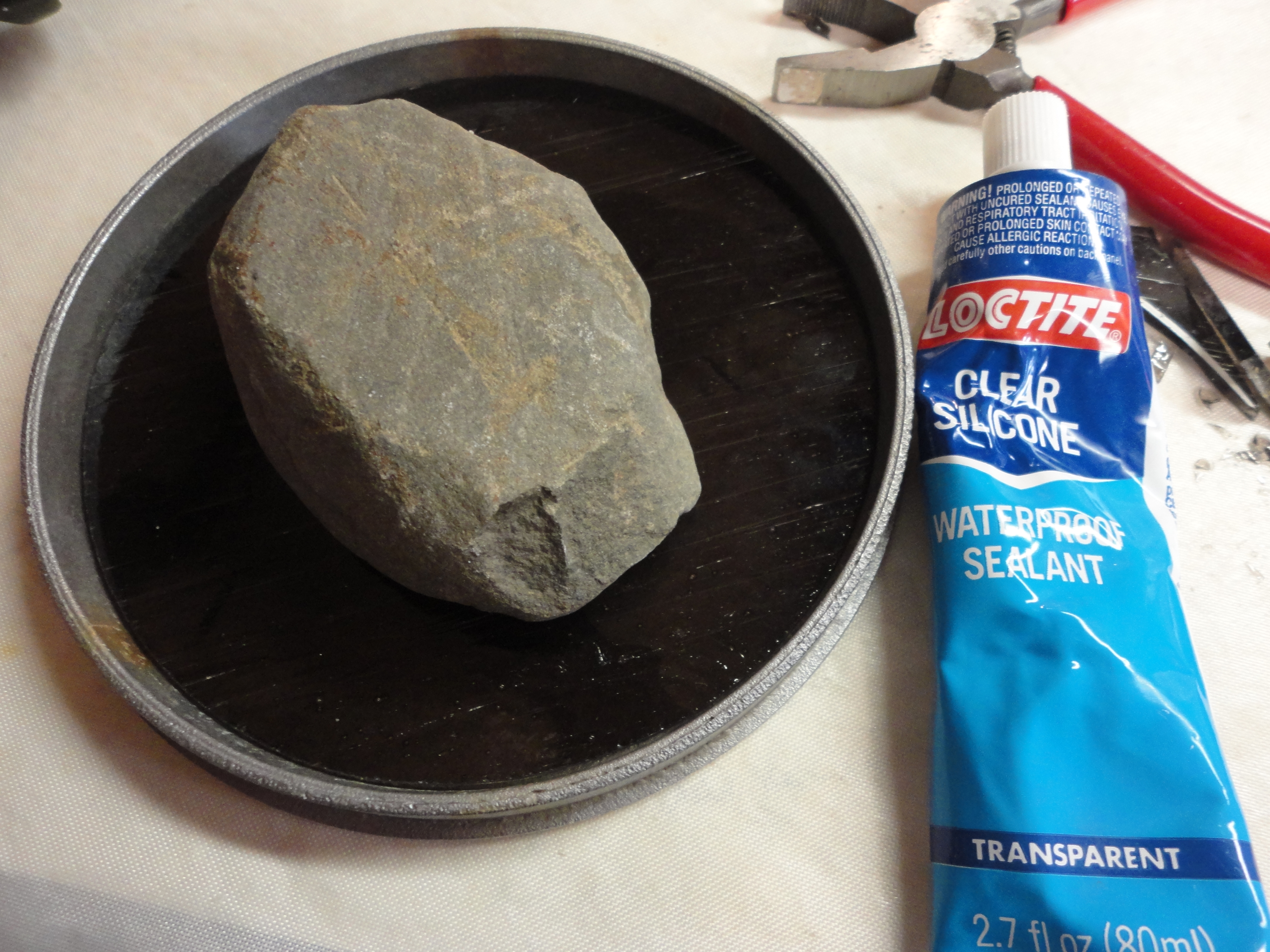
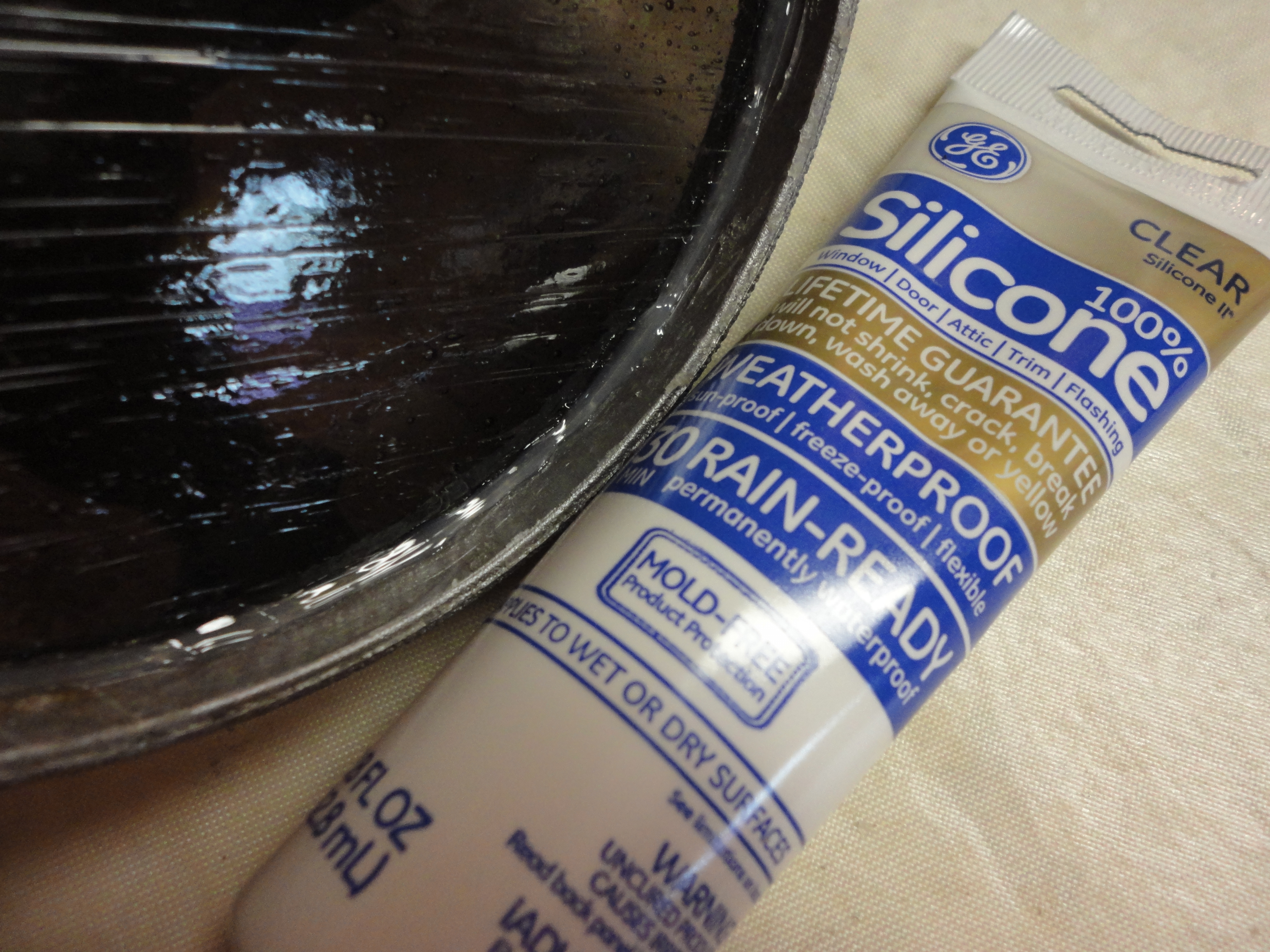
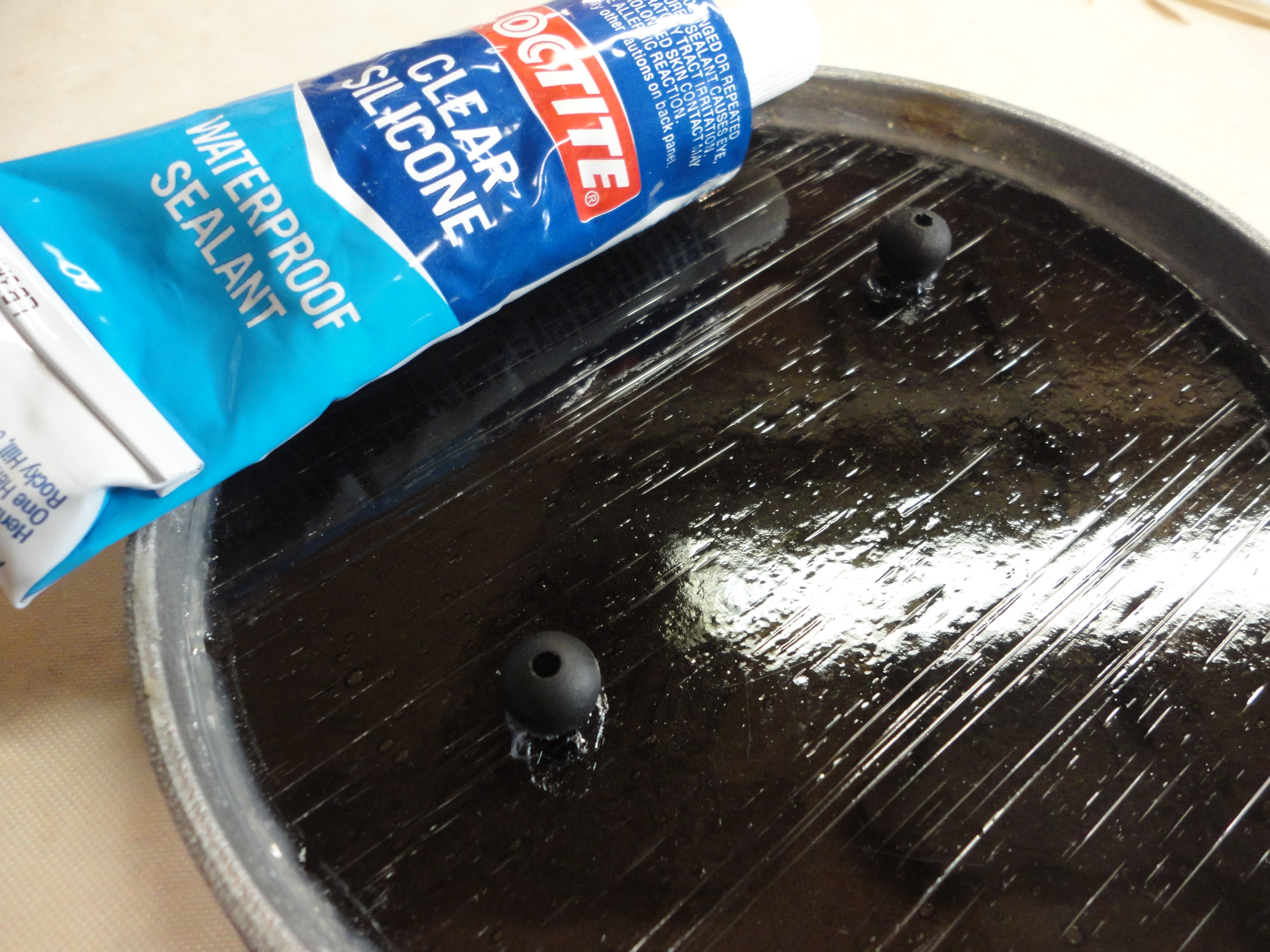
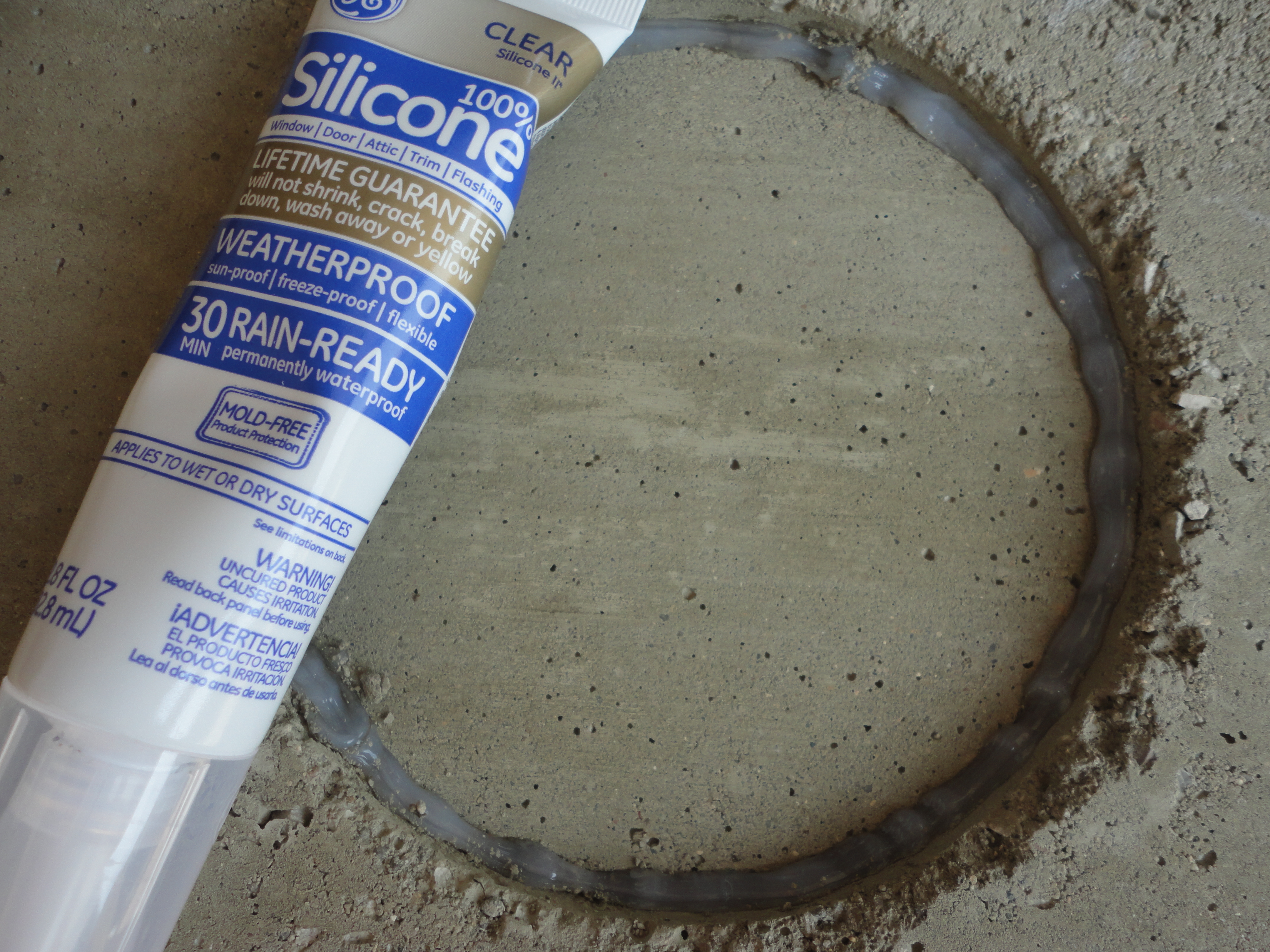
Trace your circle pattern on your choice of glass.  Cut and grind to fit inside the aluminum circle. Dab silicone glue on the backside of the “K”, insert glass, and weigh down to dry.  Run a thin bead of silicone around the backside edge of the glass. I also glued on two 3/8″ resin beads to help brace the glass against the concrete.  Let dry.DSC07664DSC07676DSC07677DSC07734DSC07740DSC07754

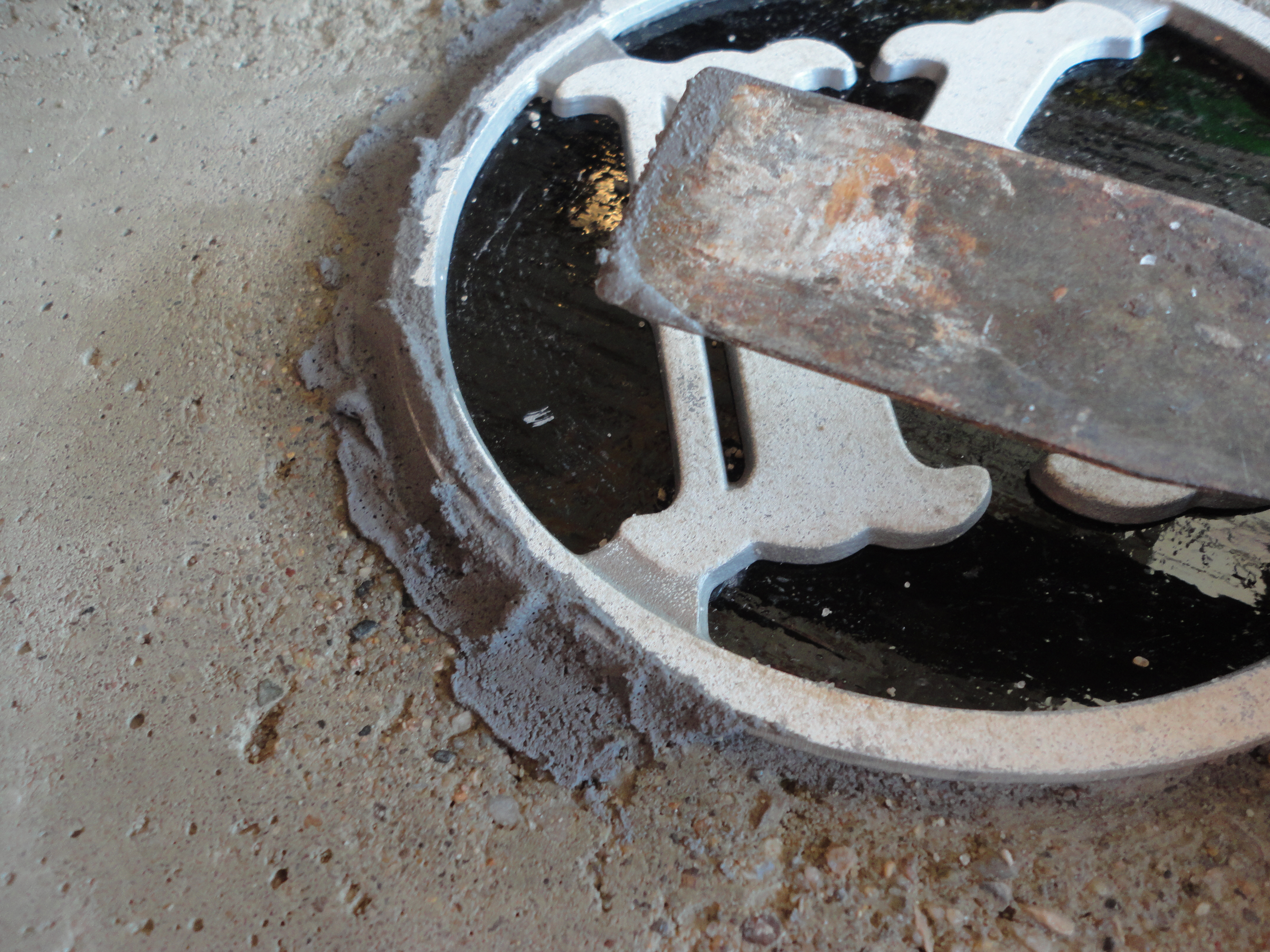
Run a thick bead of silicone around the inside circumference of the concrete circle and set the aluminum piece in place.  Dry over night.

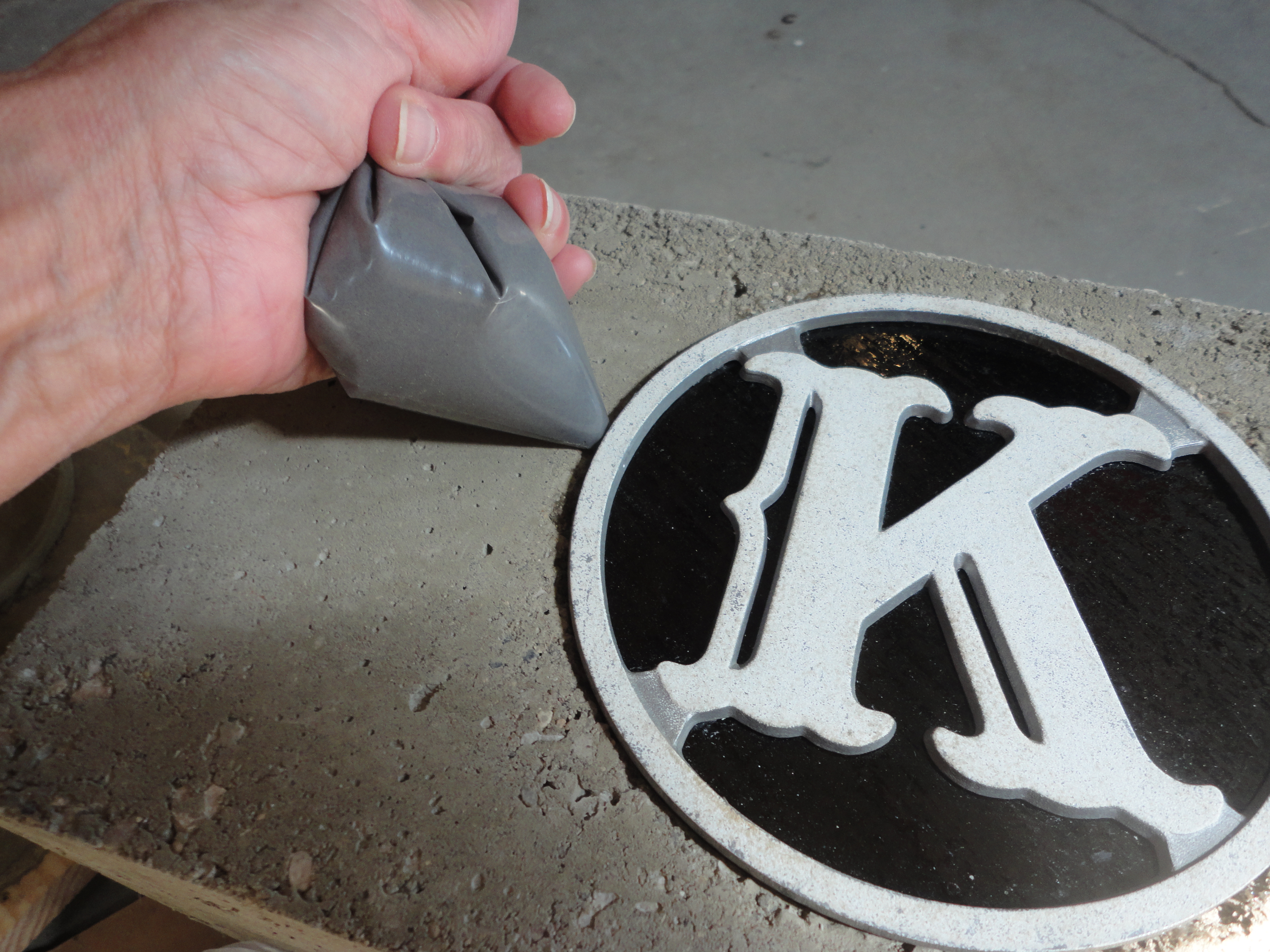
Using a baggie, pipe in an initial layer of interior/exterior sanded gray grout to fill the gap between the aluminum and concrete.  Then apply a top layer with a putty knife.  Let it dry a minute, then smooth and clean with a damp cloth. DSC07770DSC07764

Let dry 12 hours and seal with grout sealer.

DSC07830

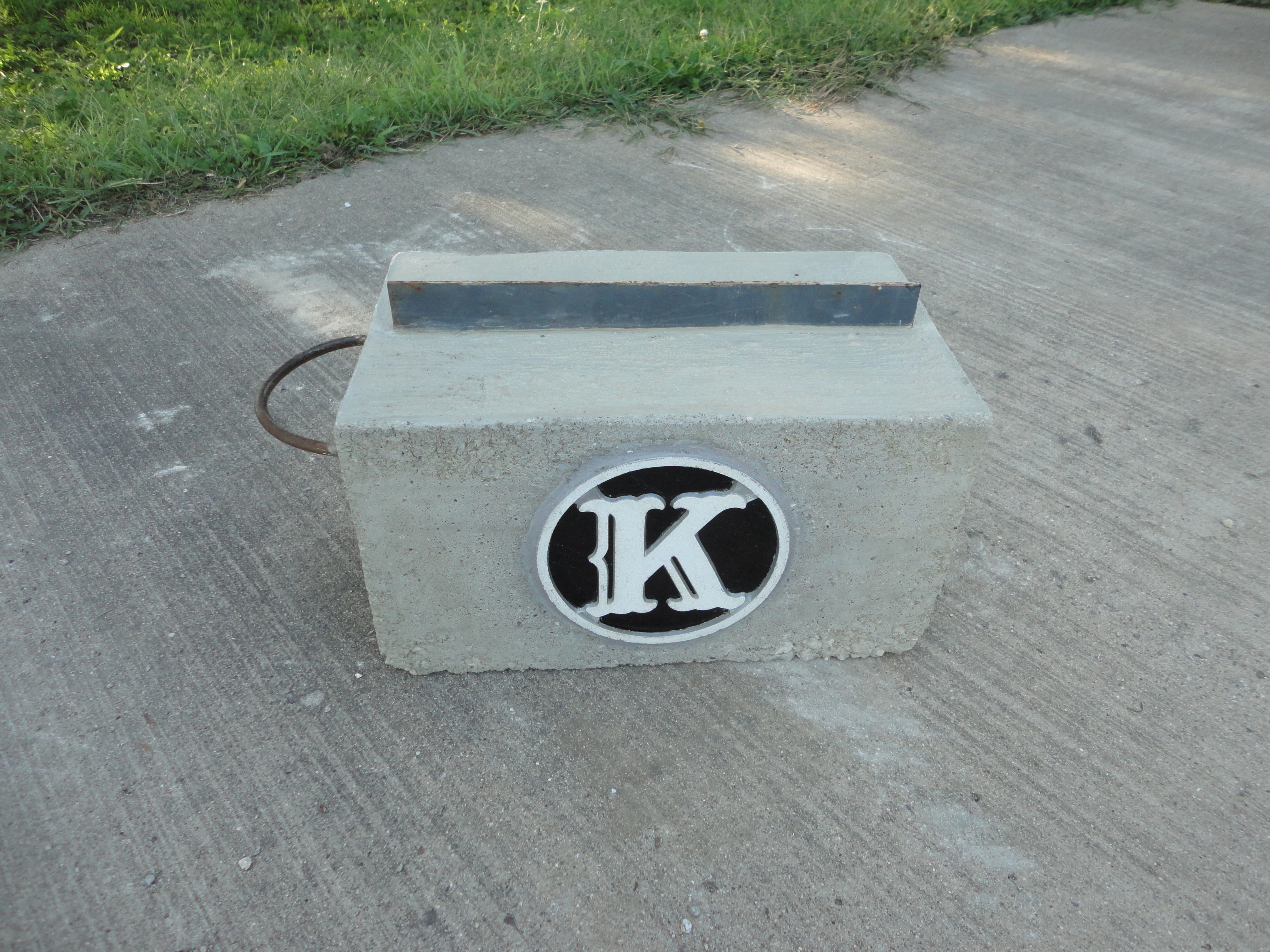
There it is.. this little “K” is once again greeting people at our door!  What do you think?
I’m thinking the time for garden projects has come to an end for the year. Its time to start thinking Fall and Christmas!

Barn Bird Feeder with Mini Barn Quilt

Welcome to glassic touch!

I’ve been eager to start my own blog for a long time, and to join the ranks of all those wonderful people who are willing to share their ideas and techniques with the world. My lack of computer savvy and a fear of not knowing what I’m doing has always held me back. Well, we can’t have anymore of that! They say “you learn by doing”, so I’m going to jump in with both feet and see how it goes!

I have a huge enthusiasm for using reclaimed items, recycled materials, glass, and wire to create unique pieces for the garden or home. For me, the most challenging and funnest step, in designing a piece, is figuring out that little touch of something special or unexpected to make it my own…. I like to call it the “glassic touch”.

We were completing a project when I decided to start my blog, and I’d like to share it with you as my first post. I hope you find it interesting and inspiring.

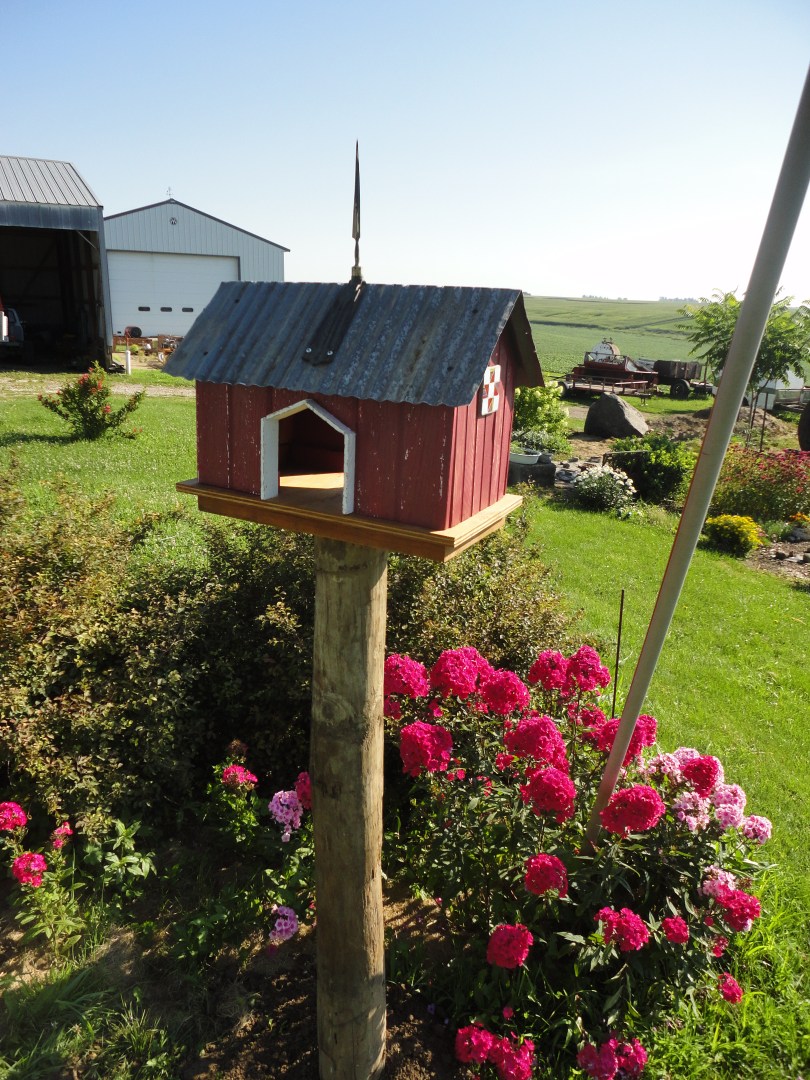
I came across a small pile of mismatched forgotten boards, while sorting through “my stuff” in the garage, and instantly recalled the image of an old rustic barn birdfeeder I had admired in a garden magazine several years ago. Although the boards were a mix of old narrow wainscoting and wide tongue and groove, it looked achieveable. After sketching out my idea and deciding the layout, my husband offered to help me build it.

DSC07238

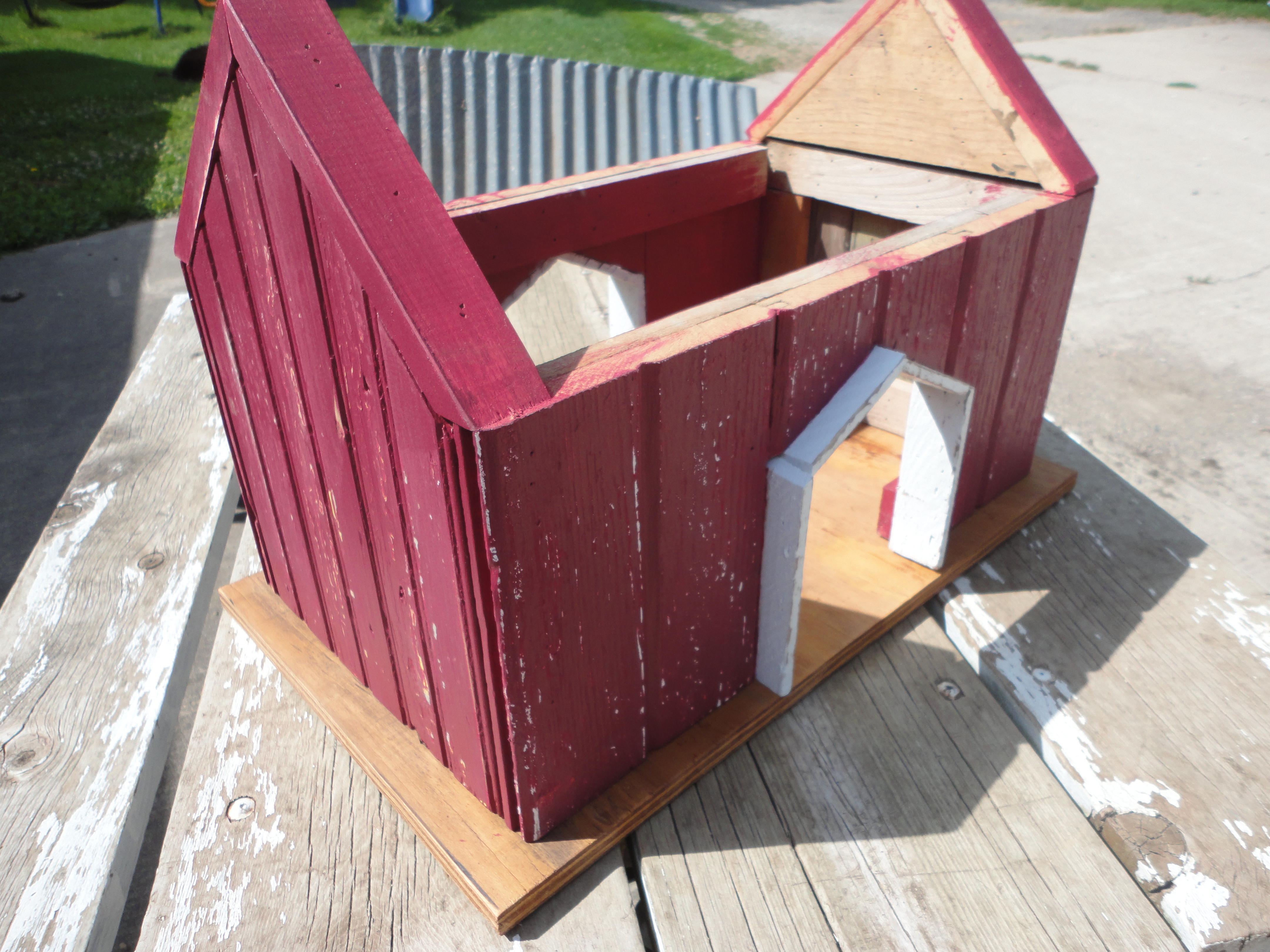
The size of our feeder was determined by the boards we had available. We used the narrow wainscoting for the sides and the wide for the front and back. A simple frame was built from scrap lumber and the boards were attached with a brad nailer, painted red, then lightly sanded. I rescued a 1 1/2″W x 1/4″ thick piece of rough shipping crate lath from the trash bin to trim out the side entries. The trim pieces were cut, attached, and painted white. My completed barn measurements, without a base, are 20 1/2″L x 11 1/2″W. The side peaks are 14 1/2″H.

For the base, we used a piece of 3/4″plywood, cut 22 1/2″L x 13″W and a 1 1/2″thick plank cut 20 1/2″L x 11″W. Both were sanded and treated with Thompson’s Water Seal.

DSC07185DSC07160

Please be careful with this next step, cut steel edges are very sharp and jagged! You may want to wear gloves. Using tin snips, cut a piece of corrugated steel, with furrows running lengthwise, 20″L x approximately 23 1/2″W. For a neater appearance, cut the steel so the sides are matching. For example, I needed the roof to be 23 1/2″W, but went a bit wider so I was at the top of a furrow on each side. I was lucky on this step and had a scrap of steel that was in very good condition on one end and I only had to make 2 cuts. Cutting up the side, along a furrow, may be difficult. We found it helpful to bend it back as we cut and take your time.

My husband clued me in on a very helpful tip for bending the steel. Once cut, lay it flat, topside down (we were working on concrete). Pencil mark in the middle where you want it to bend. Lay a steel rod on the mark and hold it down firmly.. I stood on one end while my husband held the other. Hammer on the rod to collaspe the furrows down. When done, keep the rod in place and slowly raise up one side of the steel, bending it evenly towards the rod. Easy Peasy!

DSC07153DSC07180

Disappointingly, my bird feeder sit in pieces for the last two couple of months while I debated on what I wanted to add to the top. I remembered that the one in the magazine had something protruding from the top.. a little metal weathervane, I think. Regardless, I needed something and nothing I had was really clicking. My problem was solved a few weeks ago when my sister declared she was not leaving a 75% off junk booth until she found something. After digging around a bit she popped up with a mini lightning rod on an upside down v-shaped brass holder. TA-DAA! Six Dollars!!  It was perfect!  I’m so glad she didn’t want it, that could have been a problem.

So, finally, we were ready to set my feeder in place. We enjoy bird watching, so it was positioned close to the house, amid a patch of red garden phlox, and turned at an angle so there was a view through the sides.

Coming up from the bottom, so screws wouldn’t show, the feeder was attached to the plywood. Screw on roof and lightning rod. Set your post. Attach the plank to the wooden post with lag screws. Sit barn with plywood on the plank, and attach with long screws through the bottom of the plank, again so screws are hidden. Note – Screw tips may protrude through the plywood so place screws towards the side ends of the feeder so you maintain a clean view through the side entries.

And for “the glassic touch“?  What’s a barn without a barn quilt?!

DSC07206DSC07282

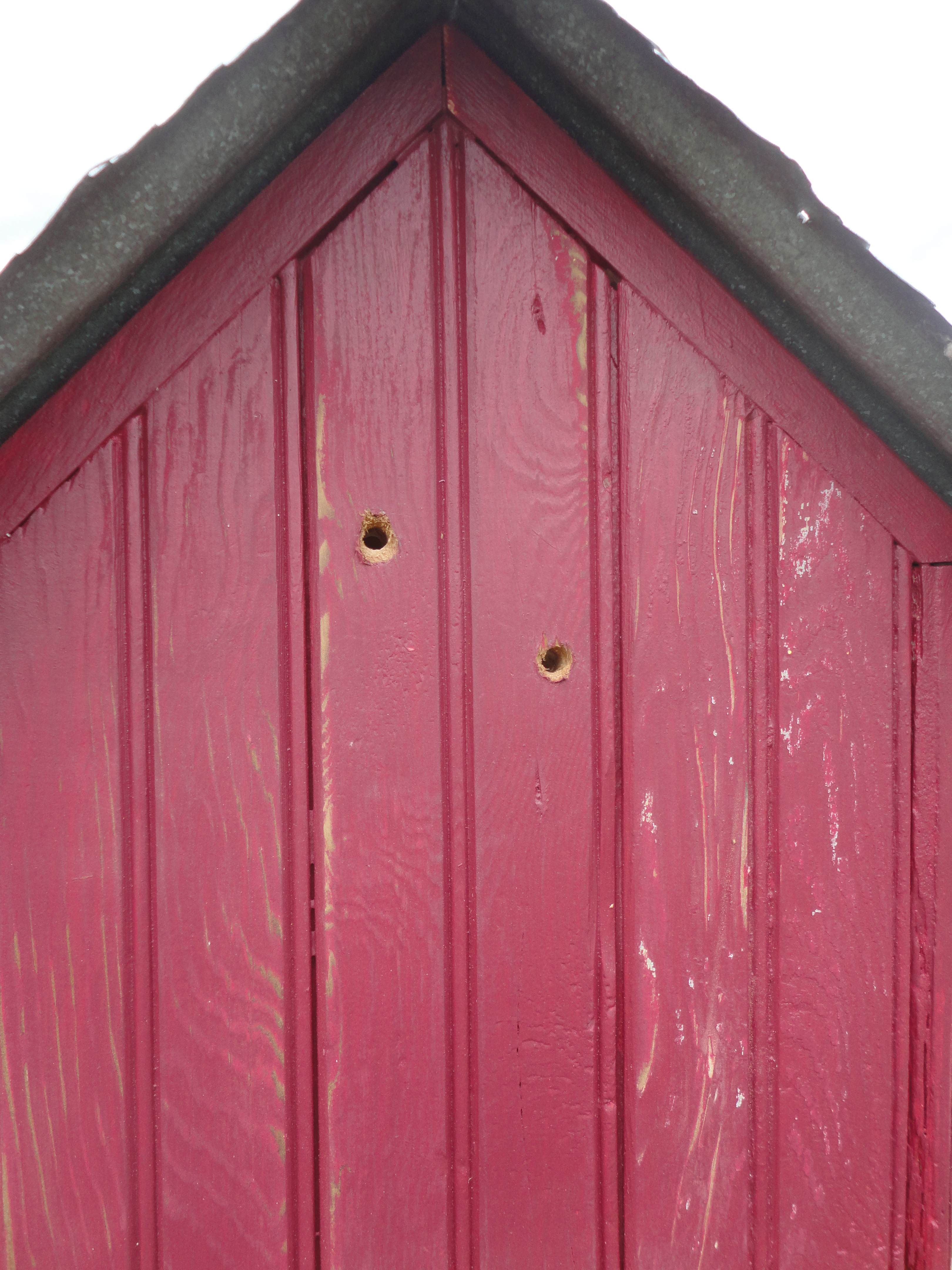
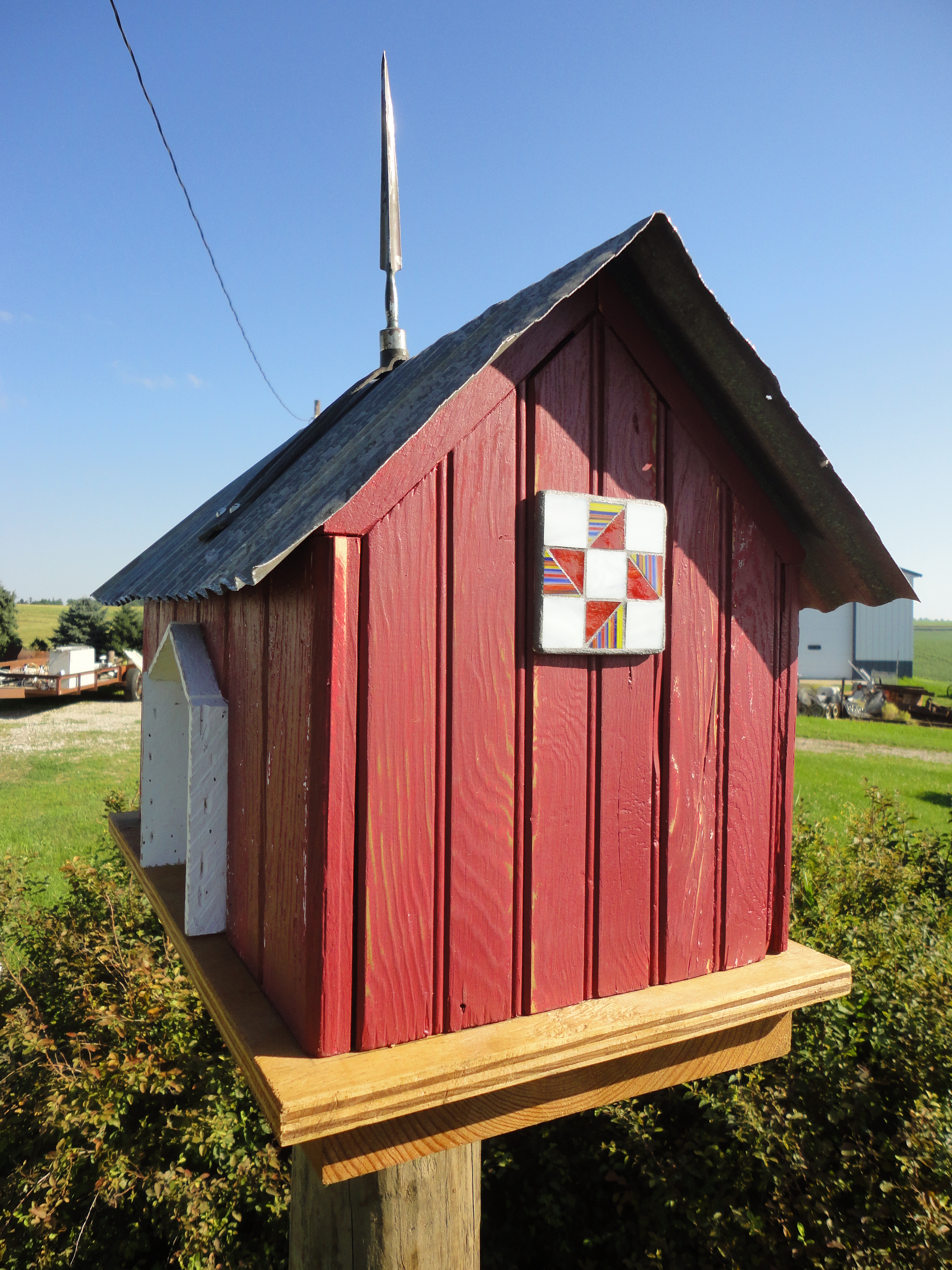
Before adding the roof, I drilled two holes, in one side, in preparation to hang a miniature mosaic glass barn quilt. The wooden frame was thick so reaming out the holes on the inside was necessary to accommodate the screws and nuts being used.

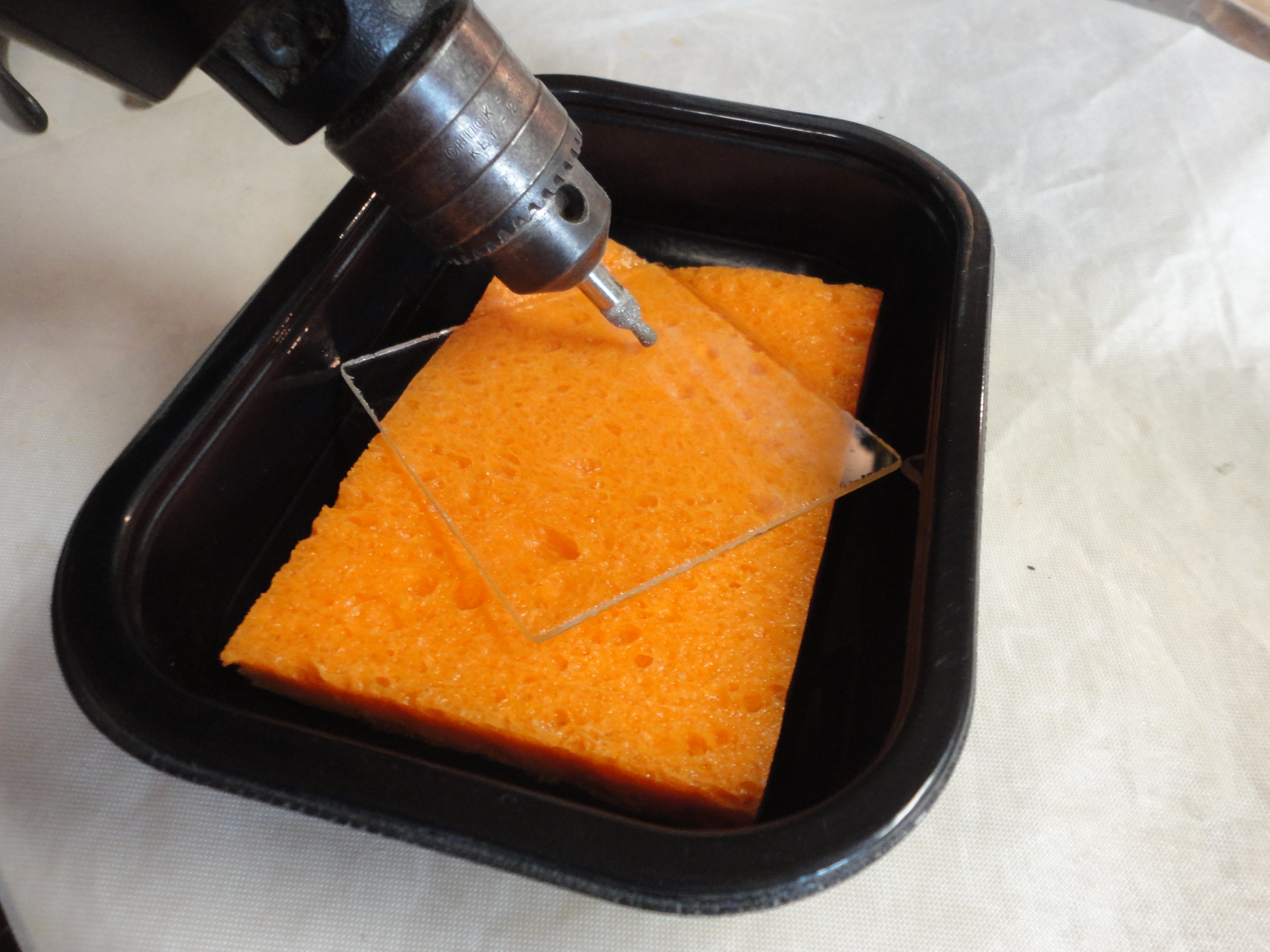
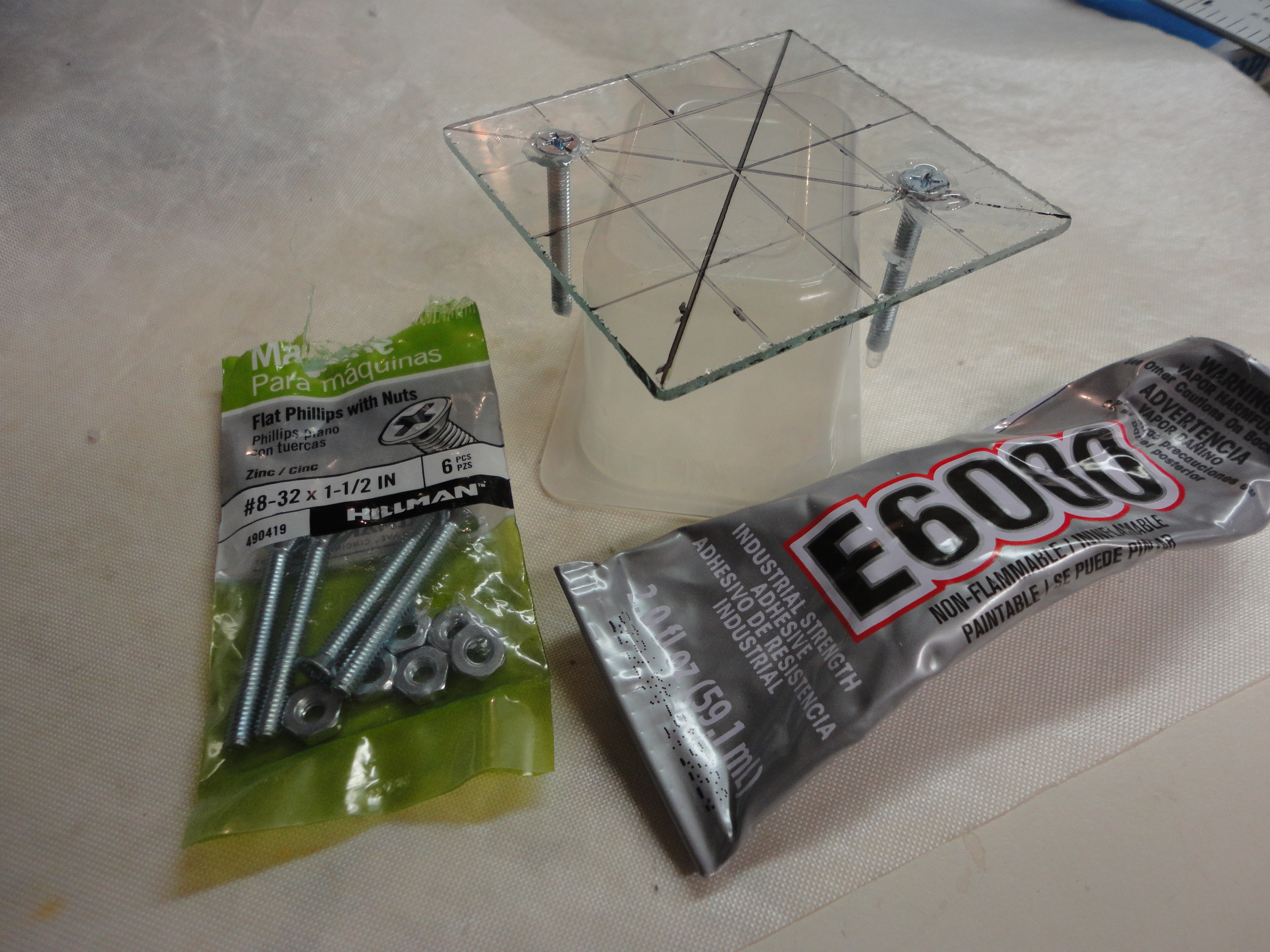
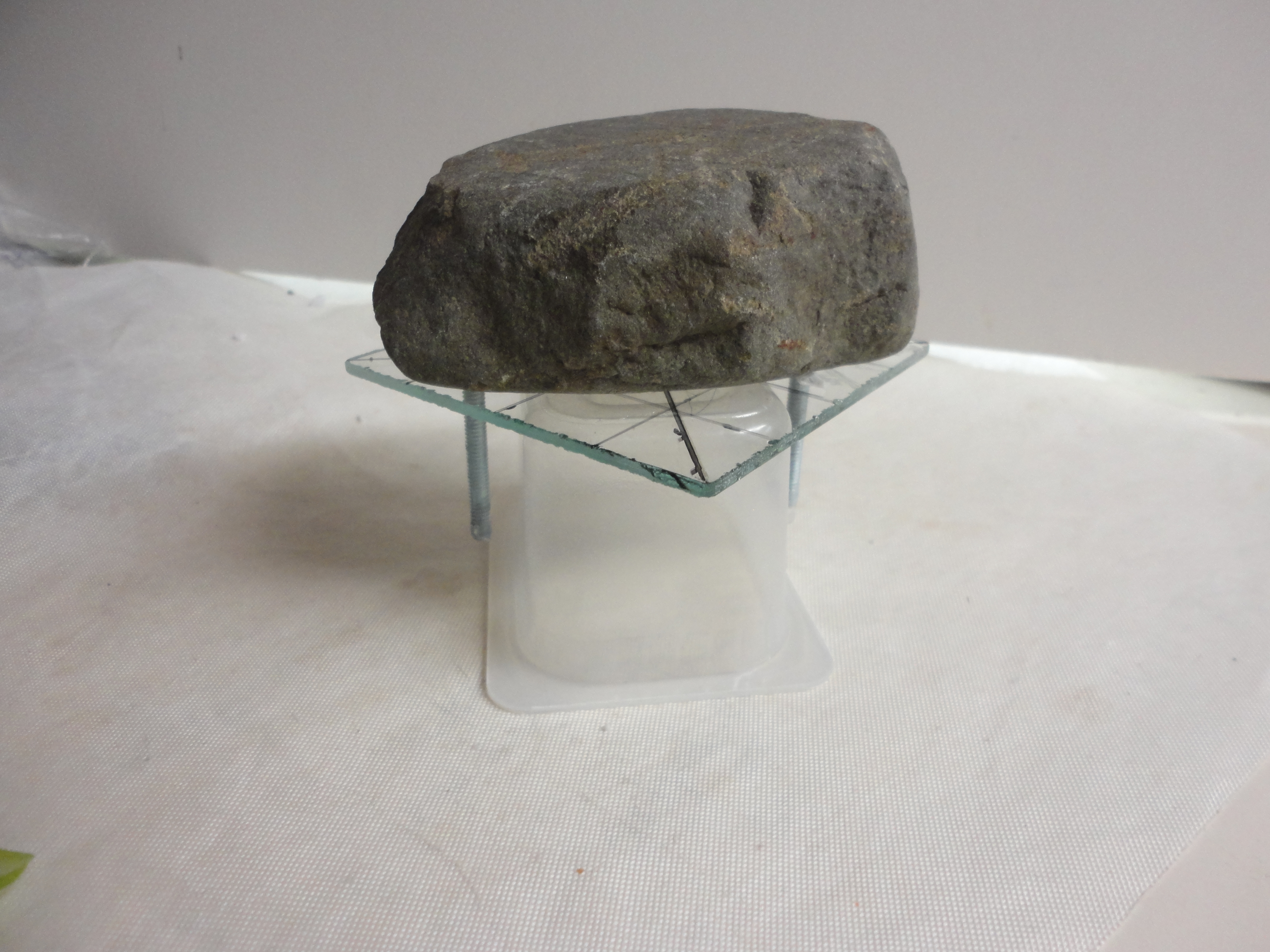
With bitter cold, icy Iowa winters, I make a habit of bringing my mosaics, glass chunks, and stepping stones inside for the winter. For this reason, I wanted my quilt removable. With a diamond head bit, I drilled 2 holes in a 3″ x 3″ square piece of glass. Then I used a coned shaped bit so the head of my screw would be inset. Always use water to cool the glass while drilling or it will break. I balanced my glass on an upturned plastic baby food container, that fit between the holes, and glued my screws in place with E6000, weighed them down with a rock, and let dry for 24 hours. With a glass marker, I drew lines from corner to corner and such so I would be able to center any design. Or, you can draw an actual design if you have one chosen.

DSC07015DSC07030

DSC07088DSC07103

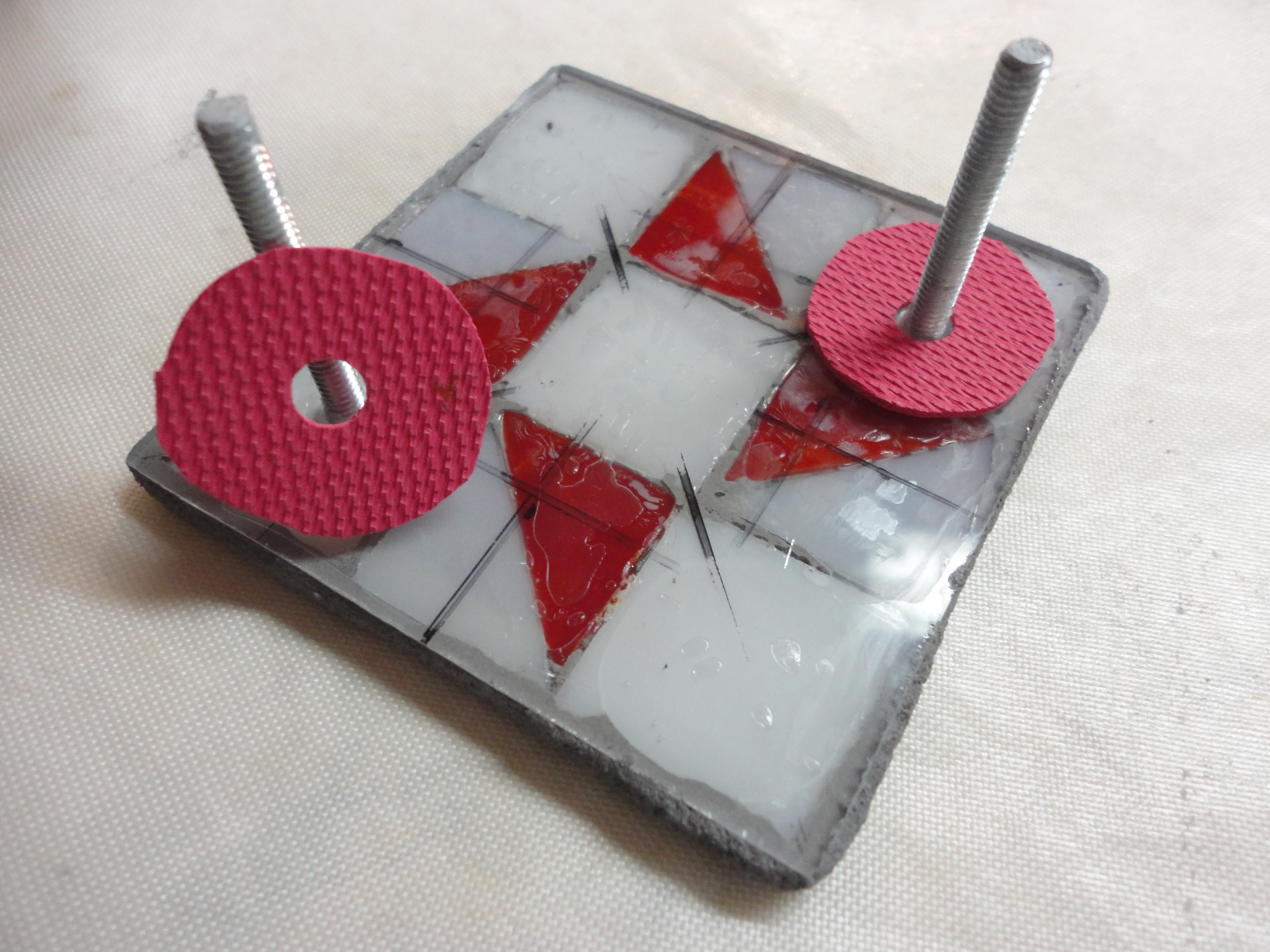
After deciding on a simple Pinwheel pattern, I cut some scrap glass and glued it on, again with E6000, and let dry 24 hours. I grouted with Interior/Exterior Sanded Gray Grout. Wanting a darker gray grout line I added a few drops of Exterior Black Primer to my water before mixing. I’ve never added paint before, so it will be a good test I guess. Let the grout dry 24 hours then seal. Follow the directions on your sealer for drying time before subjecting it to wet weather. With no light source from behind, I recommend using opalescent glass for this project to make it highly noticeable. If you do choose to use transparent glass, remember to remove any pattern lines that may show through the glass.

DSC07142DSC07199

When hanging the quilt, I added two thin rubber washers, cut from an old jar gripper, to prevent movement and add cushioning between the glass and wood. And – DONE! It’s time to toss in some bread crumbs and watch the birds while I ponder what my next project will be……

DSC07285

I hope you enjoyed my post and were able to pick up a few helpful tips while visiting here. I welcome and look forward to your thoughts, questions, or suggestions. Thanks for stopping by!